Global Markets Start the Week Higher
Global markets moved higher Monday as investors responded to improving sentiment around U.S.-China discussions, falling oil prices and continued strength in technology stocks. Asian shares advanced while U.S. stock futures also pointed higher ahead of an expected meeting between U.S. President Donald Trump and Chinese President Xi Jinping later this week.
The market moves came after U.S. Treasury Secretary Scott Bessent described weekend discussions with Chinese Vice Premier He Lifeng in New York as a successful engagement. The talks covered trade and artificial intelligence, adding to expectations that the upcoming Trump-Xi meeting could address several major economic and technology issues.
At the same time, oil prices declined by more than 2% early Monday. The drop offered some relief to investors who have been watching energy markets closely because of supply disruptions and geopolitical tensions in the Middle East.
The combination of lower oil prices and improved U.S.-China sentiment helped create a more positive start to the trading week.
Asian Stocks Advance as Investors Watch China Talks
Several major Asian markets posted gains Monday.
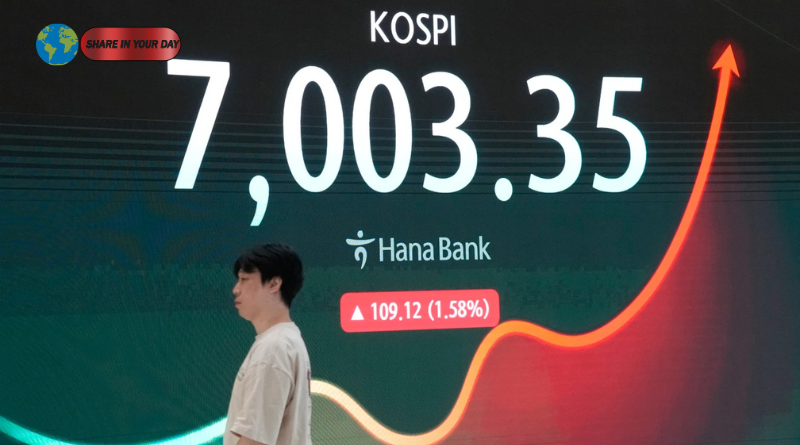
South Korea’s Kospi rose 1.7% to 7,007.72. Samsung Electronics gained 5%, while SK Hynix advanced 0.6%. Taiwan’s Taiex increased 1.1%, with Taiwan Semiconductor Manufacturing Co., one of the world’s leading semiconductor manufacturers, rising 0.8%.
Hong Kong’s Hang Seng Index climbed 0.9% to 24,975.58. The Shanghai Composite rose 1% to 3,949.91, while India’s Sensex gained 0.7%.
Japanese markets were closed Monday and are scheduled to remain closed through Wednesday because of holidays. Australia’s S&P/ASX 200 was little changed at 8,731.90.
The gains in technology shares continued to reflect strong investor interest in artificial intelligence. Semiconductor companies have been among the major beneficiaries of expectations for continued spending on AI infrastructure, computing power and advanced chips.
However, concerns about AI safety remain part of the broader technology debate. AP reported that some American technology leaders have called for a slower approach to AI development because of safety concerns.
Global Markets React to Trump-Xi Meeting Expectations
One of the most closely watched developments for global markets this week is the expected meeting between Trump and Xi in Washington.
China’s Foreign Ministry confirmed Monday that Xi is scheduled to make a state visit to the United States from Sept. 23 to Sept. 25. Trade, tariffs and artificial intelligence are expected to be among the subjects discussed, while geopolitical issues could also feature in the talks.
The meeting comes after renewed discussions between U.S. and Chinese officials in New York.
According to AP, the two countries have been discussing reciprocal tariff reductions covering $30 billion worth of goods from each side. Bessent said the latest discussions included trade and AI.
For investors, the significance of the talks extends beyond the immediate movement of stock prices. U.S.-China trade policy can affect manufacturers, technology companies, semiconductor supply chains and businesses that depend on international commerce.
Markets can also react quickly to changes in expectations. A more constructive tone between Washington and Beijing may reduce some concerns surrounding tariffs and trade restrictions, while renewed disagreements could create fresh uncertainty.
For now, investors are watching the statements and developments surrounding the meeting rather than assuming a specific outcome.
Oil Prices Drop More Than 2%
Oil prices provided another major market signal Monday.
Brent crude, the international benchmark, fell 2.1% to $101.65 per barrel. U.S. benchmark crude declined 2.3% to $93.86 per barrel.
The decline came as vessel traffic and energy flows through the Strait of Hormuz increased. However, the waterway remained largely closed, meaning significant uncertainty continued to surround the movement of oil and other energy products.
Oil prices have risen sharply in recent months because of conflict and supply concerns. AP reported that Brent crude was around $72 per barrel in late February, before the beginning of the war in Iran.
The latest decline therefore represents a notable retreat from recent highs, although crude remains well above its earlier levels.
Reuters also reported that Brent crude had moved down from levels above $109 per barrel as markets responded to signs of increased oil flows and efforts to restore pipeline operations.
Lower oil prices can have broad consequences for financial markets.
Energy companies may see changes in revenue expectations when crude prices fall. Meanwhile, consumers and businesses can benefit from lower fuel costs if the decline persists and eventually feeds through to gasoline, diesel, transportation and other energy-related expenses.
For central banks, the direction of energy prices is also important because oil can have a significant effect on inflation.
Middle East Risks Continue to Influence Energy Markets
Despite Monday’s decline, investors have not stopped watching the Middle East.
AP reported that tensions involving Saudi Arabia, Iran-backed Houthis and the closure of a key Saudi oil pipeline continued to place pressure on global energy supplies. The situation around the Strait of Hormuz also remained uncertain.
That means the recent decline in crude prices does not necessarily eliminate supply concerns.
ING commodities strategists Ewa Manthey and Warren Patterson said oil supply concerns remained elevated. They also pointed to profit-taking following the recent surge in crude prices and hopes for constructive discussions at the United Nations General Assembly and the Trump-Xi meeting as factors supporting improved market sentiment.
Reuters similarly reported that oil markets were responding to conflicting information about supply flows from the Middle East.
The result is a market where prices can move rapidly in response to new information about shipping, pipelines, production and geopolitical developments.
U.S. Stocks Ended Last Week Mixed
Wall Street also entered the new week following a mixed session Friday.
The S&P 500 gained 0.2%, while the Dow Jones Industrial Average slipped 0.2%. The technology-heavy Nasdaq Composite rose 0.4%.
Technology stocks have remained a major focus for investors because of the continuing AI investment cycle.
The strong performance of Asian semiconductor companies Monday reinforced that theme. Samsung and TSMC both moved higher, while South Korea’s broader market posted a significant gain.
Still, investors are balancing enthusiasm around AI with broader economic risks, including inflation, interest rates and elevated bond yields.
That combination could continue to produce sharp differences between individual sectors and companies.
Treasury Yields Remain a Major Concern
Another important factor for global markets is the bond market.
The yield on the U.S. 10-year Treasury briefly reached 5% before sitting around 4.97% early Monday, according to AP.
Higher Treasury yields can affect financial markets because government bonds compete with stocks and other investments for capital. Higher borrowing costs can also affect businesses, consumers and governments.
The rise in yields has been linked partly to concerns about inflation caused by the energy shock and questions surrounding U.S. government debt.
Investors are therefore monitoring both oil prices and Treasury yields closely. A sustained decline in energy prices could ease some inflation concerns, while persistent energy disruptions could have the opposite effect.
The Federal Reserve’s recent decision to raise interest rates for the first time in three years has added another layer of uncertainty to the economic outlook. AP also reported that the Bank of Japan recently raised rates to a 31-year high.
Currency Markets Also Move
Currency markets showed relatively modest movements Monday.
The U.S. dollar rose to 157.25 Japanese yen from 156.81 yen. The euro traded at about $1.1473, compared with $1.1483 previously.
The yen remains an important currency for global investors because of Japan’s monetary policy and the country’s role in international trade and finance.
The Bank of Japan’s recent rate increase has attracted attention as investors assess how Japanese interest rates may influence global capital flows.
Currency movements can also affect multinational companies. A stronger dollar can influence the overseas revenue of U.S. companies, while exchange-rate changes can alter the cost of imported goods and commodities.
What Investors Are Watching This Week
Several events could influence global markets over the coming days.
The Trump-Xi meeting is expected to be one of the most important. Investors will be watching for information about tariffs, trade and AI cooperation.
Oil markets will also remain critical. Any changes in shipping through the Strait of Hormuz, Saudi oil exports, pipeline operations or Middle East tensions could quickly affect crude prices.
Bond yields will be another key indicator. With the U.S. 10-year Treasury yield near 5%, investors are closely monitoring inflation expectations and central-bank policy.
AI and semiconductor stocks will also remain under scrutiny after another strong session for Asian technology shares.
Together, these developments create a complicated market environment. Investors are weighing optimism surrounding technology and international talks against continued concerns about energy supplies, inflation and interest rates.
Global Markets Face a Critical Week
The start of the week offered a relatively positive signal for global markets, but several major risks remain.
Asian shares advanced, U.S. futures moved higher and oil prices fell as investors responded to improving sentiment around U.S.-China discussions and signs of increased energy flows.
Yet the market remains sensitive to geopolitical developments.
The upcoming Trump-Xi meeting could provide important information about the future direction of U.S.-China economic relations. At the same time, the Middle East continues to influence oil prices, inflation expectations and government bond yields.
For investors, the key issue may be how these forces interact.
Lower oil prices could reduce some inflation pressure. Strong technology demand could continue supporting semiconductor shares. Meanwhile, higher interest rates and bond yields could keep pressure on borrowing costs and asset valuations.
As the week progresses, financial markets are likely to react to fresh information from Washington, Beijing, the Middle East and central banks.
For now, Monday’s trading showed that investors were willing to respond positively to signs of improving diplomatic engagement and easing oil prices. But the broader economic and geopolitical picture remains fluid, leaving global markets highly sensitive to the next major development.