China AI Startups Surge as Young Workers Pivot
China’s young workforce is increasingly turning toward China AI startups as unemployment, corporate burnout and a difficult graduate job market push some people to create businesses of their own. Artificial intelligence is making that transition easier by allowing individuals with limited technical backgrounds to build products, handle marketing and automate tasks that once required larger teams.
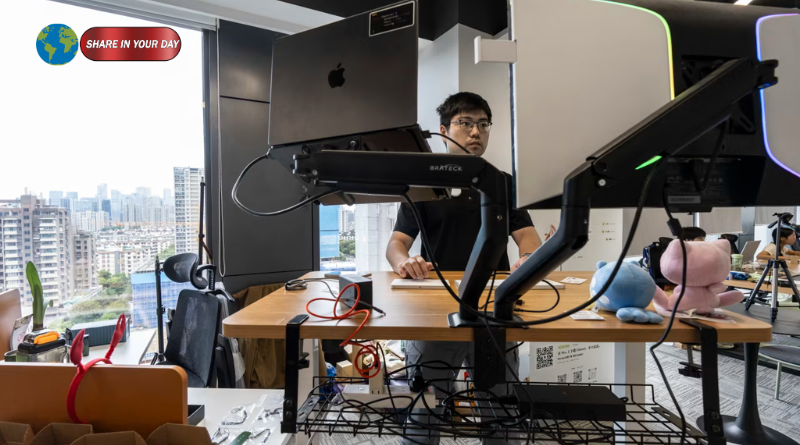
The shift comes as China’s technology industry continues to expand its use of artificial intelligence while young workers face a more uncertain employment environment. According to recent reporting by The Wall Street Journal, more than seven million one-person businesses were launched in China in 2025, a 42% increase from the previous year.
For some young entrepreneurs, starting a company is less about becoming the next technology giant and more about finding a way to work independently.
China AI Startups Offer an Alternative to Traditional Jobs
China’s employment market has become an important part of the story behind the rise of small AI businesses.
Recent reporting by The New York Times found that China’s urban unemployment rate for people ages 16 to 24 was 17.9% in July 2026. The newspaper also reported that 12.7 million young people were entering the job market, while artificial intelligence was simultaneously changing the types of entry-level work available to graduates.
That creates an unusual situation.
Young people are entering the workforce at a time when companies are increasingly demanding AI-related skills, while some traditional positions are becoming less attractive or less plentiful.
For workers who cannot find suitable employment, entrepreneurship can become an alternative.
AI lowers the cost of experimenting with that option.
A founder can use AI coding assistants to create software, generative AI to develop marketing material, automated tools to communicate with customers and increasingly sophisticated models to perform administrative work.
In the past, building even a small technology company could require programmers, designers, marketers and customer-support staff.
Today, one person can potentially coordinate many of those functions with software.
That does not mean every solo business will succeed. But it changes the initial economics of starting one.
Young Entrepreneurs Are Building With Fewer People
One of the most important characteristics of the emerging trend is its emphasis on extremely small companies.
According to the Wall Street Journal, many of the young Chinese entrepreneurs entering the AI sector are operating as one-person businesses. Rather than raising large amounts of venture capital and immediately hiring employees, founders are attempting to build products themselves and reach customers directly.
The distinction matters.
Traditional startup culture often emphasizes rapid growth, investment rounds and large teams. The new generation of AI-enabled businesses can begin with a very different objective: generating enough income for the founder to remain independent.
For some entrepreneurs, self-sufficiency is a more realistic target than creating a billion-dollar company.
That approach also reflects the changing capabilities of AI.
The Wall Street Journal reported that roughly three-quarters of solo entrepreneurs lack technical backgrounds. AI tools therefore become more than productivity software; they can serve as a bridge between an idea and a functioning product.
A founder who previously would have needed a software developer may now be able to use AI-assisted development tools to produce an early version of a service.
The result is a lower barrier to entry.
AI Is Becoming a Business Partner
For China’s emerging solo entrepreneurs, AI can effectively function as a collection of virtual employees.
A founder may use one system for writing and research, another for programming assistance, another for image generation and another for customer communication.
These tools do not eliminate the need for human judgment. Instead, they allow one person to perform more tasks.
That distinction is particularly important for entrepreneurs who have limited capital.
A conventional startup may need money to pay employees before it has revenue. A one-person AI business can potentially postpone many of those expenses.
The founder still has to find customers, understand the market and deliver something people are willing to pay for.
But the cost of reaching the first customer can be dramatically lower.
This model is appearing beyond China as well. However, China’s combination of a large technology ecosystem, intense competition, a huge young workforce and strong government emphasis on AI gives the trend particular significance.
China Is Encouraging Small Technology Businesses
The growth of China AI startups is also taking place alongside government efforts to support smaller technology companies.
In September, Reuters reported that China unveiled a five-year plan designed to support small and medium-sized enterprises, particularly companies working in emerging industries. The plan includes measures intended to improve financing, innovation and employment, with artificial intelligence and embodied AI among the targeted strategic areas.
That policy environment could provide additional support for entrepreneurs.
Local governments and startup incubators are already experimenting with programs that offer young founders access to workspace, funding, technology resources and business networks.
The goal is not simply to create more technology companies.
Small businesses are also viewed as a potential source of employment and innovation.
For a young person struggling to enter a traditional corporate career, an incubator can provide resources that would otherwise be difficult to access.
The One-Person Company Model Is Expanding
The broader rise of one-person businesses may be one of the most significant developments behind the current AI startup movement.
China registered more than seven million new single-person businesses during 2025, according to figures cited by the Wall Street Journal. That represented a 42% increase from 2024.
AI is particularly well suited to this business structure because it can reduce the amount of routine work required from the founder.
Consider a small online business.
Previously, the owner might have needed to write product descriptions, answer common customer questions, create advertising materials, analyze data and maintain a website manually.
AI can assist with many of those functions.
The owner therefore has more time to concentrate on the decisions that cannot easily be automated: what product to sell, who to target and how to differentiate the business.
This does not guarantee higher profits.
Instead, it gives individuals an opportunity to test business ideas at a lower initial cost.
Competition Could Become a Major Problem
The same technology that allows one person to create a business also allows thousands of other people to do the same thing.
That creates a major challenge.
If AI makes software development, content production and marketing easier, the number of competitors can rise quickly.
A product that once required months of development may now be replicated by another entrepreneur much faster.
This means that technical ability alone may not be enough.
Customer acquisition could become one of the biggest challenges facing China’s new generation of AI entrepreneurs.
The Wall Street Journal reported that many of these businesses struggle with generating revenue and building sustainable operations.
The ability to launch a company cheaply does not necessarily mean there is a large market for the company’s product.
That difference could determine which businesses survive.
China AI Startups Face a Brutal Technology Market
China’s AI industry is already highly competitive.
Reuters recently described the country’s AI market as operating under severe economic pressure, with companies competing on model efficiency, pricing and cost control. Chinese AI developers have increasingly focused on delivering capable systems at lower costs while dealing with constraints on investment and access to advanced technology.
That environment creates both an opportunity and a challenge for small founders.
On one hand, inexpensive AI models and increasingly accessible tools make experimentation easier.
On the other hand, competing against established companies can be extremely difficult.
Large technology companies have access to enormous datasets, engineering teams, cloud infrastructure and established customer bases.
A one-person company cannot easily compete with those resources.
As a result, many successful small AI businesses may need to focus on narrow markets rather than trying to challenge major technology companies directly.
A specialized tool for a particular profession or industry could be more practical than another general-purpose AI assistant.
AI May Change What Entrepreneurship Means
The most interesting part of the trend may not be the number of startups being created.
It may be the changing definition of a startup itself.
For decades, technology entrepreneurship was associated with teams of engineers working in offices, seeking venture capital and attempting to grow rapidly.
AI makes another model possible.
A single founder can identify a problem, develop a prototype, test it with customers and modify it without immediately building a large organization.
This could make entrepreneurship more accessible to people who would previously never have considered starting a technology company.
It also creates a different relationship between workers and employers.
Instead of competing solely for jobs, some workers can attempt to create their own sources of income.
That is particularly significant in an environment where young people face pressure from both traditional employment challenges and technological disruption.
But AI Entrepreneurship Is Not a Guaranteed Escape
The rise of China AI startups should not be interpreted as proof that unemployment has been solved.
Starting a company is inherently risky.
A founder may be able to create a website or AI-powered product in days, but building a sustainable business can take much longer.
Revenue remains the central test.
A startup must attract customers who are willing to pay. It must maintain its product, manage costs, comply with regulations and respond to competitors.
AI can reduce certain costs, but it cannot eliminate those fundamental business problems.
There is also the possibility of an overcrowded market.
If thousands of entrepreneurs launch similar AI applications, customers may struggle to distinguish between them.
That could push prices down and make it difficult for small companies to generate enough revenue.
From Job Seekers to AI Founders
For China’s young workforce, however, the appeal is understandable.
The traditional promise of a stable career is becoming harder to achieve for some young people. At the same time, artificial intelligence is becoming more accessible.
Those two developments are colliding.
Instead of waiting indefinitely for an ideal corporate position, some young workers are using AI to attempt something different.
They are becoming developers, marketers, product managers and business owners at the same time.
The model is still relatively small compared with China’s overall economy. The Wall Street Journal reported that these micro-enterprises are not yet a major economic force.
But the experiment is significant.
If AI continues to improve, the number of tasks that can be handled by a single entrepreneur could increase.
That could reshape how small businesses are created and operated.
A New Chapter for China’s AI Economy
China’s AI ambitions extend far beyond individual entrepreneurs.
The country is investing heavily in artificial intelligence, robotics and other advanced technologies, while policymakers are simultaneously trying to support employment and smaller companies.
Recent reporting shows how closely those trends are becoming connected.
Reuters reported that China is supporting emerging small and medium-sized companies as part of a broader strategy involving innovation and employment. Meanwhile, reporting on China’s young workforce shows that AI is simultaneously creating new opportunities and increasing uncertainty around traditional entry-level careers.
The rise of China AI startups therefore represents more than another technology trend.
It is also an experiment in how workers respond when economic pressure meets rapidly advancing technology.
For some founders, AI offers a chance to build a business without a large team or substantial investment.
For others, it may simply provide a temporary alternative to unemployment.
The long-term outcome will depend on whether these one-person businesses can move beyond experimentation and generate sustainable revenue.
For now, a growing group of young Chinese entrepreneurs is betting that the tools changing the job market can also help them create a place within it.