Doomsday Glacier Warning: Seawater Seeping Beneath Antarctic Ice Could Double Sea-Level Rise Projections
Scientists are raising new concerns about Antarctica’s vulnerable Thwaites Glacier after a new study found that seawater penetrating beneath the ice could significantly accelerate its retreat and increase its contribution to global sea-level rise.
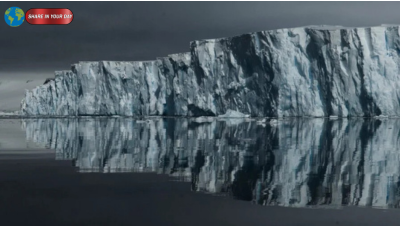
The glacier, widely known as the “Doomsday Glacier,” is one of the most closely monitored ice formations on Earth because its long-term destabilization could have serious consequences for coastal communities worldwide. New modeling suggests that Thwaites Glacier could contribute as much as 1.2 inches (30 millimeters) to global sea-level rise by 2100, approximately twice the amount projected by earlier models, according to a report published by Gizmodo on October 14, 2026.
The research, conducted by scientists affiliated with the University of California and NASA’s Jet Propulsion Laboratory, was published in the journal Nature Communications. Its findings highlight the importance of understanding what happens beneath glaciers, where ocean water can penetrate areas previously difficult to observe directly.
Warm Ocean Water Is Reaching Beneath the Glacier
Thwaites Glacier is located in West Antarctica and stretches approximately 120 kilometers (80 miles) across, making it the widest glacier on Earth.
Over recent decades, the glacier has thinned, accelerated and retreated inland. One of the primary concerns is the interaction between ocean water and the ice near the point where the glacier transitions from resting on the bedrock to floating in the sea.
This boundary is known as the grounding zone. It plays an important role in determining how quickly ice flows toward the ocean and how vulnerable the glacier is to further melting.
Scientists have traditionally represented this boundary in computer models as a relatively narrow transition. However, satellite observations indicate that the real environment beneath Thwaites is more complicated.
Researchers used synthetic aperture radar observations from Finland-based ICEYE satellites to examine changes in the glacier’s grounding zone. The observations revealed that tidal movements can lift portions of the ice, allowing seawater to penetrate several miles beneath ice that remains grounded.
This process exposes a larger area of the glacier’s underside to ocean water than conventional models may adequately represent.
When relatively warm, salty seawater reaches the base of the ice, it can intensify melting and potentially contribute to faster ice loss.
Why the New Model Predicts Greater Sea-Level Rise
The researchers developed an updated ice-sheet model designed to better reproduce changes observed in Thwaites Glacier over approximately two decades.
Previous models have struggled to match several aspects of the glacier’s observed behavior, including its retreat, thinning and acceleration. The new approach incorporates more detailed physical processes associated with the grounding zone.
According to the research described by Gizmodo, the updated model produces projections of sea-level contribution roughly twice as large as previous estimates.
The model suggests that Thwaites Glacier could contribute up to 30 millimeters of global sea-level rise by 2100, even without additional climate warming beyond the conditions assumed in the modeled scenario.
This figure represents the glacier’s projected contribution, not the total amount by which global sea levels will rise. Other glaciers, ice sheets and the expansion of warming seawater also influence future ocean levels.
The distinction is important because scientists use multiple models and scenarios to estimate future sea-level changes. The latest projection highlights a potentially underestimated risk, rather than establishing a precise prediction of what will happen by the end of the century.
Eric Rignot, a professor of Earth system science at the University of California, Irvine, and a co-author of the study, emphasized the importance of incorporating more complete physical processes into glacier models.
The research indicates that improving the representation of seawater movement beneath grounded ice can help explain the differences between satellite measurements and earlier computer simulations.
Why Thwaites Glacier Matters to the World
The concern surrounding Thwaites extends beyond the glacier itself.
Its ice rests on bedrock that descends deeper inland in many areas. As the glacier retreats into deeper sections of its underlying basin, the configuration can allow additional ice to flow toward the ocean, potentially accelerating further retreat.
Scientists are particularly concerned about the loss of ice shelves that help restrain the movement of land-based ice. If these supporting structures weaken, the glacier could become more vulnerable to rapid ice loss.
Thwaites is also an important part of the wider West Antarctic Ice Sheet. Significant destabilization could affect neighboring ice formations and increase the region’s long-term contribution to sea-level rise.
The complete loss of Thwaites Glacier alone could eventually raise global sea levels by roughly 65 centimeters (about 26 inches), although such a process would unfold over a much longer period than the projections extending to 2100.
That possibility makes understanding the glacier’s behavior an important priority for climate scientists and coastal planners.
Satellite Technology Is Improving Glacier Research
Studying the underside of an enormous Antarctic glacier presents considerable practical challenges. The region is remote, harsh and difficult to access, while much of the critical activity occurs beneath thick ice.
Satellite radar offers researchers a way to monitor movements and changes across large areas without relying exclusively on measurements taken directly on the glacier.
The ICEYE observations used in the new research helped scientists identify fluctuations associated with ocean tides and the movement of seawater beneath the ice.
By combining these observations with computer simulations, researchers can test whether their models accurately reproduce the changes taking place in the real world.
More accurate modeling could improve estimates of future ice loss and help governments and communities evaluate long-term exposure to rising seas.
Nevertheless, uncertainties remain. Future glacier behavior will depend on interacting factors, including ocean circulation, atmospheric conditions, ice-shelf stability and the physical characteristics of the bedrock beneath the ice.
Continued satellite monitoring and further field research will be necessary to refine projections.
What the Findings Mean for Future Sea Levels
The latest findings reinforce concerns that some conventional models may underestimate the vulnerability of major Antarctic glaciers.
The possibility that seawater can travel several miles beneath grounded ice demonstrates why scientists must account for processes that are difficult to observe directly when forecasting future ice loss.
For coastal communities, even relatively small additional increases in global sea levels can worsen flooding risks, particularly when combined with storm surges, high tides and extreme weather.
However, the new study does not mean that a sudden global catastrophe is imminent. The projected contribution of 30 millimeters by 2100 is a modeled estimate, and the eventual outcome remains uncertain.
Instead, the research provides a more detailed picture of how ocean water interacts with Thwaites Glacier and why these processes matter for future sea-level projections.
As scientists continue investigating Antarctica, understanding the hidden dynamics beneath its glaciers will be essential for improving climate forecasts and preparing for long-term changes along the world’s coastlines.