France Braces for Nationwide Protests as Security Concerns Rise Over Cost of Living
France prepared for a tense day of nationwide demonstrations on Saturday, October 17, 2026, as students, trade union members and supporters of the Yellow Vest movement took to the streets to protest rising living costs, fuel prices and pressure on public services. Authorities increased security measures amid fears of clashes, while growing criticism of police tactics added to the political tension.
The demonstrations followed several weeks of student-led protests that began in September over problems in the education system, including teacher shortages, overcrowded classrooms and deteriorating school facilities. The movement has since expanded, drawing support from workers and citizens frustrated by economic pressures and social inequality.
French officials warned that some gatherings could turn violent, particularly in Paris and other major cities. The government said it would protect the right to demonstrate while taking action against attacks on police officers, damage to public property and attempts to block essential infrastructure.
France Strengthens Security Ahead of Demonstrations
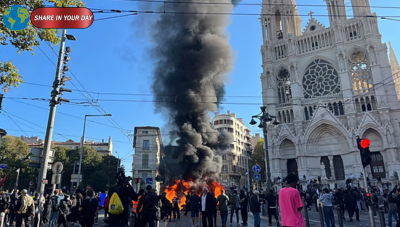
French authorities entered Saturday with heightened security preparations across the country. According to a source close to the Interior Ministry cited by Euronews, approximately 500 protest-related actions were expected nationwide, alongside an estimated 90 demonstrations.
Officials were particularly concerned about possible confrontations between demonstrators and security forces. Authorities warned that some groups could attempt to breach restricted security areas or obstruct major transport routes.
The government also indicated that blockades affecting critical infrastructure would not be tolerated. Security deployments were intended to maintain public order while allowing peaceful demonstrations to proceed.
President Emmanuel Macron called for calm ahead of the rallies, emphasizing that the right to protest must be accompanied by respect for people and property.
His appeal came as the administration faced mounting pressure over economic conditions, public spending and the government’s response to the continuing unrest.
Rising Living Costs Fuel Public Anger
The cost-of-living crisis has become a central issue for protesters. Rising prices, fuel expenses and concerns about household purchasing power have helped unite groups with different political and social priorities.
For many demonstrators, the protests represent a broader expression of dissatisfaction with economic inequality and the perceived deterioration of public services.
Students have also played a significant role in expanding the movement. Their initial demonstrations focused on educational conditions, including insufficient teaching staff, crowded classrooms and outdated facilities.
What began as a series of school-related protests has developed into a wider campaign addressing living standards and government policy.
Trade unions have joined the calls for action, highlighting demands for better wages, improved pensions, lower prices and the protection of essential public services.
The participation of Yellow Vest supporters has added another dimension to the demonstrations. The movement emerged in 2018 in opposition to planned fuel-tax increases before developing into a broader protest against economic inequality and government policies.
Its return to the streets reflects the continuing sensitivity surrounding fuel prices and the financial pressures facing French households.
Police Conduct Faces Growing Scrutiny
Security concerns have been accompanied by increasing scrutiny of police tactics during recent demonstrations.
Several incidents involving injured students have intensified criticism of the use of crowd-control weapons. According to the Euronews report, a 15-year-old student allegedly lost an eye after being struck by a rubber projectile, while a 14-year-old reportedly lost a hand after picking up a police stun grenade.
The circumstances surrounding the incidents remained under investigation.
French authorities suspended the use of certain types of stun grenades following the reported injuries. However, Interior Minister Laurent Nuñez said their use could still be authorized in cases involving serious urban violence.
The government has also acknowledged the scale of injuries reported during the unrest. Prime Minister Sébastien Lecornu said that 937 police officers and gendarmes had been injured since the protests began. He also reported injuries involving 248 students and 149 members of teaching staff.
Authorities said 36 investigations into alleged police violence during student demonstrations had been opened. The cases included allegations involving serious injuries, physical assaults, insults and reported sexual violence.
The investigations have increased pressure on officials to explain how police operations are being conducted and whether existing crowd-control procedures are appropriate.
At the same time, police representatives have expressed concerns about the risks officers face during demonstrations. Alliance Police Nationale, one of France’s major police unions, announced plans to file a complaint against the state, alleging that officers had been exposed to danger by contradictory instructions.
These competing concerns have complicated efforts to restore calm.
Political Tensions Add to the Unrest
The demonstrations are unfolding during a challenging period for Macron’s administration, which is dealing with economic pressures, public debt concerns and a fragmented political landscape.
The government’s efforts to control spending and advance budget measures have contributed to wider debates about the distribution of economic burdens and the future of public services.
Opposition politicians and government representatives have also clashed over the causes of the unrest and the language used to describe the demonstrations.
The government and political opponents have accused the left-wing party La France Insoumise of contributing to tensions through its rhetoric. Party leader Jean-Luc Mélenchon subsequently clarified that he supported peaceful methods of protest.
Such disputes illustrate the difficulty of separating legitimate public grievances from incidents involving violence and property damage.
For the government, maintaining order without further inflaming public anger remains a significant challenge.
France Faces an Uncertain Path Forward
The October 17 demonstrations highlight the convergence of several issues affecting France, from household finances and education to policing and political accountability.
Although the protests have brought together students, workers and Yellow Vest supporters, their long-term direction remains uncertain. Different groups share concerns about living costs and public services but may not agree on specific solutions.
The authorities’ response will be closely watched as investigations into alleged police misconduct continue and demonstrators press their demands.
For Macron’s administration, the unrest presents another test of its ability to manage public dissatisfaction while protecting the right to peaceful assembly.
The events also underline a broader challenge for France: addressing economic and social grievances while preventing demonstrations from escalating into violence.
Whether the movement develops into a sustained nationwide campaign will depend on how protesters, unions and political leaders respond in the coming days. For now, the combination of economic frustration, student activism and concerns over public security continues to place France on edge.