Cambodian Monks in Siem Reap Turn Temple Into Lifeline for Civilians Displaced by Border Fighting
As fighting along the Cambodia–Thailand border forced hundreds of thousands of people to flee their homes, a Buddhist temple in Siem Reap province has quietly transformed into a refuge — offering food, shelter and compassion to families escaping the violence.
Wat Kok Chak, normally a place of prayer and meditation, has become a temporary home for displaced civilians under the leadership of its abbot, Venerable Hem Kimsan, who says the scale of suffering that arrived at the temple gates in early December deeply moved him.
Inside the temple compound, tents and sleeping mats are neatly laid out. Clothes hang from makeshift lines beneath the eaves. Children run barefoot across the courtyard as aid supplies arrive, while exhausted adults rest in hammocks after days of travel.
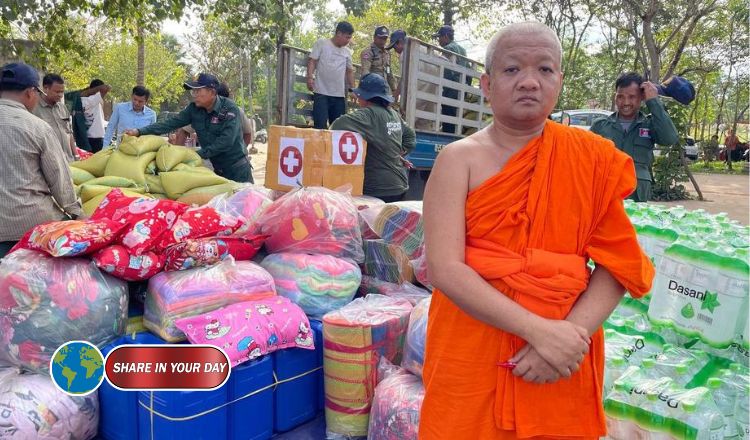
The temple’s dining hall has been converted into a sleeping area, stacked with mats, donated clothing and relief goods. What was once a communal kitchen is now a storage space and shelter — a reflection of how the monastery has adapted to meet urgent humanitarian needs.
A Response Rooted in Compassion
Behind the effort is Venerable Hem Kimsan, 43, who has served as abbot of Wat Kok Chak since 2016 and was first ordained in 2002. He says caring for people in need is not new for the monastery, but the suffering seen this month was overwhelming.
“When I heard about the outbreak of fighting on the morning of December 8, I cried,” he said. “At the time, I was in Chikreng district donating food and bicycles. I almost couldn’t continue my work.”
Displaced families began arriving at the temple that same day — fleeing artillery fire and air attacks in border provinces including Preah Vihear, Oddar Meanchey, Banteay Meanchey and Battambang.
Some arrived in cars offered by strangers. Others came by motorbike, carrying small children and whatever belongings they could salvage before escaping their homes.
Hundreds Seeking Shelter
As of this week, around 210 families — roughly 670 people — are sheltering at Wat Kok Chak, according to the abbot. At one point, the number reached 260 families before some relocated to stay with relatives.
With limited space, the temple has had to turn away additional arrivals.
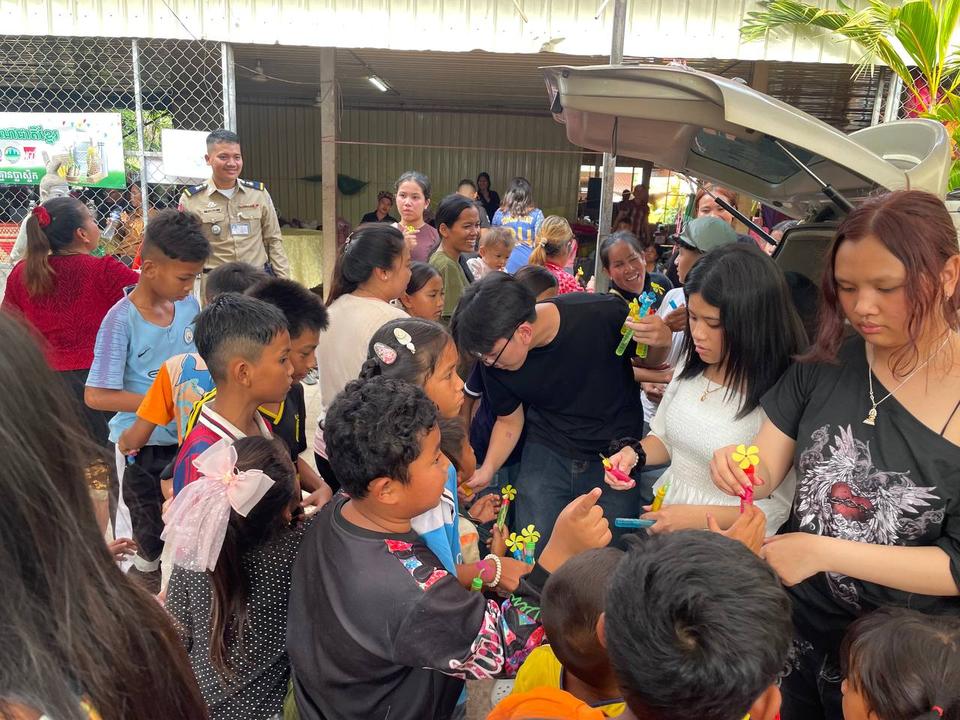
“We have arranged proper areas for people to stay,” Venerable Hem Kimsan said. “I told them families can stay together, but we must make sure the temple can properly care for everyone who is already here.”
Each day, the monastery provides three meals — breakfast, lunch and dinner. Food, basic supplies and household items are funded through donations from monks, the temple committee, local commune authorities and private donors.
“I don’t have a job and I don’t receive a salary,” the abbot said. “I rely on donations from the people. Because of that support, the temple is able to care for displaced families. This is how we share goodness with others.”
Faith in Action
For Venerable Hem Kimsan, the work is inseparable from Buddhist teaching.
“In Buddhism, the Buddha teaches us to do good — to help one another, to save people and all living beings,” he said. “This is our duty.”
Among those sheltering at the temple is Chheng Sreylap, 39, who fled from Malai district in Banteay Meanchey province after bombs fell near her home. She arrived at Wat Kok Chak on December 8.
“Life at the temple is okay,” she said. “There is enough food. The abbot takes care of displaced people both near and far. It’s clean here, and we can sleep peacefully.”
She added, “We feel this is a good place. The abbot is very kind.”
Another displaced woman, Chhiev Sok, 28, who is seven months pregnant, arrived at the temple at 7 p.m. on December 9 after fleeing Poipet with her extended family.
“We heard explosions near the border,” she said. “There are many donations here. I’m very grateful.”
Uncertainty and a Call for Peace
While the future remains uncertain, the abbot says he is already thinking about what comes next.
“If this war ends soon, I will distribute the remaining aid to the displaced families so they can take something home with them,” he said.
He has also joined religious leaders in calling for peace, urging Thailand to respect existing peace agreements discussed in Kuala Lumpur, referencing talks involving U.S. President Donald Trump and Malaysian Prime Minister Anwar Ibrahim.
The humanitarian needs remain urgent.
According to Cambodia’s Ministry of Interior, at least 17 civilians have been killed and 77 injured in the fighting. The conflict has displaced 131,672 families — about 438,953 people — across seven provinces, including more than 225,000 women and 134,000 children.
Banteay Meanchey has recorded the highest number of displaced residents, followed by Siem Reap, with others spread across Oddar Meanchey, Preah Vihear, Battambang, Pursat, Koh Kong and Kampot.
As the crisis continues, Wat Kok Chak stands as a reminder of how faith-based institutions can become lifelines — offering not only shelter and food, but dignity and hope amid conflict.