Thai Forces Razed Cambodian Homes After Ceasefire, Rights Group Says
Thai forces demolished Cambodian civilian homes in disputed border areas following a ceasefire that ended weeks of deadly clashes between the two neighbours, a Cambodian human rights organisation said on Tuesday, raising fresh concerns over potential violations of international humanitarian law.
The allegations come amid renewed tension along the Cambodia–Thailand frontier, where a decades-old border dispute reignited last year, leading to multiple rounds of fighting and the displacement of hundreds of thousands of civilians on both sides.
The two countries agreed to a ceasefire on December 27, ending three weeks of clashes that killed dozens of people and forced around one million residents to flee their homes. However, rights monitors and Cambodian officials say conditions on the ground have deteriorated since the truce took effect.
Homes demolished after fighting ended
In a statement released Tuesday, local rights group LICADHO said a “significant number of homes and structures” in two Cambodian villages in Banteay Meanchey province had been “razed and cleared by Thai forces” in areas currently under Thai control.
The demolitions occurred after the ceasefire was in place, LICADHO said, citing satellite imagery from the European Space Agency’s Sentinel-2 system as well as photographs and video footage published by media outlets.
“The destruction of civilian homes during a conflict goes against the Geneva Conventions and international human rights law, regardless of which side of the contested border the houses stand,” the organisation said.
LICADHO added that some of the destroyed homes were located in areas claimed by both countries, while others stood on land recognised by both sides as either Cambodian or Thai territory.
“Their clearance post-ceasefire serves no legitimate military objective,” the group said.
Border dispute reignites tensions
Cambodia has accused Thailand of seizing several areas in four border provinces following the ceasefire, and has repeatedly demanded the withdrawal of Thai troops from territory claimed by Phnom Penh.
Thai authorities have denied the accusations, insisting their forces are operating within Thailand’s internationally recognised borders and rejecting claims of territorial annexation.
The dispute centres on poorly demarcated sections of the roughly 800-kilometre border between the two countries, a legacy of colonial-era mapping that has long fuelled competing claims—particularly around ancient temple sites and rural border communities.
Villagers blocked from returning home
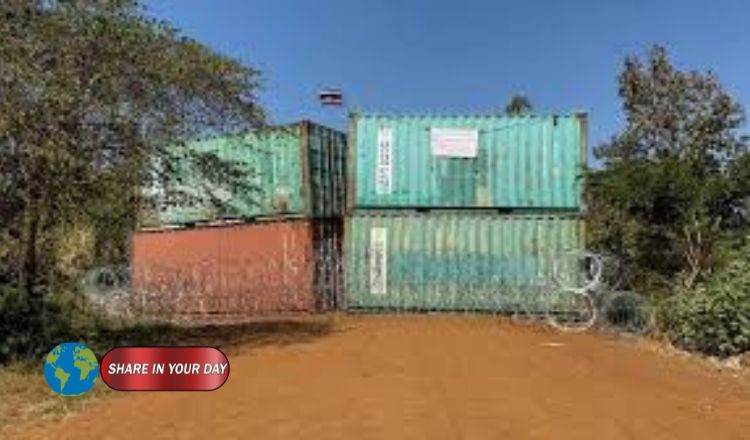
Earlier this month, Cambodian officials accused Thai forces of effectively annexing two contested villages—Chouk Chey and Boeung Trakuon—by erecting barbed wire and placing shipping containers to block access.
For residents who fled during the fighting, the restrictions have meant prolonged displacement and uncertainty.
Tep Chheang, 43, said he lived in Chouk Chey before his home was burned down during December’s clashes. Since then, he has been unable to return.
“We lost everything now,” he told AFP on Tuesday. “I have four children and I don’t know where we will live.”
He is currently staying in a camp for displaced families, relying on aid and uncertain when—or if—he will be allowed back.
Pen Rithy, the village chief of Chouk Chey, said approximately 880 families remained blocked from returning to their homes. From behind the row of shipping containers, villagers could hear excavators clearing the area, he said.
“It is like we are being buried alive,” Pen Rithy said. “Our homes, land and belongings are gone. We don’t know when we can go back into the village.”
Government responses diverge
Cambodia’s foreign ministry has condemned the demolitions, accusing Thai forces of destroying civilian homes and infrastructure in seized areas in violation of international law.
Thailand has rejected the accusations. A Thai foreign ministry spokesperson on Tuesday referred reporters to a statement issued on January 12, which dismissed Cambodia’s claims as “unfounded allegations of illegal territorial annexation”.
The statement said security measures taken by Thai forces after the ceasefire were “in full compliance” with the December 27 truce agreement.
The Thai army did not immediately respond to requests for comment regarding LICADHO’s findings.
Ongoing humanitarian impact
According to Cambodia’s interior ministry, more than 127,000 Cambodians remain displaced following the December fighting, underscoring the prolonged humanitarian impact of the conflict despite the ceasefire.
Rights groups warn that without independent investigations and clear mechanisms to protect civilians, conditions along the border could further deteriorate, deepening mistrust and complicating efforts toward a lasting resolution.
As both governments trade accusations and maintain competing claims, displaced families remain caught in the middle—unable to return home, uncertain of their future, and watching as their villages are cleared beyond the border barriers.