Archaeologists Restore Hindu Temple Tower at Cambodia’s Angkor Complex
PHNOM PENH — Cambodian archaeologists have begun restoration work on a deteriorating brick tower and eroded stone flooring at Pre Rup Temple, one of the historic Hindu monuments within the renowned Angkor Archaeological Park, authorities said on Friday.
The restoration is being carried out by experts from the APSARA National Authority (ANA), the government body responsible for safeguarding Cambodia’s Angkor heritage site, which is listed as a UNESCO World Heritage Site.
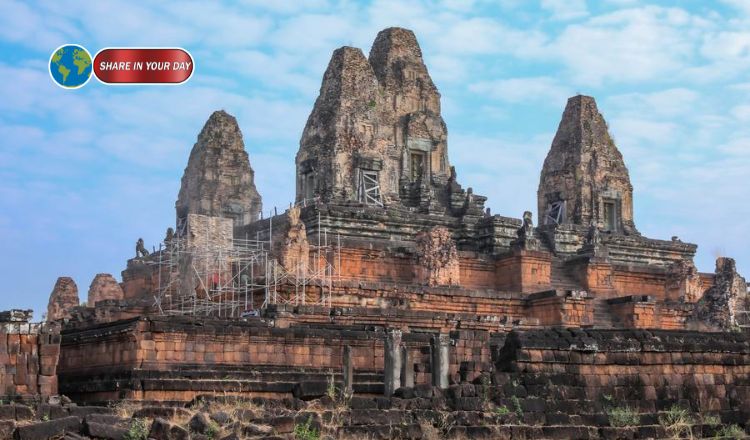
According to an ANA news release, the project focuses on brick tower No. 10 and sections of the laterite floor of the temple, after conservation specialists identified structural vulnerabilities that could threaten the monument’s long-term stability.
Structural Risks Identified
So Pot, an archaeologist with the ANA’s Department of Conservation of Monuments and Preventive Archaeology, said the restoration was launched following a technical assessment that revealed significant deterioration caused by age and environmental exposure.
“Due to the age of the temple, parts of brick tower number 10 have significantly deteriorated,” Pot said. “Sections of the brick walls have decayed and lost their original structure, making urgent restoration necessary.”
The tower, built more than a millennium ago, has suffered from weathering and material fatigue, common challenges faced by ancient brick structures in Cambodia’s tropical climate.
Erosion Threatens Temple Foundation
In addition to damage to the brick tower, archaeologists found that parts of the laterite floor, particularly in the temple’s southwestern section, have been severely eroded.
“This deterioration allows rainwater to flow down toward the temple’s foundation, posing potential risks to the stability of the monument,” Pot explained.
Unchecked water runoff can weaken foundations over time, increasing the risk of subsidence or further structural collapse, experts warn.
International Conservation Standards
ANA officials said the restoration work is being conducted in line with international conservation principles, following the technical guidelines established by the International Coordinating Committee for the Safeguarding and Development of the Historic Sites of Angkor and Sambor Prei Kuk (ICC-Angkor).
The committee brings together Cambodian authorities and international experts to ensure restoration efforts preserve the authenticity and historical integrity of Angkor’s monuments.
“These standards emphasize minimal intervention and respect for original materials,” the authority said, noting that restoration efforts aim to stabilize the structure rather than alter its historical appearance.
A Monument from the Angkor Golden Age
Pre Rup Temple is one of Angkor’s major Hindu temples and was constructed in 961 A.D. during the reign of King Rajendravarman II, a ruler associated with a period of architectural and cultural growth in the Khmer Empire.
The temple complex consists of 33 towers arranged in a pyramid-like layout, symbolizing Mount Meru, the sacred mountain in Hindu cosmology.
Located in Siem Reap province in northwestern Cambodia, Pre Rup remains a popular destination for both tourists and scholars, offering insight into the religious practices and architectural achievements of the Angkor era.
Preserving Angkor’s Legacy
The restoration comes as Cambodia continues long-term efforts to protect the Angkor Archaeological Park, which spans more than 400 square kilometers and contains hundreds of temples dating from the 9th to the 15th centuries.
Decades of exposure to monsoon rains, vegetation growth, and fluctuating groundwater levels have posed ongoing conservation challenges across the site.
APSARA officials said regular monitoring and preventive archaeology are essential to ensuring that Angkor’s monuments can be preserved for future generations.
Ongoing Conservation Efforts
The authority emphasized that the current project is part of a broader, continuous conservation program rather than a one-time intervention.
“Protecting Angkor requires constant assessment and timely restoration,” an ANA statement said. “These efforts are crucial to maintaining the cultural, historical, and spiritual value of the site.”
As restoration work continues at Pre Rup Temple, archaeologists hope the measures will stabilize the structure and prevent further deterioration, reinforcing Cambodia’s commitment to safeguarding one of Southeast Asia’s most important archaeological treasures.