South Korean President’s Scam Warning Triggers Backlash in Cambodia
A now-deleted social media post by South Korean President Lee Jae-myung warning about online scam networks has sparked a wave of criticism in Cambodia, underscoring the diplomatic sensitivities surrounding transnational crime and regional cooperation in Southeast Asia.
Lee’s post, published on X on Friday morning in both Korean and Khmer, warned of organised crime groups involved in large-scale online fraud targeting South Korean citizens. While the president did not explicitly name Cambodia as a source of the scams, the reference to the country in the post led many Cambodians to interpret the message as an accusation directed at the Kingdom.
The backlash grew swiftly online, prompting Seoul to clarify that Lee’s remarks were not intended to insult Cambodia or its people, and that the post was removed after it caused misunderstanding.
A Strongly Worded Warning
In the post, Lee accused transnational criminal syndicates of recruiting South Korean gangs to carry out online fraud, following a series of police-led repatriation operations across Southeast Asia.
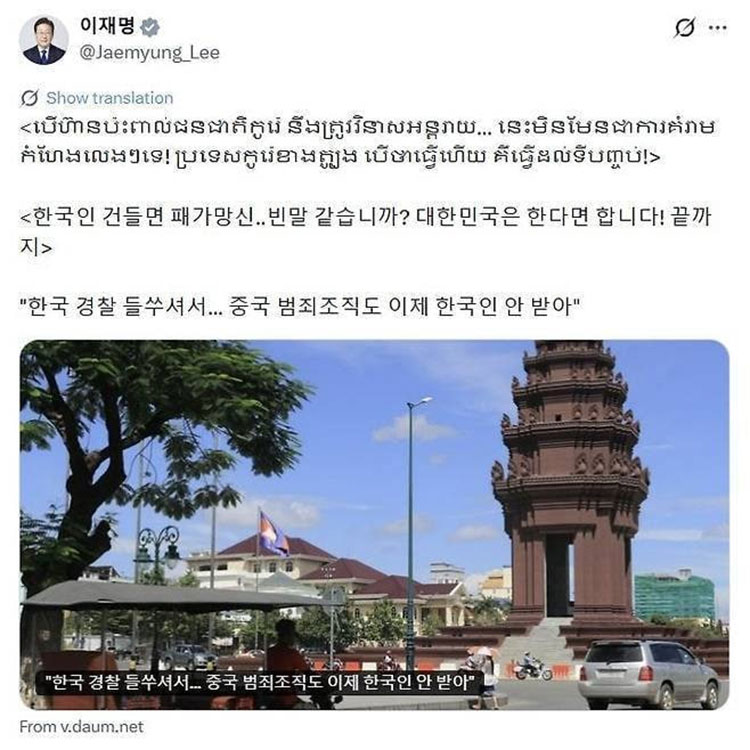
“If you dare to mess with South Koreans, it will ruin you and your family,” Lee wrote. “Did it look like I was joking? South Korea will pursue this to the very end once we make such a promise.”
The president cited a report by South Korean outlet OhMyNews, which described how police raids had disrupted Chinese organised crime groups and discouraged them from hiring South Korean members.
Lee’s comments echoed his earlier statements in October, when he pledged to dismantle international criminal syndicates harming South Korean citizens. His administration has since deployed South Korean police officers to parts of Southeast Asia, leading to multiple large-scale repatriations of South Korean nationals from scam compounds operating in the region.
Anger and Confusion in Cambodia
Despite the deletion of the post, screenshots circulated widely, fueling anger among Cambodian social media users and foreign residents.
“Why does Cambodia look so bad? What is your intention?” one Cambodian user wrote in response.
“Cambodia is safe. Such a post is not fair for the country,” said another commenter, a foreigner based in Phnom Penh.
The reaction reflects growing frustration in Cambodia over being portrayed internationally as a hub for online scams, despite government efforts to clamp down on fraud networks and cooperate with regional partners.
Seoul Moves to Contain the Fallout
A South Korean official later said Lee had not intended to single out Cambodia and that the post was removed precisely because it had been misunderstood.
South Korea, the official added, remains committed to close cooperation with Cambodia across multiple sectors, including the fight against online scams, which she stressed are transnational in nature and not confined by national borders.
Diplomats from both countries have sought to frame the episode as a miscommunication rather than a shift in bilateral relations, emphasizing shared interests in dismantling organised crime networks.
Cambodian Analysts Defend Public Anger
Cambodian political analysts say the public reaction is rooted in deeper historical and security concerns.
Kin Phea, Director-General of the International Relations Institute of Cambodia, said Cambodians had good reason to be upset by Lee’s remarks.
“Cambodian people are serious about it because Cambodia has been invaded and bombed by Thailand using its fighter jets under the pretext of an online scamming crackdown,” he said, referring to past cross-border military actions.
“The airstrike operation was very deep inside Cambodian territory. Cambodian people have been very painful under this brutal invasion carried out under the pretext of transnational crimes,” Kin Phea added, arguing that Cambodia has long cooperated with regional partners to address online fraud.
Cambodia’s Intensified Crackdown
Cambodian authorities have stepped up efforts against online scams in recent years, particularly under the current government led by Prime Minister Hun Manet.
In February last year, the government established an Ad-hoc Commission for Combatting Online Scams, chaired by the prime minister himself. Since its formation, authorities have conducted raids at 118 locations across 18 provinces and Phnom Penh.
The results, according to official figures, include thousands of arrests and deportations.
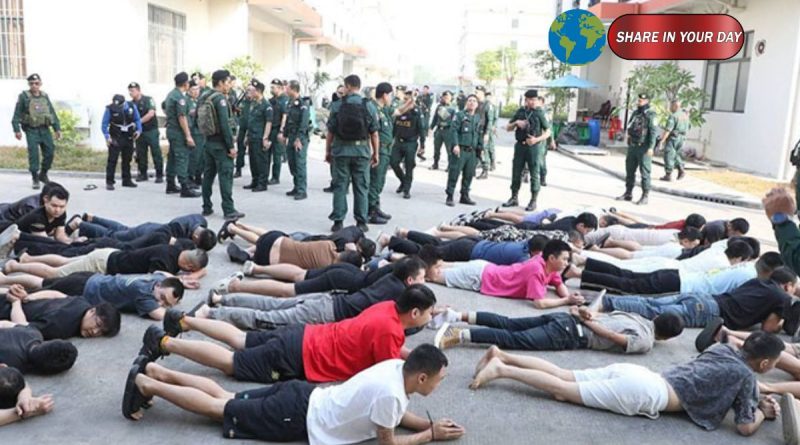
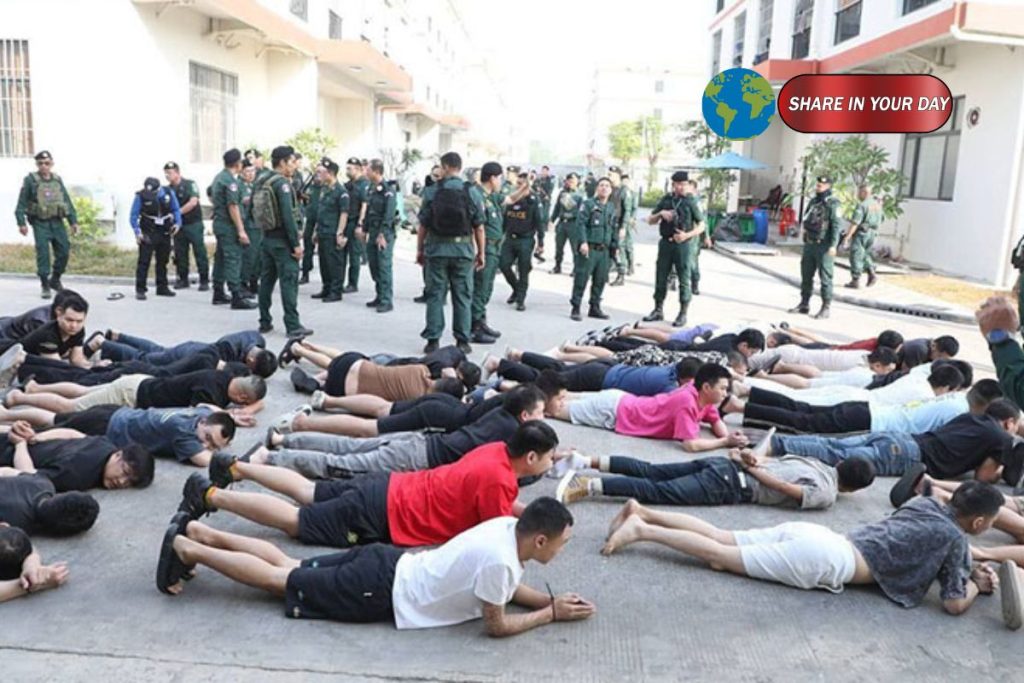
On January 23 alone, Cambodia deported 209 foreign nationals—73 South Koreans and 136 Myanmar citizens—to face legal action in their home countries. Last year, Cambodia deported a total of 244 South Korean nationals linked to online fraud cases.
Since the start of last year, authorities have detained 4,983 suspects from 23 different nationalities, deported 4,039 foreigners, and referred 35 major cases to court, resulting in the prosecution of 168 alleged ringleaders and accomplices.
A Delicate Regional Challenge
The episode highlights the diplomatic tightrope governments must walk when addressing transnational crime. Online scam networks often operate across borders, exploiting legal gaps and regional inequalities, making cooperation essential—but also politically sensitive.
While Seoul and Phnom Penh continue to present a united front against online fraud, Lee’s deleted post serves as a reminder that language matters, particularly in a region where issues of sovereignty, security, and reputation remain deeply intertwined.
For now, both sides appear keen to move past the controversy, focusing instead on the shared challenge of dismantling criminal networks that operate far beyond any single country’s borders.