Artemis II Launch Signals Historic Return to the Moon
The Artemis II launch marks a historic milestone for NASA and global space exploration, as astronauts prepare to journey toward the Moon for the first time in more than 50 years. Scheduled for liftoff on April 1, 2026, the mission represents humanity’s long-awaited return to deep space following the Apollo era.
This mission is not just symbolic—it is a critical step toward establishing a long-term human presence on the Moon and eventually sending astronauts to Mars. With a diverse international crew and cutting-edge technology, Artemis II is poised to redefine the future of space travel.
First Crewed Lunar Mission Since Apollo Era
The Artemis II mission is NASA’s first crewed flight beyond low Earth orbit since 1972, when the Apollo program concluded with Apollo 17.
Unlike its predecessor, Artemis I—which was an uncrewed test flight in 2022—this mission will carry four astronauts on a 10-day journey around the Moon.
The mission will follow a “free-return trajectory,” meaning the spacecraft will loop around the Moon and naturally return to Earth without requiring major propulsion adjustments.
This approach ensures maximum safety while allowing NASA to test critical systems in deep space.
Meet the Artemis II Astronaut Crew
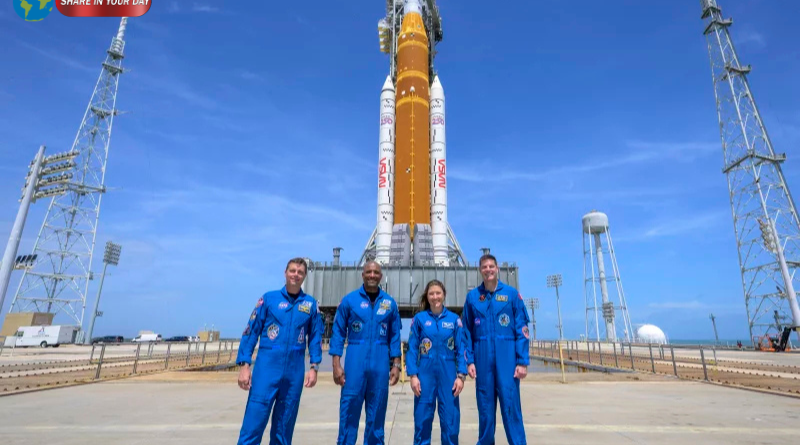
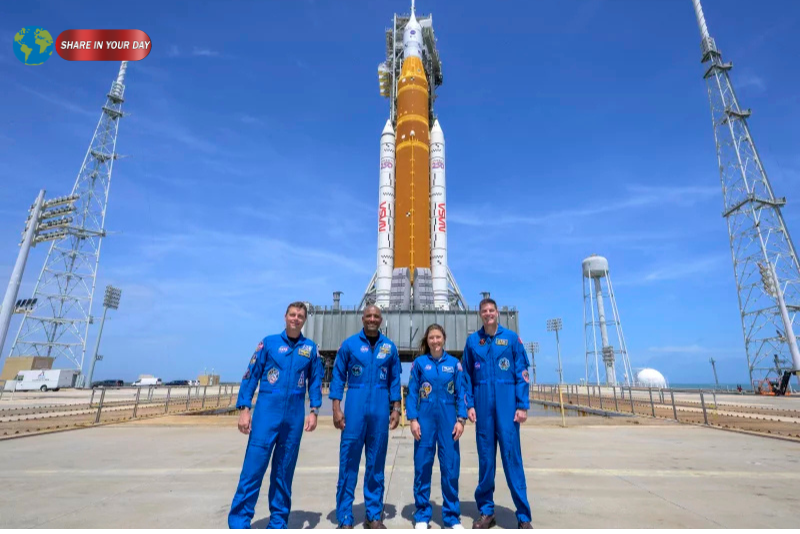
The Artemis II crew includes four astronauts representing both the United States and Canada:
- Reid Wiseman (Commander)
- Victor Glover (Pilot)
- Christina Koch (Mission Specialist)
- Jeremy Hansen (Mission Specialist, Canada)
This crew is making history in multiple ways. Christina Koch will become the first woman to travel to the Moon, while Victor Glover will be the first person of color to reach lunar space. Jeremy Hansen will also make history as the first non-American astronaut to venture beyond low Earth orbit.
These milestones highlight NASA’s push toward inclusivity and international collaboration in space exploration.
Powered by the Space Launch System and Orion
The Artemis II launch will rely on two key pieces of technology:
- Space Launch System (SLS): NASA’s most powerful rocket ever built
- Orion spacecraft: Designed for deep-space human missions
Standing about 322 feet tall, the SLS rocket is capable of carrying astronauts farther than any previous spacecraft.
Meanwhile, the Orion capsule is equipped with advanced life-support systems, navigation tools, and heat shielding designed to withstand the extreme conditions of deep space and reentry into Earth’s atmosphere.
Together, these technologies form the backbone of NASA’s Artemis program, which aims to establish a sustainable human presence on the Moon.
Mission Timeline and Journey Details
The Artemis II mission will last approximately 10 days, during which the crew will travel hundreds of thousands of miles through space.
Key mission highlights include:
- Launch from Kennedy Space Center in Florida
- Travel roughly 250,000 miles from Earth
- Loop around the Moon in a figure-eight trajectory
- Return to Earth with a Pacific Ocean splashdown
The mission is expected to break records for the farthest distance humans have ever traveled from Earth, surpassing previous Apollo missions.
Why Artemis II Matters for the Future
The Artemis II launch is not just about revisiting the Moon—it is about building the foundation for future exploration.
NASA’s broader Artemis program has several long-term goals:
- Establish a permanent human presence on the Moon
- Explore the lunar south pole for water and resources
- Develop technologies for Mars missions
- Strengthen international partnerships
Artemis II will test critical systems such as life support, navigation, and communication in deep space—capabilities essential for future missions that involve landing on the Moon.
Artemis Program Timeline and What Comes Next
Artemis II is just one step in a larger roadmap:
- Artemis I (2022) – Uncrewed test flight
- Artemis II (2026) – Crewed lunar flyby
- Artemis III (planned 2027) – Crewed mission (potentially orbital testing)
- Artemis IV (planned 2028) – Expected lunar landing
Notably, NASA has adjusted its timeline, with the first human landing now expected no earlier than 2028 due to technical and safety considerations.
Technical Challenges and Delays
The road to the Artemis II launch has not been without obstacles. Earlier delays were caused by technical issues, including hydrogen leaks and helium system concerns during testing phases.
NASA engineers have since resolved these problems, reinforcing confidence in the mission’s readiness.
Additionally, concerns about the Orion spacecraft’s heat shield—identified during Artemis I—have been addressed with design improvements and revised reentry procedures.
These fixes are critical to ensuring astronaut safety during one of the most dangerous phases of the mission: reentry into Earth’s atmosphere.
Global Excitement and Public Interest
The Artemis II launch has captured global attention, with hundreds of thousands of spectators expected to gather in Florida to witness the historic event.
Meanwhile, millions more will watch online via NASA’s official streaming platforms.
The excitement surrounding Artemis II reflects a renewed public interest in space exploration, reminiscent of the Apollo era. For many, this mission symbolizes a new space age—one driven by innovation, collaboration, and ambition.
International Collaboration in Space Exploration
One of the defining features of the Artemis II mission is its international partnership. The inclusion of Canadian astronaut Jeremy Hansen underscores the global nature of modern space exploration.
NASA is also working with multiple international agencies and private companies, including major aerospace contractors, to develop the technologies needed for future missions.
This collaborative approach is essential for tackling the enormous challenges of deep-space exploration.
Risks and Uncertainties Ahead
Despite the excitement, the Artemis II launch carries inherent risks. Human spaceflight—especially beyond low Earth orbit—remains one of the most complex and dangerous endeavors.
Potential risks include:
- System failures in deep space
- Communication delays
- Radiation exposure
- Reentry complications
However, NASA has spent years preparing for these challenges, leveraging decades of experience from previous missions and modern technological advancements.
A Defining Moment in Space History
The Artemis II launch represents a defining moment not only for NASA but for humanity as a whole. It signals a return to deep space exploration after decades of focus on low Earth orbit missions.
More importantly, it lays the groundwork for the next chapter in human exploration—one that could see astronauts living and working on the Moon, and eventually traveling to Mars.
Conclusion: A Giant Leap Forward
As the countdown begins, the Artemis II mission stands as a powerful reminder of what humanity can achieve through innovation and collaboration.
The journey may only last 10 days, but its impact will be felt for decades. From testing new technologies to inspiring future generations, Artemis II is more than a mission—it is a bold step toward the future of space exploration.
If successful, it will mark the beginning of a new era—one where the Moon is no longer a distant dream, but a destination within reach.