OPEC+ Oil Quotas: 3 Key Risks as Hormuz Crisis Deepens
OPEC+ oil quotas will remain unchanged for October, even as the ongoing Iran conflict continues to disrupt energy shipments through the Strait of Hormuz. The decision highlights the increasingly complicated position of the world’s major oil producers as geopolitical risks reshape the physical crude market. Investing Live+1
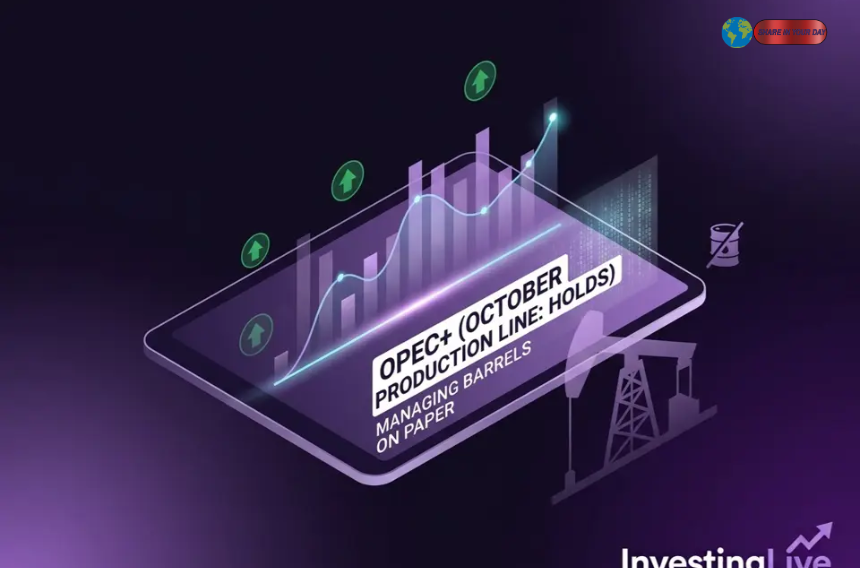
Seven major OPEC+ producers — Saudi Arabia, Russia, Iraq, Kuwait, Kazakhstan, Algeria and Oman — met virtually on September 6 and agreed to maintain September’s required production levels for October. The group said the decision was part of its continuing effort to support oil-market stability. OOPEC
The decision comes at a particularly sensitive moment for the global energy market. Oil flows through the Strait of Hormuz have been severely affected by the conflict, limiting the practical impact of production decisions made by OPEC+.
At the same time, crude prices have climbed sharply as traders assess the possibility of prolonged supply disruptions. Reuters reported on September 7 that Brent crude had reached $96.80 a barrel, while West Texas Intermediate crude was trading around $92.14. RReuters
The result is a market in which official production quotas and actual oil availability are increasingly different things.
OPEC+ Oil Quotas Stay Flat for October
The latest decision means OPEC+ will not introduce another monthly increase in October.
According to the organization’s official announcement, the seven participating countries decided to maintain September 2026 required production for October 2026. The countries also reaffirmed their commitment to market stability and said they would continue meeting monthly to assess conditions. OOPEC
The next meeting is scheduled for October 4.
The decision follows several months of production adjustments. In August, the seven countries agreed to increase production by 188,000 barrels per day beginning in September, continuing the gradual unwinding of voluntary production reductions that were originally announced in 2023. OOPEC
However, the headline production figures do not tell the entire story.
Actual output and export availability have been constrained by the conflict and transportation problems. As a result, an increase in a formal quota does not necessarily translate into an equivalent increase in barrels reaching international consumers.
That distinction is now one of the most important factors for oil traders.
Why the Hormuz Crisis Changes the Oil Market
The Strait of Hormuz is one of the world’s most strategically important energy routes.
The waterway connects the Persian Gulf with the Gulf of Oman and the wider global shipping network. Major oil-producing countries rely on it to move crude and petroleum products to international buyers.
The current conflict has significantly reduced maritime traffic.
Reuters reported that only about 10 commodity ships per day had been transiting the Strait of Hormuz over the preceding 10 days, the lowest average since May. The decline followed attacks involving U.S. and Iranian forces and increased risks for commercial shipping. RReuters
That disruption matters because crude oil is not simply produced and consumed at the same location.
A producer can technically have oil available underground, but if tankers cannot safely transport it to customers, the supply is effectively constrained.
This is why the latest OPEC+ oil quotas have a more limited immediate influence than they normally would.
The organization can change production targets. It cannot instantly reopen shipping lanes.
Risk No. 1: Oil Prices Could Remain Elevated
The first major risk from the latest OPEC+ oil quotas is that crude prices could remain elevated if physical supply disruptions continue.
Brent crude has already moved close to the $100-per-barrel level. Reuters reported that Brent gained 7.8% during the previous week, while WTI rose almost 10%, reflecting growing concerns about disrupted oil flows. RReuters
A sustained reduction in shipments through Hormuz could keep traders focused on physical availability rather than official production targets.
That creates an unusual market dynamic.
Normally, if geopolitical tensions threaten supply, OPEC+ can potentially respond by increasing production. Additional barrels can help reassure the market and limit price spikes.
But when the problem is transportation rather than production capacity, additional quotas may have little immediate effect.
For consumers, that could mean higher fuel costs.
For airlines, refiners, transportation companies and manufacturers, expensive crude can increase operating costs. Those costs can eventually filter through to consumers through higher prices for fuel, freight and goods.
Risk No. 2: OPEC+ Could Face a New Supply Problem
The second risk concerns the future balance between OPEC+ production capacity and actual market demand.
The group has spent much of 2026 gradually reversing earlier production restrictions.
In August, OPEC+ announced an additional 188,000 barrels-per-day adjustment for September. The move continued a phased rollback of the 1.65 million-barrel-per-day voluntary adjustment announced in 2023. OOPEC
But the geopolitical environment has changed dramatically.
Some producers may have difficulty returning to previously planned production levels because infrastructure, transportation routes and export logistics have been affected.
This creates a potential problem for OPEC+.
If the Strait of Hormuz eventually returns to normal, large volumes of oil could suddenly become available to the market. That could produce the opposite problem: a rapid shift from fears of shortage to concerns about oversupply.
Analysts cited by Reuters have highlighted this possibility, noting that OPEC+’s real challenge may emerge when constrained exports recover. RReuters
In other words, the current crisis may be delaying — rather than eliminating — the underlying supply debate.
Risk No. 3: The Global Oil Market Could Become More Volatile
The third risk is increased volatility.
Oil markets react not only to actual supply and demand but also to expectations.
When traders cannot determine how long a shipping disruption will last, prices can respond sharply to individual developments.
An attack on a tanker, a diplomatic breakthrough, a change in military activity or a reopening of a shipping route can all produce significant moves.
Recent developments in the Strait of Hormuz demonstrate this sensitivity.
Reuters reported that maritime traffic had fallen sharply after a series of attacks involving ships in the region. The decline in tanker movement has added another layer of uncertainty to the oil market. RReuters
For traders, the key question is therefore no longer simply how much oil OPEC+ plans to produce.
The more important question is how much oil can actually reach global consumers.
OPEC+ Is Moving Carefully
The decision to keep OPEC+ oil quotas unchanged also demonstrates that the producer group is taking a cautious approach.
OPEC’s official statement emphasized market stability and confirmed that the seven countries will continue to review market conditions through monthly meetings. OOPEC
That flexibility could become increasingly important.
If the geopolitical situation deteriorates, the group may have to reconsider its production strategy.
If shipping conditions improve rapidly, however, OPEC+ may face pressure to manage the return of barrels to prevent a sudden oversupply.
The group therefore has to prepare for two very different scenarios.
The first is a prolonged disruption, where consumers face tight physical supply and elevated prices.
The second is a normalization of shipping, where previously constrained barrels could return to the market quickly.
Both scenarios carry risks.
Oil Traders Are Watching Brent and WTI Closely
The immediate market signal remains crude pricing.
On September 7, Reuters reported Brent crude at $96.80 per barrel and WTI at $92.14, with both benchmarks supported by concerns about supply disruptions. RReuters
The approach of the $100 level is psychologically important.
A sustained move above $100 would increase pressure on import-dependent economies and could complicate inflation trends.
However, traders should also be careful about assuming that higher prices will continue indefinitely.
Oil markets can reverse quickly when geopolitical risks diminish.
If shipping through Hormuz improves and more barrels reach international markets, some of the risk premium could disappear.
That makes the next several weeks especially important.
What Happens at the Next OPEC+ Meeting?
The next scheduled meeting of the seven OPEC+ countries is October 4.
By then, market participants will have more information about shipping conditions, production levels and the wider geopolitical situation. OOPEC
The October meeting could therefore become an important checkpoint for the oil market.
If the crisis continues, OPEC+ may prioritize flexibility and market stability.
If supply routes normalize, the group may have to reassess whether its production targets are appropriate for a market receiving more physical barrels.
The outcome could have a significant influence on crude prices during the final quarter of 2026.
What OPEC+ Oil Quotas Mean for Consumers
For ordinary consumers, the technical details of OPEC+ production policy may seem distant.
But changes in crude oil prices can eventually affect gasoline, diesel, jet fuel, shipping costs and a wide range of manufactured goods.
Higher energy costs can also make it more difficult for central banks to control inflation.
That creates a difficult environment for policymakers.
If oil prices remain elevated because of supply disruptions, inflation could prove more persistent even if economic growth slows.
For oil-importing countries, the impact can also extend to trade balances and currencies.
This is why developments around the Strait of Hormuz are being watched far beyond the energy sector.
The Bigger Picture for the Oil Market
The latest OPEC+ decision is important because it shows how geopolitical disruptions are changing the traditional relationship between production quotas and oil prices.
In normal circumstances, OPEC+ production decisions can have a direct impact on expectations about global supply.
Today, that mechanism is weaker.
The physical movement of crude has become the central issue.
The group can announce production targets, but exporters still need functioning infrastructure and secure maritime routes to deliver those barrels.
That is why the latest OPEC+ oil quotas should not be interpreted simply as a signal that the group wants tighter or looser supply.
Instead, the decision reflects a market waiting for greater clarity.
The organization has chosen to keep its October targets unchanged while continuing to monitor developments.
For investors and traders, the critical variables will be the Strait of Hormuz, actual production, tanker traffic and the direction of Brent and WTI prices.
Bottom Line
OPEC+ has decided to keep its October oil production targets unchanged, but the decision comes against a backdrop of extraordinary disruption in global energy markets.
The Strait of Hormuz remains the central concern.
With tanker traffic sharply reduced and crude prices approaching the $100-per-barrel threshold, the physical oil market is being driven increasingly by geopolitical developments rather than quota changes alone. RReuters+1
For now, OPEC+ is maintaining its existing policy and preparing to reassess conditions at its next meeting on October 4.
The bigger question is what happens if Hormuz remains disrupted — or suddenly reopens.
Either scenario could produce major consequences for crude prices.
For oil traders, energy companies and consumers around the world, the next few weeks could therefore prove critical.