Quantum AI: 5 Powerful Ways It Could Transform AI
Quantum AI is moving from an ambitious research concept toward a more concrete area of scientific development, as researchers in Europe prepare to explore how quantum computing could change the way artificial intelligence learns, reasons and makes decisions.
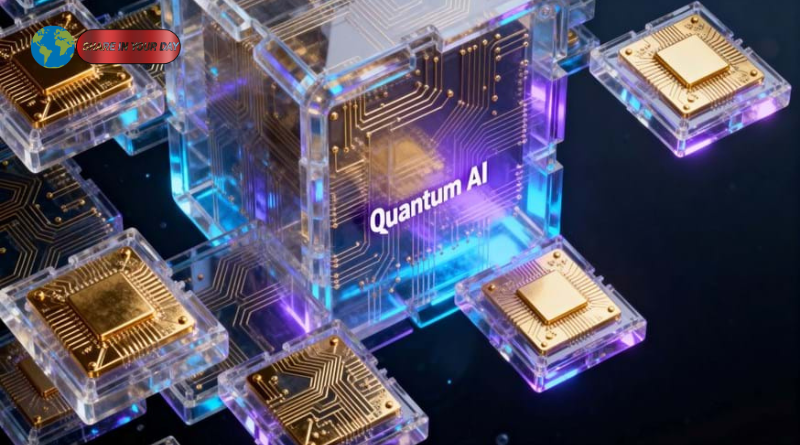
A new European research initiative led by Lancaster University is set to investigate a different approach to combining quantum computing with AI. The three-year project, known as IgnisQNC — Igniting Quantum Neural Computing, is designed to explore whether the uncertainty inherent in quantum systems can become an advantage rather than simply a technical obstacle.
The project is particularly notable because it is not focused only on making AI systems more powerful. Researchers also want them to be more efficient, robust, explainable and trustworthy.
That combination could prove important as governments, companies and researchers increasingly search for AI systems capable of operating in complex environments while providing clearer explanations for their decisions.
What Is Quantum AI?
At its simplest, Quantum AI describes the intersection of quantum computing and artificial intelligence.
Traditional AI systems run on classical computers. These machines process information using conventional bits, represented as zeros and ones. Modern AI models can process enormous amounts of information, but their calculations ultimately depend on classical computing architectures.
Quantum computers use a different physical approach.
Instead of relying solely on conventional bits, quantum computers use qubits, which can exploit quantum-mechanical properties such as superposition and entanglement. These properties create fundamentally different ways of representing and manipulating information.
The goal of Quantum AI is not necessarily to replace today’s AI systems overnight.
Instead, researchers are investigating whether quantum technologies can provide useful advantages for particular AI and machine-learning problems.
That distinction is important. Quantum computers remain an emerging technology, and researchers are still determining which real-world tasks can benefit most from quantum approaches.
The Lancaster-led project is therefore exploring new computational methods rather than claiming that quantum computers are already superior to classical machines for mainstream AI.
Lancaster’s Quantum AI Project Takes a New Approach
Lancaster University researchers are leading IgnisQNC, an international consortium that includes Ludwig Maximilian University of Munich, Aqarios GmbH, TU Bergakademie Freiberg and Pablo de Olavide University in Spain. The project is supported through QuantERA, a transnational funding network backed by the European Commission.
The consortium has a total value of approximately €1.88 million, with about €475,000 allocated to Lancaster University.
The project is expected to begin in September 2026 and will run for three years. At Lancaster, researchers from the university’s Quantum Technology Centre, School of Computing and Communications, and School of Physics and Astronomy will work together.
Dr Richard Jiang, the project’s coordinator and a senior lecturer at Lancaster University, is jointly leading the work with Professor Yuri Pashkin.
Their objective is ambitious: develop Quantum Neural Computing (QNC) as a new computational paradigm that can turn quantum uncertainty into something useful for artificial intelligence.
Quantum AI Could Turn Uncertainty Into an Advantage
One of the most interesting aspects of the project is its treatment of uncertainty.
Quantum systems naturally exhibit probabilistic behavior. For conventional computing, uncertainty and errors are generally problems that engineers attempt to control or eliminate.
But researchers behind IgnisQNC are asking a different question:
What if AI could learn from quantum uncertainty rather than simply trying to suppress it?
That idea could lead to new approaches to machine learning and decision-making.
Instead of treating probabilistic behavior solely as noise, quantum AI systems could potentially incorporate aspects of that uncertainty into their computational processes.
The concept remains a research objective rather than a proven commercial capability. However, it illustrates why the intersection of quantum computing and AI has attracted growing interest from universities, governments and technology companies.
The Lancaster team says the project aims to develop systems that can exploit quantum uncertainty while also improving their transparency and trustworthiness.
1. Quantum AI Could Improve Complex Problem Solving
One potential advantage of Quantum AI is its ability to approach certain computational problems differently from classical AI.
Some problems involve enormous numbers of possible combinations. Optimization, simulation and complex data analysis are examples where researchers are investigating whether quantum methods could eventually offer useful advantages.
However, quantum computing is not a universal replacement for classical computing.
The most realistic future may involve hybrid systems, where classical processors and quantum processors work together.
In that scenario, conventional computers could handle many everyday AI tasks while quantum processors are used for specific calculations where their architecture offers an advantage.
This could eventually create AI systems that distribute workloads between classical and quantum hardware according to the problem being solved.
2. Quantum Neural Computing Could Create New AI Models
The IgnisQNC project is specifically interested in Quantum Neural Computing, a concept intended to combine ideas from quantum technologies, machine learning and neural computation.
The objective is to investigate new forms of AI that are designed around quantum properties instead of simply adapting existing classical algorithms to quantum hardware.
That could prove significant.
Much of today’s AI development involves scaling established approaches with larger datasets, more computing resources and increasingly sophisticated models. Quantum neural computing asks whether the underlying computational architecture itself can be reimagined.
Researchers will explore whether such systems can improve efficiency, robustness and interpretability.
It is still too early to know whether these methods will produce commercially significant performance improvements. Yet establishing new algorithms and theoretical frameworks is an important step toward determining what quantum AI can realistically achieve.
3. Explainable AI Could Become a Core Priority
The Quantum AI project also emphasizes something that is increasingly important in the broader AI industry: explainability.
Many advanced AI systems can generate highly capable results without providing users with an intuitive explanation of how those results were reached.
That creates problems in areas where decisions can have significant consequences.
Healthcare, financial services, security and scientific research are among the fields where users may need to understand why an AI system reached a particular conclusion.
IgnisQNC aims to combine quantum computing with explainable AI techniques so that future quantum-enabled systems are not only capable but also more transparent.
This could become particularly important if quantum AI eventually moves into sensitive applications.
A system that delivers a powerful prediction but cannot explain its reasoning may face serious barriers to adoption.
By contrast, researchers hope that explainability can be built into quantum AI architectures from an early stage.
4. Quantum AI Could Support Healthcare and Intelligent Sensing
The Lancaster-led consortium plans to investigate applications in several areas, including intelligent sensing, biometrics, healthcare technologies and complex data modelling.
Healthcare is particularly interesting because medical systems frequently involve complex datasets.
Researchers could potentially investigate quantum-enhanced approaches to pattern recognition, modelling and decision support.
However, it is important not to confuse research possibilities with established medical applications.
The current project is designed to develop and validate methods. It does not mean quantum AI is already being deployed as a proven medical technology.
Future breakthroughs would still need extensive validation, safety testing, regulatory review and real-world evaluation.
The same principle applies to intelligent sensing and biometric applications.
Quantum technologies may eventually offer new ways to process complicated signals or identify patterns, but practical advantages must be demonstrated experimentally.
5. Quantum AI Could Strengthen Europe’s Technology Position
There is also a broader strategic dimension to the project.
Quantum computing has become an increasingly important area of international technology competition. Countries and research institutions are investing in quantum hardware, software, algorithms, cybersecurity and education.
Europe is seeking to establish strong capabilities across this emerging ecosystem.
IgnisQNC brings together researchers and companies from several European countries, creating a collaborative model that combines academic research with industry participation.
Lancaster University says the initiative could strengthen its position in Europe’s emerging quantum technology landscape while helping develop foundations for trustworthy AI.
The university already operates research programs spanning quantum technologies, computing and physics, making the project a natural example of interdisciplinary research.
Its School of Computing and Communications also has established research activity across AI, data science, systems and related fields.
Quantum AI Still Faces Major Challenges
Despite the excitement surrounding the technology, significant challenges remain.
Quantum computers are difficult to build and operate. Quantum states can be extremely sensitive to environmental disturbances, and maintaining reliable calculations remains a major engineering and scientific challenge.
There is also a question of scale.
An experimental demonstration does not automatically translate into a practical technology capable of outperforming conventional systems in commercial environments.
Researchers therefore need to identify specific problems where quantum approaches provide measurable benefits.
Software is another major challenge.
Quantum hardware requires specialized algorithms, programming methods and expertise. Developing useful quantum AI systems requires people who understand multiple disciplines, including quantum physics, computer science, machine learning and mathematics.
That interdisciplinary expertise is relatively scarce.
Projects such as IgnisQNC could help address that gap by bringing specialists together and creating new research opportunities.
Why Trustworthy Quantum AI Matters
The emphasis on trustworthy AI may ultimately be one of the most important elements of the Lancaster project.
AI systems are increasingly being integrated into decisions that affect individuals, businesses and public institutions. As AI becomes more sophisticated, questions about transparency, reliability and accountability become harder to ignore.
Quantum computing adds another layer of complexity.
Future quantum AI systems could potentially process information in ways that are difficult for conventional users to understand. Building explainability into the technology from the beginning could therefore be more effective than trying to add transparency after deployment.
That is why the IgnisQNC researchers are treating explainability and trust as central parts of the project rather than secondary features.
What Happens Next?
The IgnisQNC project is scheduled to begin in September 2026, marking the start of a three-year research program. Researchers will investigate their methods on emerging quantum computing platforms and examine potential applications across several fields.
The results will help determine whether Quantum Neural Computing can move beyond theory toward practical demonstrations.
There is no guarantee that the project will produce a commercially transformative quantum AI system.
That is normal for frontier research.
The immediate objective is to understand what is possible, establish useful methods and determine where quantum approaches can provide genuine value.
If successful, however, the research could contribute to a broader shift in how scientists think about AI.
Instead of simply building larger classical models, future researchers may increasingly explore new computational architectures designed around the physical properties of quantum systems.
The Bigger Picture for Quantum AI
The development of Quantum AI is still at an early stage, but the field is becoming more structured.
The Lancaster-led IgnisQNC initiative illustrates this transition. Rather than presenting quantum computing as a futuristic replacement for conventional computers, researchers are exploring specific ways quantum principles could complement artificial intelligence.
The focus on quantum uncertainty is particularly intriguing.
If researchers can demonstrate that uncertainty can be incorporated into learning and decision-making in useful ways, it could open a different path for AI development.
At the same time, the project’s emphasis on explainability suggests that future AI breakthroughs may be judged by more than raw computational performance.
The most valuable systems may be those that combine capability with reliability, transparency and responsible deployment.
For now, Quantum AI remains a developing research frontier. But with major European collaborations beginning new projects in 2026, the technology is moving another step closer to determining whether its theoretical promise can become a practical reality.
The coming years will reveal whether quantum computing can deliver meaningful advantages for artificial intelligence—or whether the most effective future will be a carefully engineered partnership between quantum and classical machines.
Either way, the research underway today could help define what the next generation of intelligent computing looks like.
Source & Further Reading
The article is based primarily on the reported Lancaster University research initiative and supporting institutional information. Lancaster University says IgnisQNC will investigate Quantum Neural Computing, explainable AI and applications including intelligent sensing, biometrics, healthcare and complex data modelling.