China Keeps Benchmark Lending Rates Steady Amid Weak Economic Data and Property Slump
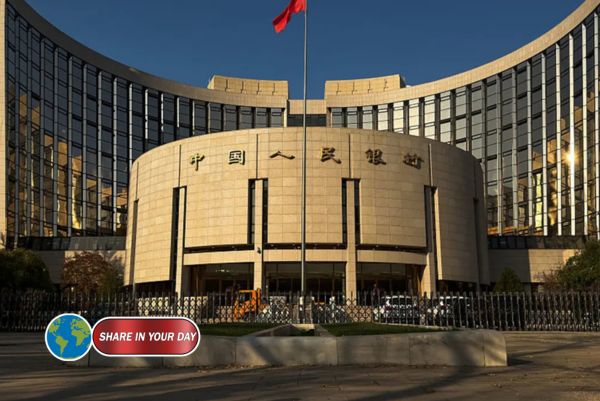
In a move that reflects the country’s cautious approach to monetary policy, China’s central bank has opted to keep its benchmark loan prime rates unchanged for the seventh consecutive month. Despite mounting signs of economic sluggishness, particularly in the property sector, the People’s Bank of China (PBOC) held the 1-year and 5-year loan prime rates steady at 3% and 3.5%, respectively.
This decision comes amid disappointing economic data for November, which saw retail sales and industrial production miss expectations. The 1-year rate, which acts as a benchmark for new loans, and the 5-year rate, which influences mortgage costs, remain unchanged, signaling the PBOC’s commitment to maintaining a cautious but stable approach in these uncertain times.
Weak Economic Data Fuels Concerns
China’s economy continues to face headwinds, as recent data reveals a slowdown in key sectors. Retail sales, a vital indicator of domestic consumption, grew by just 1.3% in November compared to the same period a year ago. This marked a significant underperformance, falling short of the expected 2.8% growth and slowing from a 2.9% rise in October.
Industrial production also showed signs of weakness, with a 4.8% year-on-year increase in November, falling below expectations of 5%. This marked the slowest growth in industrial output since August 2024. Economists have expressed concern over the sustained sluggishness in the Chinese economy, particularly in the wake of ongoing struggles in the real estate sector.
China’s property market has been in a prolonged slump, with new home prices in major cities, including Beijing, Guangzhou, and Shenzhen, continuing to fall. In November, prices of newly built homes dropped by 1.2% in these first-tier cities, while resale home prices plummeted by 5.8% from the previous year. Investment in fixed assets, which includes real estate, contracted by 2.6% during the first 11 months of the year, exceeding economists’ expectations for a 2.3% decline.
Monetary Policy and Stimulus Prospects
Despite the economic challenges, the PBOC’s decision to keep interest rates steady reflects its cautious stance. Some experts, however, argue that the Chinese government may need to take more decisive steps to spur economic growth.
Eswar Prasad, a professor of trade policy and economics at Cornell University, spoke to CNBC about the need for additional stimulus, noting that monetary policy alone may not provide sufficient traction in boosting the private sector. “Some stimulus will help,” Prasad said, “but at a time when there’s weakness in the private sector, monetary policy probably won’t get that much traction.”
Prasad recommended combining monetary stimulus with fiscal reforms and broader policy changes to create a more effective growth strategy. Earlier this month, China’s finance ministry announced plans to issue ultra-long-term special government bonds in 2025 to finance critical infrastructure projects, a move aimed at injecting liquidity into the economy and stimulating growth.
Property Sector Challenges and Deflationary Pressures
The persistent slump in China’s property sector is another concern weighing on the economy. With fixed asset investment declining, policymakers are exploring ways to combat the deflationary pressures that have taken hold of the nation’s economy. As a result, China has committed to implementing “special actions” aimed at boosting consumption and stabilizing the economy.
The government is also working to address the long-standing issues in the housing market. In addition to efforts to stimulate demand for new homes, the Chinese government is taking steps to ease the regulatory burden on developers to encourage investment in real estate. However, these measures may take time to show significant results.
Global Economic Outlook and Trade Relations
On the global stage, China’s economy is still grappling with the effects of trade tensions, particularly with the United States. While recent trade negotiations have led to the suspension of some tariffs on Chinese exports, experts remain cautious about the long-term impact on China’s growth. The prospect of increased exports to the U.S. could help China meet its economic growth target of around 5% in 2025, but global trade dynamics remain uncertain.
Despite these challenges, Chinese financial markets showed some resilience on Monday, with the CSI 300 index climbing by 0.43%. Meanwhile, the onshore yuan remained stable at 7.04 against the U.S. dollar, although the offshore yuan weakened slightly to 7.03.
Looking Ahead: Will China Pivot to Fiscal Stimulus?
As 2025 approaches, China’s policymakers face a delicate balancing act: managing the ongoing property crisis while also ensuring that the broader economy stays on track. While the decision to maintain the loan prime rates may offer some stability, experts agree that more targeted fiscal and monetary interventions will be necessary to stimulate growth and address the country’s economic challenges.
The Chinese government’s next steps will be crucial in determining the trajectory of its recovery, particularly in a global environment where economic uncertainties are mounting. With trade relations, domestic consumption, and the property sector all hanging in the balance, the coming months will be pivotal in shaping China’s economic future.