Iran President Apologizes for Protest Crackdown as Nation Marks 1979 Revolution Anniversary
DUBAI — Iran marked the 47th anniversary of its 1979 Islamic Revolution on Wednesday under mounting domestic and international pressure, as President Masoud Pezeshkian issued a rare public apology over the government’s deadly crackdown on nationwide protests while tensions with the United States intensified over Tehran’s nuclear program.
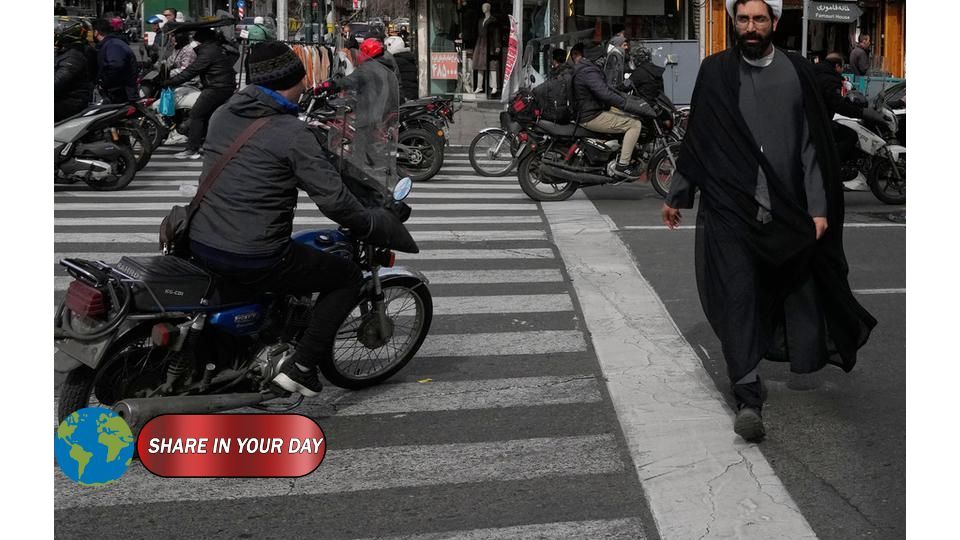
State-organized rallies filled streets across major cities, with supporters of the Islamic Republic waving Iranian and Palestinian flags and holding portraits of Supreme Leader Ayatollah Ali Khamenei and the late Ayatollah Ruhollah Khomeini, the revolution’s architect. Chants of “Death to America” and “Death to Israel” echoed in parts of the capital.
Yet the anniversary unfolded against a backdrop of deep internal unrest and escalating geopolitical strain.
A Rare Apology Amid Lingering Anger
Speaking at a ceremony marking the revolution’s anniversary, Pezeshkian addressed the months of turmoil that followed nationwide protests and the subsequent security crackdown that left thousands dead and tens of thousands detained.
The president expressed regret toward those affected, acknowledging the “great sorrow” felt across the country, though he stopped short of directly assigning responsibility to Iranian security forces.
“We are ashamed before the people, and we are obligated to assist all those who were harmed in these incidents,” Pezeshkian said. “We are not seeking confrontation with the people.”
His remarks represent one of the most conciliatory public statements from Iran’s leadership since the unrest erupted. However, the apology was coupled with criticism of what he described as “Western propaganda” surrounding the protests.
The dual messaging reflects the delicate position of Iran’s leadership: attempting to temper public anger without conceding broader institutional fault.
Despite official celebrations, signs of dissent were visible. On Tuesday night, as government-sponsored fireworks illuminated Tehran’s skyline, witnesses reported hearing shouts of “Death to the dictator!” from residential neighborhoods — a slogan widely associated with anti-government demonstrations.
Nuclear Talks Under a Cloud of Distrust
Beyond domestic tensions, Iran faces renewed pressure abroad, particularly from Washington.
Tehran is currently engaged in negotiations with the United States over its nuclear program, though the prospects of a breakthrough remain uncertain. Complicating matters, the International Atomic Energy Agency has reported difficulties in inspecting and verifying aspects of Iran’s nuclear stockpile in recent months.
Pezeshkian reiterated that Iran is “not seeking nuclear weapons” and declared the country ready for “any kind of verification.” Still, trust between the two nations remains fragile.
Iranian Foreign Minister Abbas Araghchi underscored that skepticism in an interview with Russian state media, pointing to last year’s escalation when negotiations were underway before military confrontation erupted.
“We do not have full trust for the Americans,” Araghchi said. “Last time we were in the middle of negotiation, and they decided to attack us. That was a very bad experience for us. We need to make sure that scenario is not repeated.”
Despite those reservations, Araghchi suggested that a new agreement could potentially surpass the 2015 nuclear deal negotiated under former U.S. President Barack Obama — an accord later abandoned by Donald Trump during his first term in office.
Trump Raises Stakes in the Gulf
As diplomacy continues, military signaling has intensified.
President Donald Trump has indicated he may deploy a second aircraft carrier strike group to the Middle East, reinforcing an already significant U.S. naval presence in the region. The USS Abraham Lincoln, accompanied by additional ships and aircraft, has been positioned in regional waters in what U.S. officials describe as a deterrent posture.
In a recent interview, Trump said, “We have an armada that is heading there and another one might be going,” raising the possibility of expanded U.S. firepower near Iran.
American forces recently reported shooting down a drone that approached too closely to the Lincoln and intervening when Iranian forces attempted to stop a U.S.-flagged commercial vessel in the Strait of Hormuz — a strategic chokepoint through which a significant share of global oil shipments passes.
The potential arrival of another carrier group would further heighten tensions in a region already strained by previous confrontations, including a brief but intense Iran-Israel conflict earlier this year.
Regional Diplomacy in Motion
Amid the uncertainty, regional mediation efforts continue.
Senior Iranian security official Ali Larijani traveled from Oman to Qatar on Wednesday. Oman has played a key role in facilitating backchannel communications between Washington and Tehran, while Qatar — home to a major U.S. military base — has historically acted as a diplomatic intermediary.
Qatar’s strategic importance is amplified by its shared offshore natural gas field with Iran, one of the largest in the world.
The diplomatic shuttle underscores the fragile balance at play: a blend of confrontation and negotiation unfolding simultaneously.
A Divided Nation
Iran’s 85 million citizens remain deeply divided. Hardline supporters of the Islamic Republic, including members of the Revolutionary Guard, turned out in large numbers for anniversary rallies. For many, participation is ideological; for others, attendance reflects employment ties to state institutions or the appeal of a government-sponsored public holiday.
At the same time, the scale and intensity of recent protests revealed significant dissatisfaction, particularly among younger Iranians.
The anniversary thus served as both a demonstration of resilience for the ruling establishment and a reminder of unresolved grievances.
A Pivotal Moment
Nearly five decades after the revolution reshaped Iran’s political landscape, the Islamic Republic faces a complex convergence of challenges: public anger over domestic repression, economic strain, nuclear scrutiny and mounting military pressure from abroad.
Pezeshkian’s apology may signal an attempt to ease internal tensions. But whether symbolic contrition can translate into substantive reform remains unclear.
Meanwhile, nuclear negotiations proceed under the shadow of warships in the Gulf — a reminder that diplomacy and deterrence are unfolding in parallel.
For Iran’s leadership, the anniversary was not merely a commemoration of past upheaval. It marked a test of whether the system born in 1979 can navigate one of its most precarious moments yet.