Asian Economies Confront Fresh Uncertainty as Trump Unveils New 10% Tariff After Supreme Court Setback
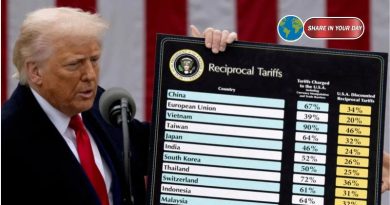
HONG KONG/TAIPEI — Asian governments and businesses scrambled to assess the fallout on Saturday after U.S. President Donald Trump pledged to impose a sweeping new 10% tariff on imports from all countries, only hours after the Supreme Court of the United States struck down a key pillar of his earlier trade measures.
The court’s ruling invalidated a series of tariffs introduced under the International Emergency Economic Powers Act (IEEPA), a law traditionally reserved for national emergencies. The decision undercut a significant portion of the levies that had targeted Asian export heavyweights, including China, South Korea, Japan and Taiwan.
But any relief proved short-lived.
Within hours of the ruling, Trump announced he would invoke a different legal authority to impose a new 10% universal duty on U.S. imports starting Tuesday, initially for 150 days. The move signaled that the administration’s broader trade agenda remains intact, even as legal challenges chip away at its foundations.
Relief Tempered by Renewed Volatility
According to estimates by Global Trade Alert, the Supreme Court’s decision alone would reduce the U.S. trade-weighted average tariff rate from 15.4% to 8.3% — nearly halving the burden. For countries facing the steepest penalties, including China, Brazil and India, the reductions would amount to double-digit percentage-point cuts.
Yet analysts warned that the announcement of a fresh across-the-board levy risks reigniting uncertainty just as markets began recalibrating.
“Businesses may have hoped for clarity after the court ruling, but the rapid policy pivot introduces another layer of unpredictability,” said one regional trade economist in Hong Kong. “Companies must now factor in both legal risk and executive flexibility.”
Across Asia-Pacific boardrooms, firms have already reported financial hits, supply-chain reconfigurations and strategic withdrawals as tariffs escalated through 2025 and early 2026. The latest twist could prolong that instability.
Tokyo, Taipei Monitor Developments
In Tokyo, government officials struck a cautious tone. A Japanese government spokesperson said authorities would “carefully examine” both the court’s ruling and Washington’s subsequent response before determining next steps.
Japan’s export-driven economy remains deeply integrated with U.S.-bound supply chains, particularly in automotive and semiconductor equipment sectors. While the invalidation of IEEPA-based tariffs offers potential relief, a universal 10% duty would blunt those gains.
Taiwan’s cabinet issued a similarly measured statement, noting that Washington has yet to clarify how it will implement trade arrangements already negotiated with allies.
Taipei has recently concluded two agreements with the United States, including a memorandum of understanding committing Taiwan to invest $250 billion and another accord aimed at lowering reciprocal tariffs. Officials said the “initial impact” of the court decision appears limited but pledged close communication with Washington to clarify implementation details.
For Taiwan — home to the world’s most critical semiconductor manufacturing capacity — stability in U.S. trade policy carries global implications for technology supply chains.
Hong Kong Sees Strategic Opening
In contrast, officials in Hong Kong framed the developments as highlighting the city’s distinct trading position.
Christopher Hui, Hong Kong’s secretary for financial services and the treasury, described the U.S. situation as a “fiasco” during a Saturday briefing, arguing that the volatility underscored Hong Kong’s “unique trade advantages.”
Hong Kong operates as a separate customs territory from mainland China, a status that has historically insulated locally produced goods from the full weight of tariffs imposed on Chinese exports. While geopolitical tensions have tightened scrutiny, the city’s differentiated status has allowed certain trade flows to continue even as U.S.–China frictions intensified.
“This shows the stability of Hong Kong’s policies and our certainty,” Hui said, emphasizing predictability as a selling point for global investors navigating turbulent trade conditions.
Broader Political and Legal Stakes
The Supreme Court ruling targeted tariffs enacted under IEEPA, signaling judicial limits on the executive branch’s ability to invoke emergency powers for long-term trade policy.
However, Trump’s swift move to announce a new tariff under alternate legal authority suggests that the administration is prepared to pursue its trade objectives through other statutory avenues.
The broader concern among Asian policymakers is not merely the level of tariffs, but the unpredictability surrounding them.
In Thailand, the head of the Trade Policy and Strategy Office suggested the renewed uncertainty could trigger another wave of “front loading,” a practice in which exporters rush shipments to the United States ahead of anticipated tariff hikes. Such surges can temporarily boost exports but distort supply chains and inventory cycles.
For multinational corporations, repeated cycles of escalation and legal reversal complicate capital allocation decisions. Investment strategies in Asia’s export hubs — from Japanese industrial conglomerates to Taiwanese chipmakers — depend on assumptions about long-term access to the U.S. market.
A Region Watching Washington
The unfolding episode highlights the central role of U.S. legal and executive decisions in shaping Asia’s economic outlook. For governments already navigating slowing global demand and geopolitical tensions, the latest developments reinforce a sense that trade policy remains fluid.
While the Supreme Court’s intervention curtails one mechanism for imposing tariffs, Trump’s counter-move signals that the broader trade war framework remains far from resolved.
For Asia’s export-reliant economies, the message is clear: the rules governing access to the world’s largest consumer market can shift overnight — and strategic planning must adapt just as quickly.