Bad Bunny’s Stunning Redefinition of “America”
An estimated 135 million viewers across the United States tuned in Sunday night to watch Benito Antonio Martínez Ocasio — better known as Bad Bunny — headline the Super Bowl halftime show. Millions more streamed it worldwide in the hours that followed. What unfolded over 13 minutes was more than a pop spectacle. It was a carefully staged meditation on labor, migration, culture and belonging — and, for many viewers, a direct rebuttal to the narrow nationalism that has shaped American politics in recent years.
Within seconds, it was clear this would not be a conventional halftime show built solely on pyrotechnics and chart-topping hooks. Bad Bunny opened amid a sugar plantation tableau, performers cutting cane beneath a stark industrial skyline. The imagery was unmistakable: labor as origin story.
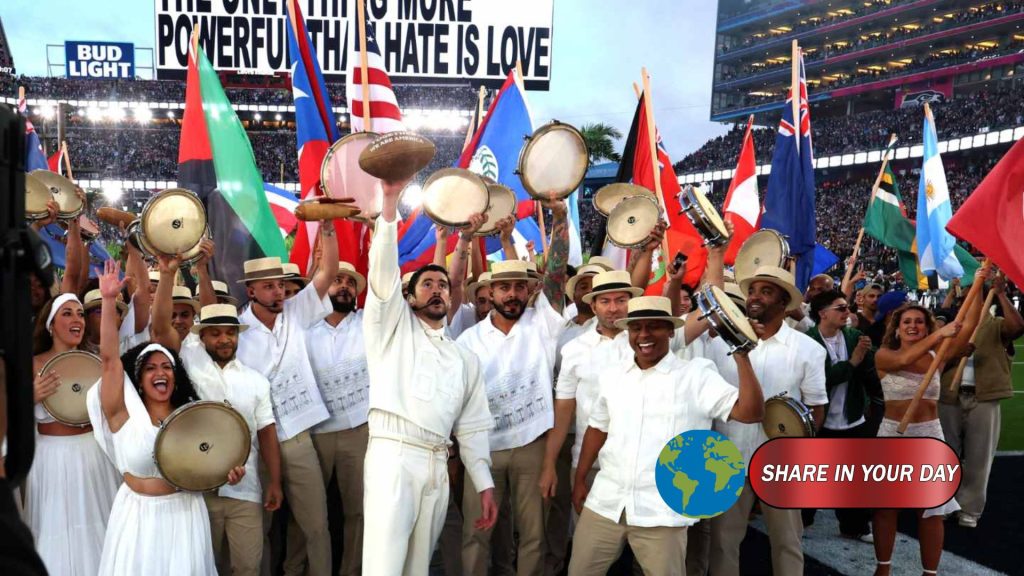
Sugar production, particularly in the Caribbean, has long generated enormous wealth for European and American markets while leaving producing regions grappling with economic dependency and inequality. By foregrounding that history — and situating it visually within his Puerto Rican heritage — Bad Bunny reframed the American story as one inseparable from colonial labor and migration.
The set design did not abandon that theme as the music accelerated. Cane fields gave way to tightly packed urban blocks, Puerto Rican casitas, Bronx bodegas and rows of plastic patio chairs familiar across Latino neighborhoods. The performance moved fluidly between rural and urban landscapes, between island and mainland, suggesting that these worlds are not separate chapters but part of the same American narrative.
The scale of the production — monumental yet intimate — felt less like a pop concert than a living mural. Some viewers compared it to a Works Progress Administration fresco brought to life, history pulsing to the rhythm of reggaeton.
Language as Defiance
Bad Bunny performed largely in Spanish, anchored in the percussive cadences of reggaeton. On a stage that has historically favored English-language pop dominance, the choice was unmistakable.
Spanish was not translated, softened or diluted. It simply existed — confident, global and unapologetic.
For supporters, that linguistic choice alone signaled a cultural shift. America, the performance suggested, is not monolingual. Nor is it culturally singular. The halftime stage, watched by more Americans than any other annual broadcast event, became a platform for an internationalist vision of identity.
Yet much of the political messaging was embedded rather than declared. The pageantry allowed symbolism to breathe without explicit slogans.
Subtle Signals in a Divided Era
Midway through the show, a couple exchanged vows in a brief onstage wedding. Online speculation quickly followed: was the bride pregnant? Some interpreted the scene as a symbolic challenge to political efforts aimed at restricting birthright citizenship. The imagery — a new family forming at midfield, under the gaze of millions — invited viewers to consider who belongs and who defines American lineage.
Later, Bad Bunny handed a recently won Grammy to a young boy standing at the edge of the stage. Social media buzzed with speculation about whether the child represented migrant youth caught in immigration enforcement actions. While the child was not connected to any widely reported immigration case, the symbolism resonated regardless. The gesture evoked inheritance, opportunity and continuity — a passing of recognition to the next generation.
The show’s politics were not delivered as partisan slogans. Instead, they unfolded through narrative imagery: work, migration, celebration, resilience. It was a vision of America rooted not in exclusion, but in contribution.
Beyond Culture Wars
In recent years, the Super Bowl halftime show has frequently been drawn into broader cultural conflicts. Performances by artists such as Beyoncé, Jennifer Lopez and Rihanna have sparked political backlash, FCC complaints and debate about sexuality, race and patriotism.
Bad Bunny’s show entered that same contested arena. Critics argued that his music — known for explicit lyrics in recorded form — has often pushed boundaries. But Sunday’s performance leaned more heavily on symbolism and choreography than on provocation. The cultural statement was expansive rather than confrontational.
Where Trump-era rhetoric has often framed America through border enforcement and linguistic conformity, Bad Bunny’s stagecraft offered a different lens: one centered on workers, migrants, musicians and families who move between worlds without surrendering identity.
The sugar cane never disappeared from the set. Even as dancers filled the stage and guest performers joined the spectacle, the harvest remained in the background — a reminder that prosperity is built on labor, often invisible.
An Internationalist America
Bad Bunny is one of the world’s most streamed artists, commanding audiences far beyond the United States. By positioning Puerto Rican history and diasporic culture at the heart of America’s biggest sporting event, he underscored a simple but powerful argument: American identity is global, layered and in constant evolution.
The halftime show did not declare war in the traditional political sense. There were no campaign slogans, no direct references to elected officials. Instead, it staged a cultural counterargument — that patriotism can be multilingual, worker-centered and celebratory rather than exclusionary.
For some viewers, it was entertainment. For others, it was a reclamation of narrative.
What remains clear is that for 13 minutes on the 50-yard line, America looked different: less bounded, more polyphonic, and unafraid of its Caribbean, Latino and immigrant threads. In an era when definitions of belonging are fiercely debated, Bad Bunny offered his own — not in speech, but in rhythm, memory and spectacle.
And judging by the global audience that watched, that definition reached far beyond the stadium lights.