Lonely Baby Monkey Goes Viral — And His IKEA Comfort Toy Sells Out
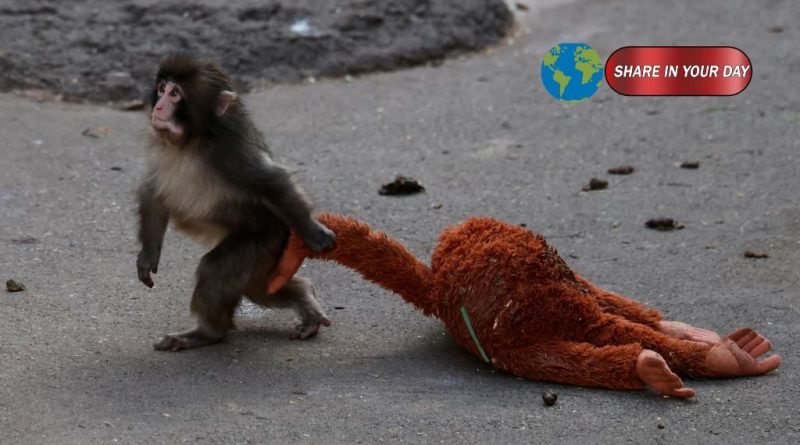
An orphaned baby monkey in Japan has captured global attention — not for a daring escape or playful antics, but for the quiet image of him clutching a stuffed orangutan as he struggles to fit in.
Punch, a seven-month-old Japanese macaque, was abandoned shortly after birth and raised by staff at Ichikawa City Zoo, just outside Tokyo. Without a mother to cling to, the young primate was given a soft toy as a substitute — an orangutan plush from IKEA.
Now that toy has become both his emotional anchor and an unlikely international bestseller.
A Viral Symbol of Loneliness
Footage shared by the zoo shows Punch dragging the plush companion across the enclosure, curling into it when distressed, and returning to it after awkward encounters with other macaques. In some clips, he approaches older monkeys only to be rebuffed or scolded. In others, he appears momentarily isolated before retreating to his toy.
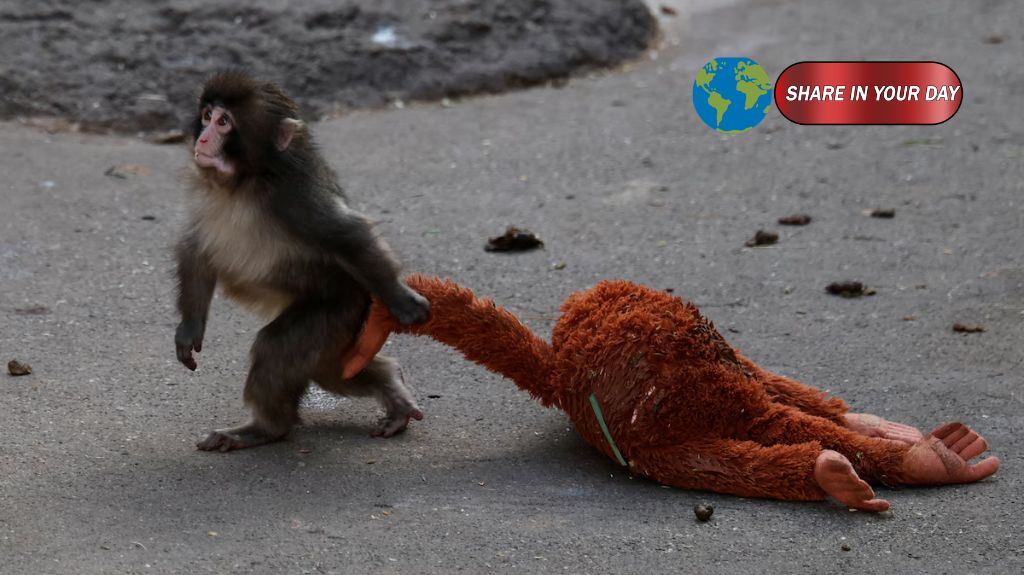
The videos have racked up millions of views across social media platforms, drawing an outpouring of sympathy from viewers around the world.
Zoo officials say Punch was moved last month into the macaque enclosure known as “Monkey Mountain,” where he is gradually learning to socialize with his own species. Integration has not been seamless.
In a statement posted online, the zoo acknowledged that clips showing Punch being dragged or scolded by other monkeys were genuine, describing the behavior as part of the natural process of social learning among macaques.
“Punch has been scolded by other monkeys many times in the past and has learned how to socialize with them,” the statement said, adding that the young monkey continues to show resilience.
Comfort in a Stuffed Orangutan
The toy — IKEA’s DJUNGELSKOG orangutan — has become inseparable from Punch. When overwhelmed, he runs back to the plush surrogate, hugging it tightly before gathering the courage to rejoin the group.
Zookeepers have also observed Punch clinging to their legs when they enter the enclosure, another sign of his search for reassurance in the absence of maternal care.
As images of the young macaque cuddling the toy spread online, the effect was immediate. IKEA reported a surge in demand for the orangutan plush in Japan, the United States and South Korea. In several markets, the toy quickly sold out.
Javier Quiñones of IKEA’s Ingka Group said the company was working to replenish stock as quickly as possible, noting that the toy had long been popular but was now receiving “a little extra love.”
The retailer has leaned into the moment, promoting the plush in advertisements as “Punch’s comfort orangutan.”
Meanwhile, the small zoo has experienced an unexpected influx of visitors. Long lines have formed at the entrance, prompting staff to urge guests to use public transportation during the busy holiday weekend.
A Reminder of a Landmark Experiment
For scientists observing from afar, Punch’s attachment to a soft surrogate echoes a landmark psychological study that reshaped understanding of emotional development.
In the mid-20th century, American psychologist Harry Harlow conducted controversial experiments with infant rhesus monkeys. Separated from their mothers, the monkeys were given two substitutes: a wire “mother” that provided milk and a soft cloth “mother” that offered no food but physical comfort.
The infants overwhelmingly preferred the cloth figure, clinging to it for security and only visiting the wire structure to feed. The findings demonstrated that emotional warmth and tactile comfort were as essential to development as nourishment — a conclusion that challenged prevailing child-rearing theories at the time.
Joan Silk, an evolutionary anthropologist at Arizona State University, said Punch’s behavior reflects those same fundamental needs.
Without a mother to model social behavior, Silk explained, young primates face steep challenges integrating into complex social hierarchies. Among baboons and macaques alike, social bonds influence stress levels, survival and overall health.
“The reasons social bonds matter aren’t that different for humans,” Silk has noted. “They help us cope with stress and uncertainty.”
Learning to Be a Monkey
Despite the emotional images circulating online, experts caution against projecting too much human interpretation onto Punch’s experience.
While some social media users have called for the monkey to be “rescued” or adopted, researchers stress that long-term wellbeing depends on successful integration into his troop.
“He’s got to live a monkey life,” Silk has said, emphasizing that the social friction seen in viral videos is often part of normal development.
At Ichikawa City Zoo, staff say Punch continues to make progress. After moments of rejection, he regains composure with the help of his plush companion before re-engaging with the group. Gradually, he appears to be building tolerance and learning the signals that govern macaque society.
The process may be slow, but it is not without hope.
Fame, Fragility and Resilience
Punch’s story has resonated far beyond Japan because it captures something instantly recognizable: the vulnerability of a young creature navigating the world without the comfort of a parent.
In the digital age, that vulnerability has also made him an accidental influencer — boosting toy sales, swelling zoo attendance and reigniting conversations about emotional development in primates.
Yet for all the attention, Punch’s journey remains fundamentally simple. Each day, he ventures out into the enclosure, tests the boundaries of his social group, retreats when necessary, and tries again.
Clutching a soft orange surrogate, the young macaque is learning — in full public view — how to belong.