Walking Grass Steals the Spotlight at Bad Bunny’s Super Bowl Halftime Show
Bad Bunny may have been the headline act, but it was the walking grass—hundreds of performers dressed as moving shrubs—that quietly stole the spotlight during Sunday’s Super Bowl halftime show.
As millions of viewers tuned in expecting a star-driven spectacle, they were instead greeted with an unexpected visual: waves of human “grass” flooding the field, transforming a football stadium into a living Puerto Rican village in a matter of minutes.
The 13-minute performance blended music, movement and symbolism, with more than 350 performers sprinting onto the field at the end of a largely uneventful first half. Once in place, they formed an undulating landscape of sugarcane fields, palm trees and rural pathways, framing Bad Bunny’s set with constant motion and texture.
A living, moving stage
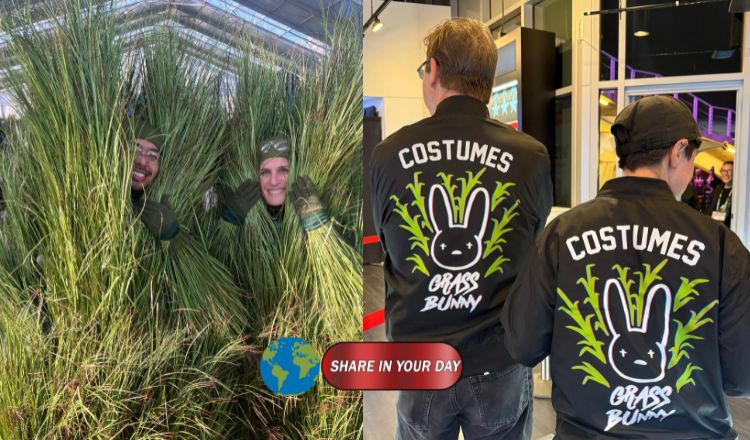
The performers—clad in grass-like costumes weighing up to 40 pounds—were carefully choreographed to move between blocks of artificial sugarcane and tropical foliage. From above, the field appeared alive, rippling and shifting as the music pulsed.
The effect was immersive. For a moment, the Super Bowl no longer felt like it was taking place in Santa Clara, California, but somewhere much closer to the sugarcane fields of Puerto Rico.
At the heart of the performance was a tribute to the cultural and historical importance of sugarcane on the island. Farmers, food carts and a buzzing casita brought the setting together, grounding the spectacle in everyday imagery familiar to many Puerto Ricans.
The casita itself became a focal point, featuring surprise appearances from actor Pedro Pascal and other stars, who joined the celebration by dancing along with the performers.
Carefully selected — and heavily disguised
Behind the scenes, the walking grass performers were the result of a meticulous casting process. A cryptic job posting called for field performers between 5-foot-10 and 6-foot-1, athletic enough to move quickly and capable of wearing costumes weighing up to 40 pounds.
Once suited up, they became indistinguishable as individuals, blending into a single moving organism that carried much of the show’s visual weight. Before showtime, crew members were seen adjusting and “preening” the grass stalks, adding to the surreal nature of the production.
The result was a halftime show that relied less on pyrotechnics and more on atmosphere, texture and cultural storytelling.
A moment that resonated
While Bad Bunny delivered the music that anchored the performance, the moving landscape surrounding him amplified its emotional impact. The choreography created a sense of place rarely achieved on the Super Bowl stage, where scale often overshadows subtlety.
For some viewers, the grass became an unexpected source of humor as well as admiration. Clips of the performers waddling into position and swaying in unison quickly spread across social media, earning affectionate nicknames and fan-made hashtags.
One behind-the-scenes video circulating online captured the lighter side of the production, showing the grass-clad performers preparing for the show—a moment that contrasted sharply with the precision required once the cameras were rolling.
More than a visual gimmick
The walking grass was more than a novelty. It served as a visual metaphor for roots, labor and resilience—core themes woven throughout Bad Bunny’s music and public persona. By centering the performance around agricultural imagery, the show paid homage to Puerto Rico’s past while presenting it on one of the world’s largest stages.
In a halftime show often dominated by spectacle for spectacle’s sake, the decision to let “grass” take center stage felt deliberate and grounded.
Bad Bunny may have been the star attraction, but when the final notes faded, it was the image of hundreds of moving blades of grass—quietly reshaping the field—that lingered longest.