Plasma Turbulence Is Revealing New Secrets Inside Fusion Reactors
Fusion energy research has long focused on confining superheated plasma long enough to extract power. But recent experiments are showing that turbulence — the chaotic swirling and fluctuation of particles in that plasma — does more than scientists once thought. Rather than simply degrading performance, turbulence appears to play two distinct roles during heat transport inside magnetic confinement devices. Phys.org
Seeing Turbulence in a New Light
Traditionally, turbulence in fusion plasmas was seen as a nuisance: unpredictable motions that whisk heat and particles from the core to the edge, undermining confinement and efficiency. This view is rooted in decades of theoretical and simulation work showing that turbulent eddies carry energy outward, limiting how long plasma stays hot enough for fusion reactions. PSFC
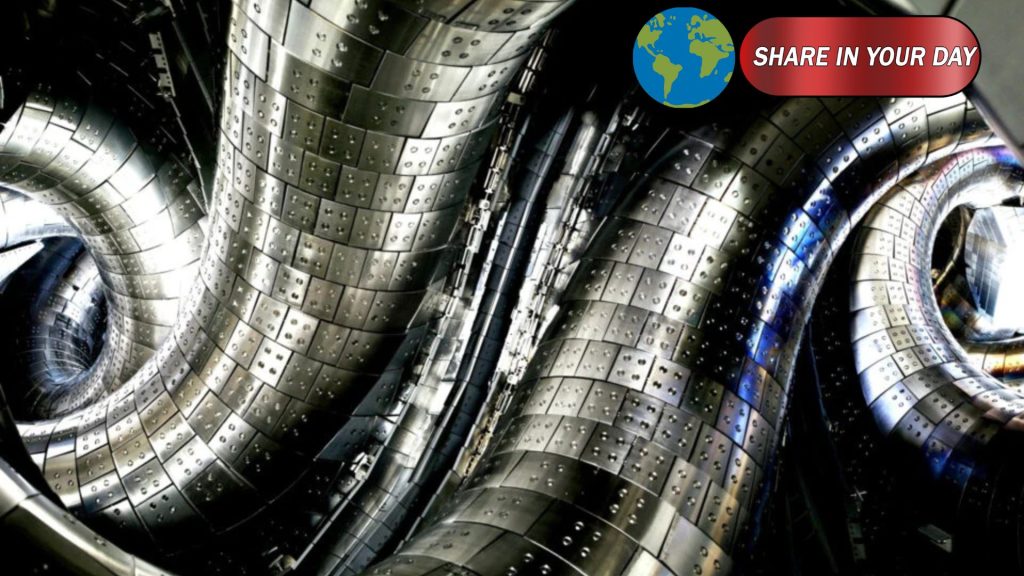
However, a new set of observations from Japan’s Large Helical Device (LHD) — one of the world’s largest stellarator plasma experiments — is challenging that simple picture. Using precision heating and very high time‑resolution diagnostics, researchers have captured turbulence dynamics with unprecedented detail, uncovering two simultaneous behaviors that reshape how we understand heat flow in fusion plasmas. Phys.org
Dual Roles: Mediator and Carrier
The LHD team found that turbulence in the plasma acts in a co‑existing “mediator” and “carrier” mode:
- Mediator turbulence emerges almost instantly after a brief heating pulse. In less than one ten‑thousandth of a second, this turbulence links distant regions of the plasma, enabling rapid, long‑range responses to local changes. It’s as if different zones of the plasma “communicate” almost instantaneously, breaking from the slow cascade model traditionally used in turbulence theory. Phys.org
- Carrier turbulence then takes over to transport heat outward more steadily, shaping the broader temperature profile over longer times and distances. Phys.org
This two‑in‑one behavior helps explain why heat sometimes spreads through the plasma far faster than standard theory predicts. It also gives scientists a new handle on tailoring plasma conditions for better performance. Phys.org
Why This Matters for Fusion Energy
Understanding and controlling turbulence is central to practical fusion power. In magnetic confinement devices like tokamaks and stellarators, heat retention and plasma stability are essential for reaching and maintaining the extreme conditions required for net energy gain. Improved insight into turbulence dynamics has several potential implications:
- Better predictive models: Current fusion design codes can struggle to match experimental outcomes, especially in how heat and particles redistribute in the plasma. Observations of mediator‑type turbulence offer new benchmarks for validating and refining these models. Phys.org
- Targeted control strategies: If the mediator component of turbulence can be understood and controlled — strengthened when needed, damped when harmful — engineers may enhance confinement and reduce energy losses. Phys.org
- Cross‑disciplinary insights: The dual‑role characteristics observed in turbulent plasmas resemble other complex systems — from ocean currents to atmospheric weather patterns — suggesting broader relevance beyond fusion research
The Road Ahead
Physics still has much to unravel about how turbulence behaves across scales and operating regimes in fusion devices. Work by global teams using supercomputers and machine learning tools is already pushing forward our ability to simulate and interpret turbulent dynamics in greater detail. Nuclear Power Daily+1
As experimental and computational fusion science advances, insights like dual‑role turbulence could be pivotal to designing next‑generation reactors that are more efficient, stable, and closer to delivering on the promise of clean, abundant energy.
If you want, I can also add internal links, featured image suggestions, or schema markup to this article for WordPress SEO enhancement