
Cambodia Joins US Board of Peace, Signalling Strategic Gains and New Diplomatic Opportunities
WASHINGTON, DC — Cambodia has taken a high-profile step onto the global diplomatic stage as Prime Minister Hun Manet attended the inaugural meeting of the Board of Peace (BoP) in Washington, signalling what analysts describe as both a principled commitment to peacebuilding and a calculated effort to strengthen the Kingdom’s strategic leverage.
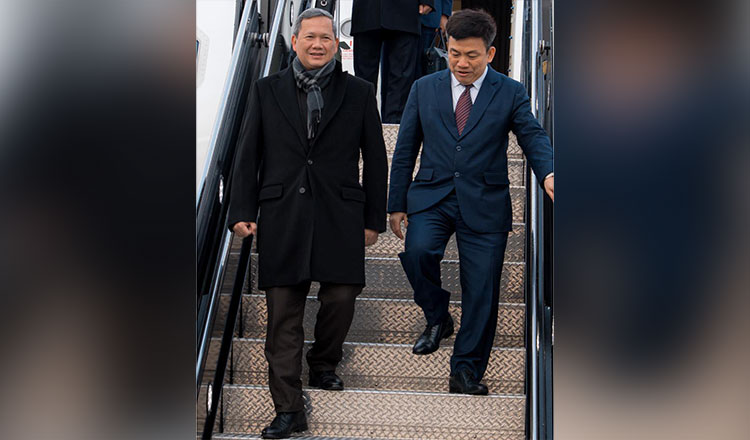
Hun Manet arrived in the US capital accompanied by a senior delegation to participate in the first formal gathering of the board, where he is scheduled to meet US President Donald Trump and other world leaders. The meeting marks the official launch of the BoP’s mandate, initially focused on Gaza reconstruction, peacebuilding and broader discussions on regional and global stability.
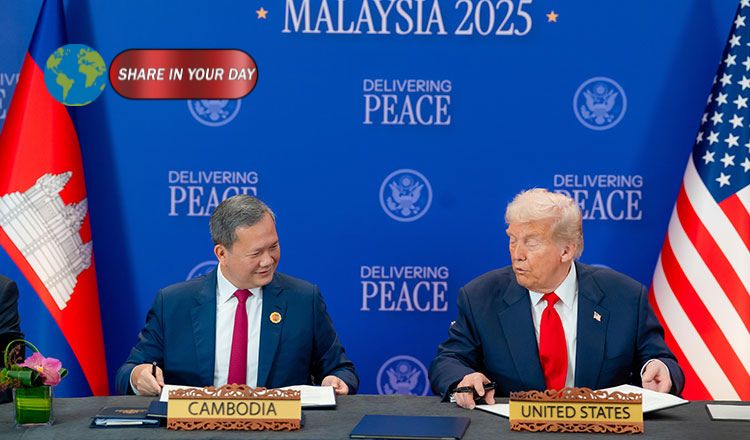
The session is being held at the recently renamed Donald J Trump Peace Institute — formerly known as the United States Institute of Peace — and is expected to bring together delegations from more than 20 countries.
Reinforcing Cambodia’s Peace Identity
Political observers in Phnom Penh say Cambodia’s participation reflects a deliberate attempt to institutionalise its image as a peace-oriented nation.
Ky Sereyvath, Director-General of the Institute of China Studies at the Royal Academy of Cambodia, said the move offers Phnom Penh an opportunity to demonstrate that its peace narrative is not confined to domestic or regional matters.
“Joining the inaugural meeting of the Board of Peace as a founding member, alongside President Donald Trump in Washington, provides opportunities for Cambodia to show the world that Cambodia is a peaceful and peace-building country,” he said.
For Cambodia, whose modern history is deeply marked by conflict and reconstruction, projecting stability and constructive diplomacy remains central to its foreign policy messaging. Participation in a US-led multilateral platform adds symbolic weight to that effort.
Regional Leaders Join the Initiative
Hun Manet is not alone among Southeast Asian leaders attending the meeting. Vietnam’s top leader To Lam and Indonesian President Prabowo Subianto have also confirmed their participation, underscoring ASEAN’s visible presence at the board’s launch.
Diplomats say this convergence of regional figures in Washington provides additional space for sideline discussions on shared security concerns and economic cooperation, even as the board’s formal mandate centres on Gaza.
Established following a United Nations Security Council resolution adopted on November 17, 2025, the BoP’s stated objective is to promote global peace and spearhead reconstruction efforts in Gaza. However, participating leaders are also expected to address broader stability and development issues.
Strategic Leverage Beyond Symbolism
Beyond reputational gains, analysts argue that Cambodia’s engagement serves practical strategic purposes.
Thong Mengdavid, a geopolitical and international security analyst, said participation signals Cambodia’s intention to position itself as a normatively committed, peace-oriented state while simultaneously broadening its diplomatic reach.
“Engagement in a new multilateral platform provides Cambodia with opportunities to collaborate with major powers and regional stakeholders on issues of shared security concern,” he said.
He added that the institutional framework of the BoP could, over time, expand to encompass disputes beyond Gaza — potentially including tensions in Southeast Asia.
For Phnom Penh, that possibility carries clear relevance. President Trump previously brokered a ceasefire between Cambodia and Thailand on July 28 last year after five days of border fighting, later witnessing the signing of the Kuala Lumpur Peace Accord in October.
Cambodian officials suggest that participation in a peace-focused multilateral platform could create additional diplomatic space to address lingering border sensitivities within a broader, peace-oriented agenda.
Financial Questions and Founding Member Status
Nearly 60 countries reportedly received invitations to join the BoP as founding members. According to the proposal, states seeking permanent membership would be required to contribute $1 billion.
Hun Manet clarified that Cambodia’s status as a founding member carries no financial obligation and involves a three-year term on the board. Addressing public concerns, he emphasised that participation is symbolic and diplomatic rather than financial.
“This participation is to demonstrate Cambodia’s commitment to supporting and contributing to the promotion of global peacekeeping,” he stated earlier via social media.
The decision was discussed with US Indo-Pacific Command Admiral Samuel J Paparo, who noted that Cambodia’s involvement would strengthen bilateral relations and contribute to regional stability.
Diversifying Multilateral Diplomacy
Kin Phea, Director-General of the International Relations Institute of Cambodia, framed the move as part of a broader strategic recalibration.
First, he said, Cambodia sends a strong signal of active engagement in global peace mechanisms rather than passive alignment. Second, it reinforces the Kingdom’s long-standing pacifist and multilateral foreign policy, demonstrating openness to collaboration with diverse global actors.
Third, participation reflects an effort to diversify diplomatic partnerships beyond traditional blocs, thereby reducing overreliance on any single major power in a shifting geopolitical landscape.
In practical terms, the BoP platform offers Hun Manet opportunities for what analysts describe as “personal diplomacy” — direct engagement with influential global leaders and policymakers that may translate into expanded cooperation across trade, investment and security sectors.
European Stops to Follow
Following the Washington meeting, Hun Manet is scheduled to visit Geneva and Brussels, where he will engage with European stakeholders and international organisations. The Ministry of Foreign Affairs said the visits aim to deepen partnerships and broaden Cambodia’s diplomatic footprint.
Together, the US and European engagements reflect a coordinated diplomatic push, positioning Cambodia as an active participant in global governance conversations rather than a peripheral actor.
Calculated Commitment to Peace
While the Gaza conflict remains the board’s immediate focus, Cambodia’s involvement illustrates how smaller states can leverage multilateral platforms to enhance both visibility and influence.
For Phnom Penh, joining the Board of Peace appears to be more than symbolic alignment with a peace initiative. It is a calculated move designed to elevate international prestige, expand diplomatic access and strengthen Cambodia’s voice in global forums.
As the inaugural meeting unfolds in Washington, the long-term impact of the Board of Peace remains to be seen. But for Cambodia, the message is clear: peace diplomacy is not only a moral posture — it is also a strategic asset.

Instem a Google a identificar i eliminar immediatament aquests enllaços dels resultats de cerca per evitar que estiguin influenciats per contingut perjudicial, enganyós o que indueixi a error.