Talks Begin Today as Troop Buildup Raises Escalation Fears
BANTEAY MEANCHEY – High-stakes diplomatic talks between Cambodia and Thailand commenced today at the Poipet International Border Checkpoint, unfolding against a backdrop of mounting military tension. While the official agenda aims to solidify a fragile month-long ceasefire, reports of fresh troop movements and the construction of new fortifications on both sides have ignited fears that the peace may be short-lived.
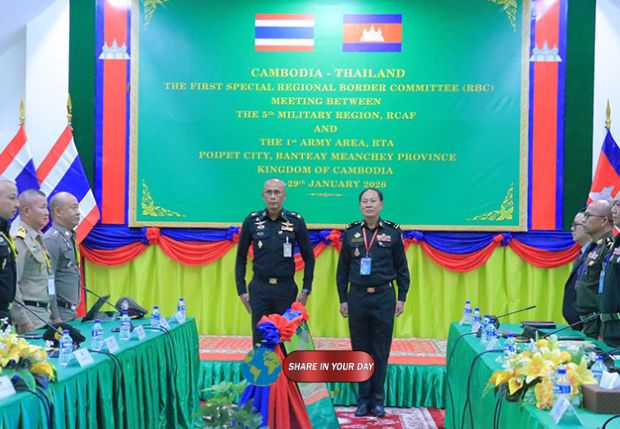
The Regional Border Committee (RBC) Secretariat, involving Cambodia’s 5th Military Region and Thailand’s 1st Army Area, convened preparatory sessions on Tuesday. These talks, overseen by the ASEAN Observer Team (AOT), are intended to pave the way for a “Special RBC Meeting” scheduled for today.
A Peace on Paper, A Buildup on the Ground
The current ceasefire, signed on December 27, 2025, explicitly prohibited “troop movements, including patrols, towards the other side’s position.” However, the reality on the ground appears increasingly at odds with the diplomatic rhetoric.
Cambodian military sources have flagged significant Thai military buildups along the frontier. Most notably, reporters at the scene have observed the construction of concrete bunkers by Thai forces just meters from the entrance to the Preah Vihear Temple. The UNESCO World Heritage site—already bearing the scars of heavy Thai artillery fire from the three-week December conflict—has become a symbolic flashpoint once again.
In a mirrored escalation, Thailand has accused Cambodian forces of digging extensive trench systems along the western border in Trat province. While the Royal Thai Navy recently conceded these trenches are within Cambodian territory, the optical impact has reinforced a “wait-and-see” military posture that threatens to undermine the spirit of the Kuala Lumpur Joint Declaration.
The Human Cost: 113,000 Still in Limbo
While the Ministry of Interior reports that approximately 82% of the 640,000 displaced Cambodians have returned home, the humanitarian situation remains dire for those left behind.
According to official data, 113,040 people, including over 59,000 women and 37,000 children, remain in temporary shelters. Their return is obstructed not only by fear of renewed shelling but by the physical destruction of their communities.
The scale of the damage since December 7, 2025, is staggering:
- Private Property: Nearly 1,000 houses, hotels, and gas stations destroyed or damaged.
- Public Infrastructure: Dozens of schools and hospitals remain shut across Oddar Meanchey, Banteay Meanchey, and Preah Vihear.
- Cultural Loss: Extensive damage to pagodas and ancient temple structures.
Diplomatic Maneuvers and the “No Concession” Policy
Government spokesman Pen Bona reaffirmed this week that the ceasefire is a “sacred objective” to prevent further loss of life, but emphasized it is not a sign of surrender. “Cambodia will not make any concessions that would compromise its sovereignty or dignity,” Bona stated, reiterating the government’s adherence to the 1904 and 1907 Franco-Siamese treaties.
The Ministry of Interior has been more blunt, criticizing the Thai armed forces for what it termed the “illegal occupation” of certain areas and the looting of property—actions it claims constitute serious violations of international humanitarian law.
As the Special RBC Meeting progresses today, the primary challenge for Major General Sar Kimpak (Cambodia) and Major General Phittayakool Pothisuwan (Thailand) will be to transform a technical ceasefire into a sustainable de-escalation. Without a verified withdrawal of the newly built bunkers and trenches, the “return to normalcy” remains a distant prospect for the thousands still living in the shadow of the border.
Excerpt: Military officials from Cambodia and Thailand are meeting in Poipet today for a Special RBC Meeting aimed at salvaging a month-long ceasefire. However, reports of concrete bunkers near Preah Vihear and new trench systems have raised the specter of a “third round” of fighting, even as 113,000 Cambodians remain unable to return to their homes.