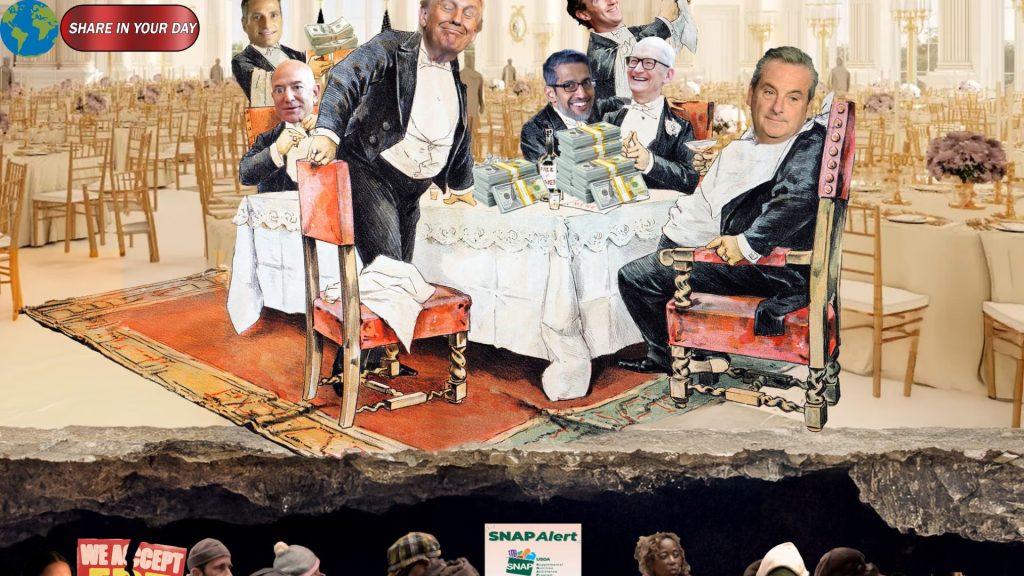
Trump’s $300 M White House Ballroom Amid Shutdown Sparks Outrage
Since the shutdown of large parts of the U.S. federal government began, the contrast between austerity and extravagance has never been sharper. On 15 October, President Donald Trump hosted nearly 130 ultra-wealthy donors and corporate leaders at the White House for a lavish dinner. They feasted on heirloom tomato panzanella, beef Wellington, roasted pears with cinnamon crumble and butterscotch ice-cream — all to commemorate their pledges toward a massive new ballroom project, now expected to cost $300 million.
At the same time, the government shutdown has begun to bite: programs critical to low-income Americans — including the Supplemental Nutrition Assistance Program (SNAP) — face a freeze that would affect tens of millions of beneficiaries.
The optics are striking: while families wonder if their food stamp cards will load, the administration is pushing ahead with a gold-rimmed ballroom funded by donors of big business and crypto.
A Tale of Two Realities
Trump brands himself as a “blue-collar billionaire” championing Americans left behind.
Yet his personal history tells a different story: he grew up in an affluent Queens neighbourhood, got a million-dollar loan from his father for Manhattan real-estate deals, and built an empire of luxury hotels, golf resorts and reality TV fame.
The ballroom project accentuates this disparity: the East Wing of the White House was demolished without approved review by the federal design-and-planning agency so that the 90,000 sq ft ballroom could move ahead.
Politically, the gamble is risky. In a poll conducted by the Washington Post‑ABC News –- Ipsos group, only 28 % of Americans supported the ballroom project, while 56 % opposed it. Independents blamed Trump and his party for the shutdown at a 2-to-1 margin.
Why It Matters
Social Safety Net at Risk: With SNAP, early-years education, subsidised travel to remote communities and pay for federal employees all threatened, the shutdown isn’t just rhetoric — it’s imminent hardship.
Symbolism of Excess: The ballroom has become a symbol of excess — and the imagery evoked harks back to monarchs and oligarchs while many Americans struggle.
Influence and Access: The donor list for the ballroom’s funding includes big-tech companies (Amazon, Apple, Google), defence contractors (Lockheed Martin), and crypto entrepreneurs (the Winklevoss twins). Critics say the dinner sold access.
Political Opening: For the opposition, there’s now a tangible issue — linking a luxury White House project to the hardships of ordinary Americans could resonate in rural and low-income communities.
The Broader Picture
Observers such as the director of the Centre for the Study of Politics and Governance at the University of Minnesota, Larry Jacobs, warn the divide is “glaring” — the gilded life of Trump and his circle contrasted with the lives of many Americans.
Historians say scenes like this recall the late-19th-century Gilded Age rather than 21st-century democracy.
One former Republican congressman-turned-Democrat noted: “We’ve got a guy in the White House who every day is taking a blowtorch to this country … He ploughs ahead and tears down the East Wing because he knows he can get away with it.”
What to Watch
Funding: Will donor commitments hold up? Will taxpayers eventually pick up the cost?
Shutdown Fallout: How far will critical services slide before a deal to reopen funds is reached?
Political Impact: Will this issue shift voter sentiment in key demographic groups for either party?
Legal/Procedural Review: Will investigations or congressional oversight follow the demolition of the East Wing and the bypassing of design-review agencies?