Transatlantic Rift Deepens: How the U.S. Has Redefined Europe as a Strategic Threat
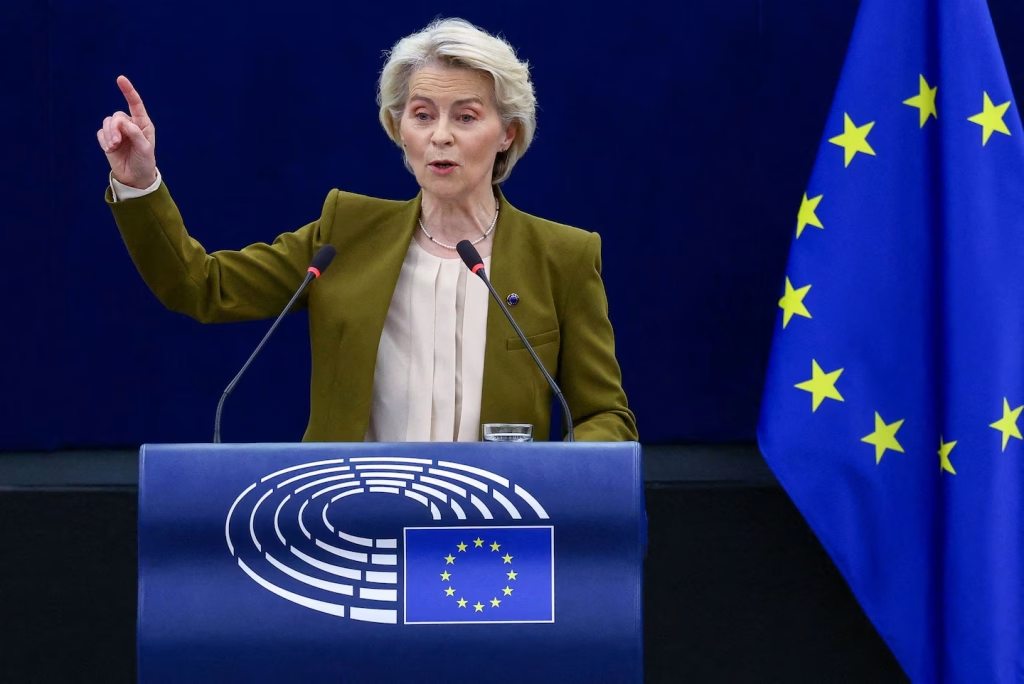
A sweeping U.S. national security strategy released in December 2025 has re‑cast the relationship between Washington and Europe. Under that document, the European Union (E.U.) — rather than traditional strategic rivals like Russia or China — is now framed as the primary geopolitical threat.
The strategy warns of “civilizational erasure” in Europe, citing immigration, liberal social policies, and demographic shifts as causes.
Officials in Brussels and other European capitals responded with alarm. The tone of the new strategy — once largely relegated to political rhetoric — has become official U.S. doctrine.
What changed — from global leadership to critical appraisal
Under the new U.S. strategy:
- The United States moves away from using its global power as a stabilizer, shifting to a narrower, interest‑driven foreign‑policy model.
- The strategy criticizes European liberal democratic trends, asserting that E.U. policies on immigration, climate, and social regulation undermine political freedom and sovereignty.
- It signals support for nationalist and far‑right political actors in Europe and encourages “resistance” internally against current European institutions.
- Importantly, the document downplays threats from Russia and China, promoting instead a vision of the U.S. as a mediator — or even broker — of a new “strategic stability” between Moscow and Europe.
In effect, this shifts the paradigm: from the U.S. leading a collective Western alliance to the U.S. redefining Europe as a strategic competitor.
European backlash: Unity shaken, autonomy debated
For many European leaders, the strategy crosses a red line. The top political official of the E.U., António Costa, warned that the post–World War II alliances have changed — and urged Europe to protect itself, not only from external foes but from “allies who challenge us.”
Another senior voice, former commissioner Thierry Breton, condemned the policy as a clear statement that the United States now views European institutions “as an enemy” and aims to destabilize them.
At the same time, some nationalist and Euroskeptic factions within Europe — including the recently controversial Alternative for Germany (AfD) — welcomed the strategy. For them, Washington’s stance validates long‑standing criticism of Brussels and central European institutions.
Nevertheless, most European capitals are recoiling: many view this as a betrayal of shared democratic values and global cooperation. Several have already signaled moves toward increased defense budgets and reassessment of their dependence on U.S. security guarantees.
What this means for the future of NATO and global order
The rift threatens to fracture the post–World War II order that kept Europe and North America aligned for decades. Under the new doctrine:
- The U.S. appears willing to withdraw from its traditional role as a global “security umbrella,” focusing instead on narrower hemispheric and economic interests.
- Institutions like NATO may be weakened as European countries weigh bolstering their own defense capabilities over relying on U.S. backing.
- The ideological bridge that once united transatlantic partners — shared democratic values, collective security, common stance against authoritarian powers — is under strain, if not breaking entirely.
European policymakers are now debating a path toward greater strategic autonomy, possibly reshaping alliances, defense postures, and foreign‑policy strategies independent of U.S. influence.
Conclusion
The December 2025 U.S. national security strategy marks a turning point: one where Washington no longer sees Europe as an ally bound by shared values and mutual defense, but as a potential rival with diverging political and cultural trajectories. European institutions and leaders have reacted with alarm, but some nationalist factions are welcoming this shift.
The transatlantic alliance is at a crossroads. Whether Europe will stand firm with renewed autonomy — or attempt to restore a fractured partnership — remains uncertain.