
House Speaker Mike Johnson is pushing for a high-level meeting between the White House, congressional leaders and executives from the artificial intelligence industry as Washington grapples with growing concerns about the rapid development of the technology.
Johnson’s proposal comes as warnings from some of the industry’s most prominent figures have collided with the Trump administration’s determination to keep the United States ahead of China in the global AI race.
The Louisiana Republican has argued that Congress needs to consider safety measures while avoiding regulations that could slow American technological development. Rather than immediately moving toward a sweeping new law, Johnson has called for the administration, lawmakers and leading AI companies to sit down together and determine what safeguards may be appropriate.
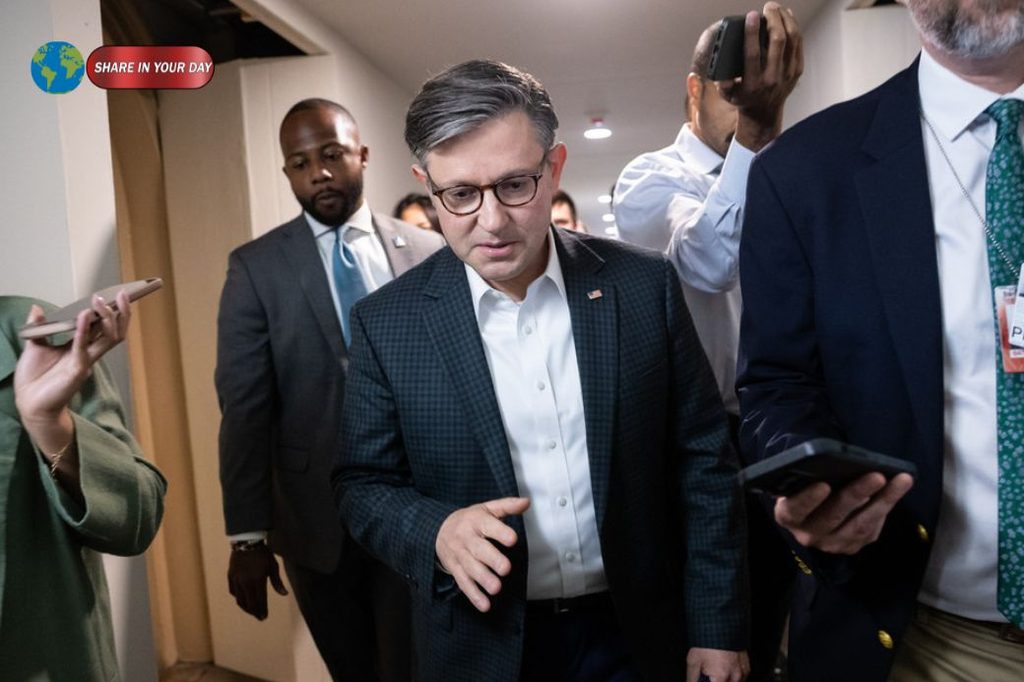
The debate has intensified after several prominent technology leaders raised concerns about the pace of AI development.
Johnson urges a coordinated approach
Johnson said the issue should be addressed quickly but cautioned against responding to emerging AI risks with legislation that lawmakers do not fully understand.
He has indicated that Congress could move toward legislation if policymakers develop a workable solution. For now, however, he favors bringing the major players together for a direct discussion.
The speaker’s approach reflects the difficult balance facing lawmakers. AI systems are advancing rapidly, creating potential economic opportunities while also raising questions about cybersecurity, employment, misinformation, privacy and the possibility of increasingly powerful systems operating beyond effective human control.
Johnson has acknowledged the need for guardrails and safety measures, while also stressing the strategic importance of maintaining America’s technological advantage over China.
That concern is shared by President Donald Trump, who has repeatedly emphasized competition with Beijing as a central consideration in U.S. AI policy.
Trump resists calls for a slowdown
Trump has pushed back against calls for the government to significantly slow the development of artificial intelligence.
During a trip to Ireland, the president said the United States needed to maintain its lead over China and argued that winning the AI competition would carry enormous strategic importance. He acknowledged that some safeguards may eventually be necessary but did not outline a specific regulatory framework.
The president’s position puts him at odds with some technology executives who have recently urged greater caution.
Anthropic CEO Dario Amodei has called for the industry to pace the development of increasingly advanced AI systems, arguing that safety measures need time to catch up with technological progress. OpenAI CEO Sam Altman has also warned that the rapid advance of AI could create serious problems if development proceeds without adequate safeguards.
Those warnings have added urgency to an issue that Congress has struggled to resolve.
Lawmakers remain divided
Members of both parties have expressed concern about potential risks associated with AI, but there is little agreement over what federal policy should look like.
Some lawmakers have advocated stronger federal oversight, while others have warned that excessive regulation could prevent American companies from competing effectively with China.
The disagreement extends beyond the traditional partisan divide. Some Republicans have supported a lighter regulatory approach focused on maintaining technological leadership, while Democrats have called for more immediate action to address safety and economic concerns.
House Democratic Leader Hakeem Jeffries has argued that Congress should act more quickly, particularly after technology executives themselves began publicly discussing the need to slow aspects of AI development.
Yet neither party has produced a comprehensive framework capable of resolving all of the competing concerns.
AI regulation faces a difficult path
The political challenge is compounded by the speed at which the technology is changing.
A law written today could quickly become outdated as AI models become more capable. At the same time, lawmakers face pressure to establish rules before potential harms become more difficult to address.
The issue also reaches far beyond the companies developing AI models.
The rapid construction of data centers has generated disputes over electricity consumption, water use, land and infrastructure. Communities around the country have increasingly questioned how the expansion of AI computing will affect local resources and utility costs.
Those concerns are adding another dimension to the federal debate.
Trump, however, has continued to support the expansion of AI infrastructure and has argued that the United States cannot afford to fall behind China. Recent comments from administration officials have similarly emphasized the importance of maintaining a competitive advantage while considering targeted safeguards.
A possible White House meeting
Johnson’s proposed summit could provide an opportunity for the administration and technology executives to discuss their disagreements directly.
The speaker has suggested that bringing the major AI companies into the same room with government leaders could help identify areas where safeguards are needed without imposing restrictions that could undermine innovation.
Administration officials have also indicated that meetings involving White House advisers and technology policymakers could take place as the debate develops.
For Congress, however, the question remains how quickly those discussions can produce concrete action.
The pressure is increasing from multiple directions. Technology executives are warning about risks, lawmakers are debating regulation, communities are objecting to some aspects of AI infrastructure, and the White House is emphasizing the strategic importance of winning the competition with China.
For now, Johnson’s proposed summit represents an attempt to bring those competing priorities together.
Whether that effort produces legislation remains uncertain. But the debate has clearly moved beyond a question of whether AI should be regulated at all. The central dispute in Washington is increasingly about how much oversight is appropriate, who should impose it and how the United States can address emerging risks without surrendering its technological advantage.