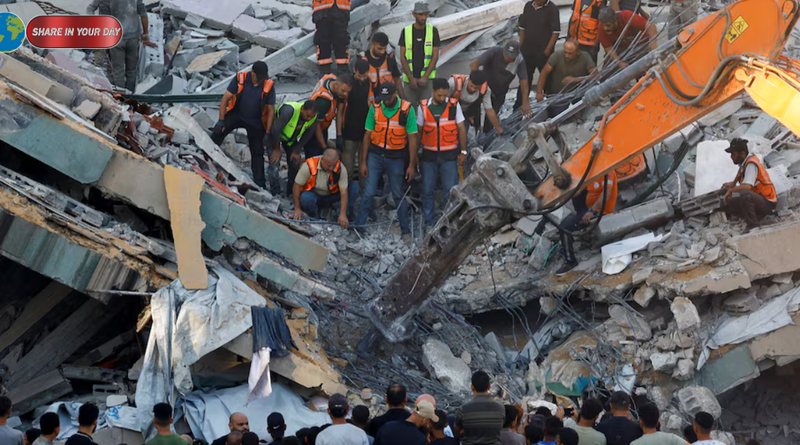
Gaza Building Collapse Kills 21 People
The Gaza building collapse that struck a war-damaged apartment block has killed 21 people, including eight children, after a seven-storey structure gave way while displaced families were sheltering inside. Rescue teams pulled 45 people from the rubble, but the operation highlighted the severe dangers facing families living in damaged buildings across the Gaza Strip. RReuters
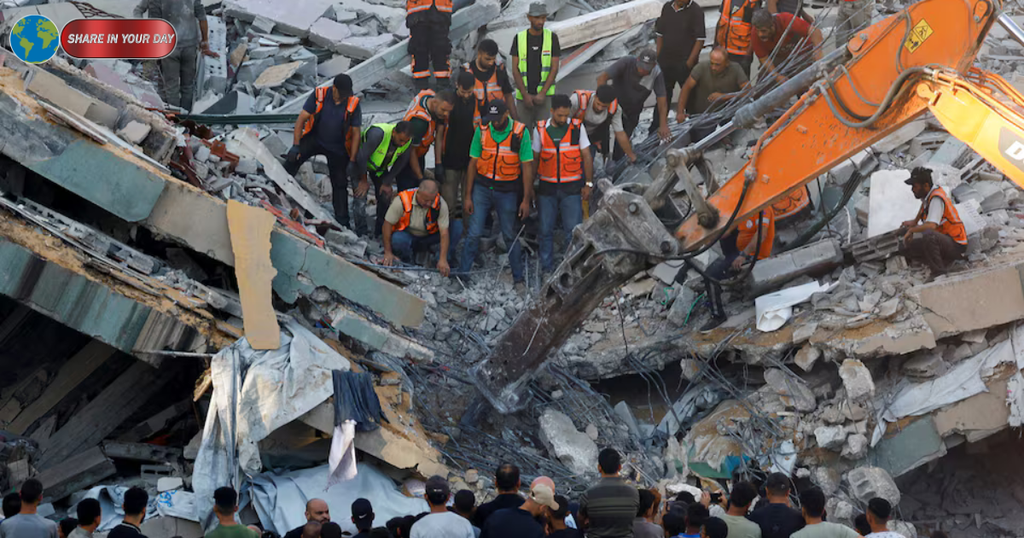
The apartment building had been damaged during the conflict and was being used as accommodation by families who had few alternatives. When the structure collapsed overnight, residents and rescue workers were forced into a race against time to search for survivors beneath the concrete and debris.
The tragedy has renewed attention on Gaza’s damaged housing stock, where thousands of people remain in buildings that were damaged during the war.
Reuters reported that the collapsed building had housed more than 110 people. Many residents had moved into damaged structures because shelters were overcrowded and reconstruction had made little progress. RReuters
Gaza Building Collapse Leaves Families Trapped
The building was among roughly 2,000 damaged structures in Gaza that have continued to be inhabited by families, according to Gaza’s civil defence service.
For people without safe housing, a partially damaged apartment can become the only available protection from the elements. Families have previously told Reuters that they sometimes choose damaged buildings because they provide more shelter from wind and rain than tents or other temporary accommodation.
That choice carries obvious structural risks.
A building that has already suffered major damage can become increasingly unstable. Cracks, weakened columns and damaged floors may leave the structure vulnerable to further deterioration, particularly when additional weather or other stresses affect the building.
The latest collapse illustrates how the destruction of housing can continue to threaten civilians even when they are not directly caught in an active attack.
Children Among Those Killed
Eight children were among the 21 people who died in the collapse, according to the latest Reuters report.
The number underscores the extent to which families with children are living in unsafe conditions. Reuters reported that about half of those injured in the incident were also children. RReuters
The presence of children in the building was not unusual. Families displaced by fighting have repeatedly sought whatever accommodation remains available, even when buildings have been damaged.
The collapse therefore represents more than an isolated structural accident. It is part of a broader housing and displacement problem that has developed throughout the conflict.
For rescue workers, the presence of children also made the search especially urgent. Teams continued looking through the wreckage despite limited equipment and difficult conditions.
Rescue Teams Face Severe Equipment Shortages
Gaza’s civil defence teams faced major challenges during the rescue operation.
Heavy machinery needed to move large sections of concrete and safely reach people beneath the rubble has remained in short supply. Rescue workers have consequently had to rely heavily on available equipment and manual efforts.
Reuters reported that Palestinian rescue teams worked despite a lack of essential machinery. Forty-five people were eventually pulled from the rubble alive. RReuters
The rescue operation demonstrates both the limitations and the importance of Gaza’s emergency services.
Searching a collapsed multi-storey building requires specialized equipment, including excavators, cranes and tools capable of cutting through reinforced concrete. Without sufficient machinery, rescuers face greater risks while operations can take considerably longer.
Every additional hour can be critical for people trapped beneath debris.
Why Gaza’s Damaged Buildings Remain Occupied
The Gaza building collapse has drawn attention to a difficult reality for displaced residents: damaged housing can sometimes appear safer than the alternatives.
Large numbers of people remain displaced after the conflict. Many have lived in temporary shelters for extended periods, while reconstruction has been slowed by restrictions, shortages and the continuing political and security dispute.
Reuters reported that more than 2 million people in Gaza are living in overcrowded or damaged accommodation or temporary tents. RReuters
For some families, moving into a damaged apartment can offer walls, a roof and greater protection from weather.
But the apparent security of a concrete structure can be deceptive.
Buildings that survived earlier attacks may have hidden structural weaknesses. Damage that is not immediately visible can affect the integrity of floors, walls and support systems.
That creates a dangerous dilemma for displaced families: remain in an exposed temporary shelter or move into a structure that may not be structurally safe.
Gaza Reconstruction Remains Limited
The condition of Gaza’s housing is closely connected to the lack of large-scale reconstruction.
The war caused extensive destruction to residential areas and public infrastructure. However, rebuilding requires construction materials, heavy machinery, engineers and secure access to damaged areas.
Reuters reported that Israeli restrictions on materials and machinery entering Gaza have been cited by U.N. officials and Palestinian authorities as a major obstacle to reconstruction. Israel says restrictions are necessary to prevent militant groups from obtaining materials for military purposes. RReuters
The disagreement over access and security has contributed to a prolonged reconstruction problem.
Meanwhile, displaced residents continue to need housing.
This creates a cycle in which damaged buildings remain occupied because there are insufficient alternatives, while the absence of reconstruction leaves those same residents exposed to continuing structural hazards.
Gaza Building Collapse Highlights Humanitarian Risks
The latest collapse also comes amid a wider humanitarian crisis.
The October 2025 U.S.-backed ceasefire halted large-scale fighting but did not completely end violence or resolve the underlying disputes between Israel and Hamas. Reuters reported that Israeli strikes have continued, while both sides have accused the other of violating the ceasefire. RReuters
The continuing instability has made long-term recovery difficult.
Even where active fighting has decreased, civilians remain surrounded by the physical consequences of the conflict. Destroyed homes, damaged roads, disrupted utilities and limited access to equipment all complicate efforts to restore normal living conditions.
For families living in damaged buildings, the danger can therefore remain long after the original attack.
Rescue Operation Comes to an End
Rescue efforts following the collapse eventually concluded after emergency teams searched through the wreckage.
The latest Reuters account said 21 people died and 45 were rescued. Eight of the dead were children. RReuters
The operation required rescuers to work through extensive debris while facing equipment shortages.
Images and videos from the scene showed emergency workers digging through the remains of the building and carrying survivors away from the wreckage.
The conclusion of the rescue effort brought an end to the immediate search, but it did not resolve the broader problem confronting residents across Gaza.
Thousands of people remain dependent on damaged buildings or temporary shelters.
Other Damaged Buildings Could Pose Similar Dangers
Gaza’s civil defence service has warned about the number of damaged buildings still being occupied.
According to Reuters, around 2,000 damaged buildings are inhabited by families. That means the structural danger highlighted by the latest collapse is not limited to a single location.
Some buildings may remain standing for years despite significant damage. Others could deteriorate gradually.
Weather can also increase the risks. Rain, wind and changes in ground conditions can place additional stress on already weakened structures.
As winter approaches, the pressure on families to find enclosed shelter can become even greater.
That makes the reconstruction challenge increasingly urgent for displaced residents.
Gaza Families Continue Searching for Safe Shelter
For the families affected by the Gaza building collapse, the immediate priority was survival.
People living nearby gathered around the wreckage while rescue workers searched for those trapped underneath. Families waited for information about relatives and neighbors as emergency crews attempted to reach survivors.
The tragedy illustrates the human consequences of Gaza’s housing shortage.
A home is normally expected to provide safety. For many displaced Palestinians, however, even a damaged home can represent the least dangerous option available.
That reality has forced families to make decisions under circumstances they would not otherwise face.
The Broader Cost of Gaza’s Destruction
The collapse is also a reminder that the effects of war extend beyond the moments when buildings are struck.
Infrastructure damage can create secondary dangers. Destroyed hospitals can reduce medical capacity. Damaged roads can slow emergency response. Water and electricity systems can become unreliable. Housing destruction can leave families exposed to both weather and structural hazards.
These problems can continue long after the initial destruction.
The latest incident demonstrates how those consequences can become deadly.
For emergency workers, rebuilding a damaged building is not simply a construction task. It can determine whether families have a safe place to live and whether rescuers can respond effectively when something goes wrong.
What Happens Next in Gaza?
The collapse is likely to increase pressure for assessments of damaged buildings and greater access to reconstruction equipment.
Such measures, however, depend on the broader political and security situation.
Israel has cited security concerns for restrictions affecting materials entering Gaza, while Palestinian authorities and international organizations have argued that restrictions have impeded reconstruction and humanitarian work. RReuters
The challenge is particularly difficult because Gaza needs both immediate shelter and long-term rebuilding.
Temporary accommodation can provide short-term protection, but it cannot replace permanent housing for millions of displaced people.
At the same time, allowing families to occupy severely damaged buildings creates potentially serious safety risks.
Gaza Building Collapse Becomes a Symbol of Continuing Danger
The death toll from the Gaza building collapse has now reached 21, with children among the victims and dozens of people rescued from the rubble.
The incident has exposed the dangers created by damaged housing, displacement and limited reconstruction.
For the families who survived, being pulled from the rubble does not necessarily mean their housing crisis is over. Many still face the question of where they can safely sleep.
For rescuers, the incident has demonstrated the importance of heavy equipment and emergency resources.
And for Gaza as a whole, the collapse is another indication that the physical consequences of the conflict remain deeply embedded in everyday life.
The immediate rescue operation may have ended, but the broader challenge remains: providing displaced families with housing that is structurally safe, accessible and capable of protecting them from the dangers that continue to surround them.
Key Facts
- Incident: Collapse of a war-damaged seven-storey apartment building
- Location: Gaza Strip
- Deaths: 21 people, including eight children
- Rescued: 45 people
- Building occupants: More than 110 people
- Other damaged buildings occupied: About 2,000, according to Gaza civil defence
- Main rescue challenge: Shortage of heavy equipment and machinery
- Broader issue: Displacement and limited reconstruction
- Ceasefire context: A U.S.-backed ceasefire began in October 2025, but violence and disputes have continued
Sources
- Reuters — Gaza building collapse report
- Reuters — Follow-up on rescue operation and revised death toll
Suggested internal link: Link to an existing article on your website covering the Gaza conflict, humanitarian situation, ceasefire developments or reconstruction efforts.
Image ALT Text
Gaza building collapse leaves rescuers searching rubble for survivors
Editorial note: Because this is a developing conflict-related tragedy, the death toll and other details can change. The article above uses the latest Reuters follow-up available on September 17, 2026, rather than preserving the earlier 20-death figure in the original September 16 report. RReuters+1
For publication, use a properly licensed, non-graphic editorial image of Gaza’s damaged buildings or emergency response rather than graphic casualty imagery.