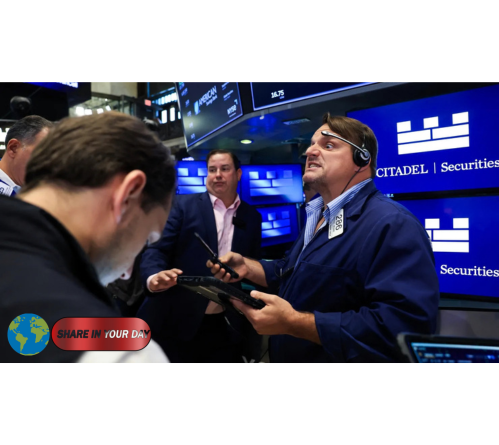
Stock Market Today: Wall Street Turns Lower

The stock market today took a sharp step back as rising Treasury yields and renewed inflation concerns pressured U.S. equities. The Dow Jones Industrial Average, S&P 500 and Nasdaq Composite all finished lower on Wednesday, September 23, while the benchmark 10-year Treasury yield climbed above 5% and reached its highest level since 2007.
The sell-off came just one session after the Nasdaq had reached another record close. Investors had been encouraged by strength in technology stocks and hopes that diplomatic developments could eventually reduce geopolitical pressure on energy markets.
That optimism faded quickly.
The Dow fell about 0.7%, while the S&P 500 dropped roughly 0.8%. The Nasdaq Composite declined 1.1%, ending a four-session winning streak.
The reversal highlights a growing tension in financial markets. Investors continue to see strong demand for artificial intelligence and technology companies, but higher borrowing costs could make it harder for stocks to maintain elevated valuations.
Dow, S&P 500 and Nasdaq All Fall
The three major U.S. indexes moved lower during Wednesday’s session.
The Dow Jones Industrial Average finished at 51,511.59, down 0.68%. The S&P 500 ended at 7,706.03, a decline of 0.75%, while the Nasdaq Composite closed at 26,936.04, falling 1.13%.
The Nasdaq’s decline was particularly notable because the index had just established back-to-back record closing highs.
Technology stocks have been one of the strongest drivers of the 2026 rally. However, technology and growth shares are also particularly sensitive to changes in interest rates because higher yields can reduce the relative attractiveness of future earnings.
That relationship was evident again Wednesday.
Investors moved toward a more defensive position as bond yields accelerated higher. The result was a broad decline across equities, although some individual companies continued to outperform.
The Russell 2000, which tracks smaller U.S. companies, performed even worse. The index fell about 1.8%, suggesting that the pressure was not limited to large technology companies.
10-Year Treasury Yield Hits a Major Milestone
The biggest story behind the stock market today was the sudden rise in Treasury yields.
The 10-year Treasury yield climbed above 5% and reached approximately 5.11% during the session, according to market reports. That marked its highest level since 2007.
For investors, the move matters because Treasury yields influence borrowing costs across the economy.
Mortgage rates, corporate financing costs and other consumer and business borrowing rates can all be affected by movements in government bond yields.
Higher yields can also put pressure on stock valuations. When investors can earn more from relatively low-risk government bonds, they may demand a greater potential return before committing money to equities.
This is especially important for technology companies whose valuations depend heavily on expectations for future growth.
The rise in yields therefore created a difficult environment for the broader market.
Inflation Concerns Return to Wall Street
Inflation was another major concern for investors on Wednesday.
Fresh economic data showed stronger-than-expected business activity in the United States. That raised questions about whether price pressures could remain elevated for longer than previously expected.
A stronger economy is normally positive for corporate earnings. However, the situation becomes more complicated when strong economic activity is accompanied by persistent inflation.
The Federal Reserve is attempting to balance those competing forces.
If economic growth remains strong while inflation stays above the central bank’s target, policymakers may have less flexibility to lower interest rates.
That possibility is becoming increasingly important for Wall Street.
Federal Reserve officials have already signaled concern about inflation, and traders are watching closely for evidence that another interest-rate increase could come as soon as October.
The prospect of higher rates helped push Treasury yields higher and contributed to Wednesday’s equity sell-off.
Federal Reserve Policy Becomes a Bigger Market Risk
The Federal Reserve is once again at the center of the investment debate.
The central bank raised its benchmark interest rate by a quarter percentage point last week. Investors initially focused on the possibility that the move could eventually help contain inflation.
However, subsequent comments from Fed officials have reinforced the message that inflation remains a serious concern.
Boston Fed President Susan Collins said there was an increased likelihood that inflation could remain notably above the Federal Reserve’s 2% target. She supported the recent rate increase and argued that a somewhat more restrictive policy could help return inflation to target.
Those comments matter because markets had hoped that the latest rate increase might eventually be followed by a pause.
Instead, investors are increasingly considering whether the central bank could raise rates again.
That shift in expectations can quickly affect stock prices.
Oil Prices Add Another Layer of Uncertainty
Oil markets also played an important role in Wednesday’s trading.
Crude prices moved higher after initially benefiting from hopes that diplomatic discussions between the United States and Iran could eventually reduce disruptions to global energy supplies.
The conflict has kept oil markets unusually sensitive to political developments.
Earlier in the week, investors had been encouraged by signs that negotiations might be possible. Lower oil prices helped support stocks because cheaper energy can reduce costs for consumers and businesses.
That optimism weakened Wednesday.
Near-term Brent crude prices moved back above $100 per barrel, while West Texas Intermediate also gained. One market recap reported November Brent settling around $103.08 per barrel and November WTI around $92.16.
Higher oil prices can create a difficult combination for financial markets.
They can increase inflationary pressure while simultaneously raising costs for companies and households.
For the Federal Reserve, that creates another complication. If energy prices remain high, inflation could prove more persistent even if other parts of the economy begin to cool.
Technology Stocks Lose Momentum
Technology shares have been a major source of strength for the U.S. market in recent weeks.
But Wednesday showed how quickly that momentum can reverse when interest-rate expectations change.
Nvidia fell about 1.5%, while Alphabet dropped roughly 3.8%. Meta, by contrast, gained about 1%, while Microsoft edged higher.
The mixed performance demonstrates that investors are not simply selling every major technology stock.
Instead, markets appear to be becoming more selective.
Companies with strong growth prospects, powerful cash flows or compelling artificial intelligence strategies can still attract investors. But stocks with particularly high valuations may face greater pressure when bond yields rise.
That dynamic could remain important for the rest of 2026.
The artificial intelligence investment boom continues to support semiconductor companies, cloud providers and software businesses. Yet investors are increasingly asking whether expected earnings growth can justify current valuations in an environment where interest rates may remain high.
Meta Stands Out as AI Optimism Continues
Meta was among the technology names that bucked the broader market decline.
The company’s shares continued to benefit from investor enthusiasm surrounding its artificial intelligence strategy. The stock had already gained significantly in the previous session, helped by excitement around its new AI agent.
The move illustrates the importance of company-specific developments in the current market.
Even when major indexes decline, investors can continue to reward companies that deliver strong growth prospects or introduce products viewed as potentially transformative.
AI remains one of the most powerful themes driving the technology sector.
However, Wednesday’s trading also demonstrated that the broader macroeconomic environment cannot be ignored.
A company can have strong AI prospects while its stock remains vulnerable to rising bond yields.
Financial Stocks Face Additional Pressure
Financial stocks were also under pressure.
Banks can benefit from higher interest rates in some circumstances, but rapidly changing yield conditions can create challenges. Investors are also concerned about the outlook for loan demand, trading activity and corporate earnings.
Major banks including JPMorgan Chase and Wells Fargo had already experienced significant weakness during the previous session.
The financial sector’s performance is important because banks are closely linked to the health of the broader economy.
If interest rates remain high, consumers and businesses may become more cautious about borrowing.
At the same time, banks must manage the impact of higher funding costs and changing credit conditions.
That combination can make financial stocks particularly sensitive to Federal Reserve policy.
Why Wednesday’s Sell-Off Matters
The latest decline does not necessarily mean the long-term stock market rally is over.
The S&P 500 and Nasdaq remain close to historically elevated levels, and corporate earnings remain a major source of support.
Instead, Wednesday’s session could be viewed as a warning about the market’s sensitivity to interest rates.
The Nasdaq had just reached consecutive record closes before the sudden reversal.
That means investors are still willing to pay high prices for growth companies, but they may become more cautious when Treasury yields rise sharply.
The key question now is whether higher yields remain temporary or become a persistent feature of the market.
If yields stabilize, stocks could regain momentum.
If yields continue rising, however, equity valuations could face additional pressure.
What Investors Are Watching Next
The economic calendar will remain important over the next several trading sessions.
Investors will be watching weekly jobless claims, housing data and additional comments from Federal Reserve officials.
Markets will also monitor corporate earnings and developments surrounding U.S. trade negotiations with China.
The upcoming meeting between U.S. President Donald Trump and Chinese President Xi Jinping is another major event for investors. Trade policy, artificial intelligence regulation and restrictions on strategic technologies could all influence market sentiment.
Meanwhile, geopolitical developments involving Iran will continue to affect oil prices.
That creates several interconnected risks.
A stronger-than-expected economy could support corporate earnings but also keep inflation elevated. Higher oil prices could add to inflation. Higher inflation could encourage the Federal Reserve to maintain restrictive policy. And higher interest rates could place additional pressure on stock valuations.
For investors, those relationships may matter more than any single day’s market move.
Stock Market Today: A Market at a Crossroads
The stock market today reflects a complicated investment environment.
The U.S. economy remains resilient, technology companies continue to benefit from artificial intelligence demand, and major indexes remain near record territory.
At the same time, inflation has not disappeared.
Treasury yields are rising. Oil prices remain volatile. And investors are once again considering the possibility of additional Federal Reserve rate increases.
Wednesday’s decline therefore serves as an important reminder that strong stock-market momentum can change quickly.
The Nasdaq’s 1.1% decline ended a four-session winning streak, while the S&P 500 and Dow also moved lower. The 10-year Treasury yield’s climb above 5% added to concerns that borrowing costs could remain elevated for longer than investors had hoped.
For now, Wall Street is caught between two powerful forces.
On one side is optimism surrounding corporate earnings, artificial intelligence and economic growth.
On the other is the growing risk that inflation, oil prices and Federal Reserve policy could keep financial conditions tight.
That balance will likely determine the market’s next major move.
For investors watching the stock market today, the most important signal may not be whether the Dow, S&P 500 or Nasdaq rises or falls on any single session.
Instead, the focus will be on whether Treasury yields continue climbing, whether inflation shows signs of cooling and whether the Federal Reserve becomes more or less aggressive.
Those factors could ultimately determine whether the latest pullback is simply a temporary pause—or the beginning of a more significant shift in Wall Street’s 2026 rally.