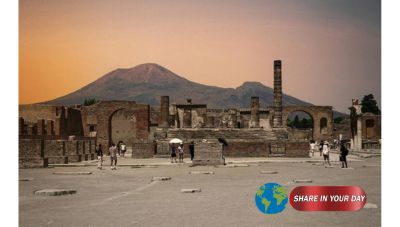
Vesuvius eruption becomes a scientific time marker
The Vesuvius eruption that buried Pompeii nearly 2,000 years ago has taken on a new scientific role.
Researchers are using the historically documented disaster to improve one of geology’s most important methods for determining when volcanic rocks formed. The work could make it easier to establish the timing of ancient eruptions and connect major geological events with greater precision.
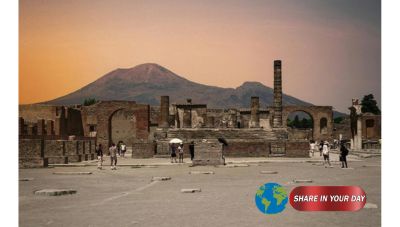
The study focuses on the catastrophic eruption of Mount Vesuvius in 79 CE. That event destroyed Pompeii and surrounding Roman settlements while killing thousands of people, including the Roman writer and naval commander Pliny the Elder.
His nephew, Pliny the Younger, witnessed the eruption from across the Bay of Naples and later provided a detailed written account.
That historical record gave modern scientists something extremely valuable: an eruption whose date could be investigated independently through historical evidence.
Researchers from the Berkeley Geochronology Center, the University of California, Berkeley, and the University of Padua used that benchmark to refine argon-argon dating, a technique widely used to determine the ages of volcanic rocks.
The results represent a significant improvement in the precision with which relatively young volcanic events can be dated.
How the Vesuvius eruption helped solve a dating problem
Scientists have long relied on radioactive decay to determine the ages of rocks and minerals.
One important technique is argon-argon dating, which uses the radioactive decay of potassium-40 into argon-40. When molten rock cools after a volcanic eruption, minerals inside the rock begin preserving information that scientists can later analyze.
By measuring specific argon isotopes, researchers can estimate how long ago the mineral crystallized or cooled.
The basic principle is powerful.
However, determining very precise dates for relatively recent geological events can be difficult.
That is where the Vesuvius eruption provided an unusual advantage.
Scientists had a volcanic event that occurred at a time documented by a historical eyewitness. Instead of trying to establish an unknown date from geological evidence alone, researchers could compare the radiometric result against a historically constrained event.
The comparison allowed the team to test and improve the dating system.
According to the new research, the recalibrated method produced a precision of about 0.7% and an accuracy of approximately 0.4% when tested using samples connected with the eruption.
That level of performance is especially useful when scientists are trying to distinguish between geological events that happened relatively close together.
Pliny the Younger provided the crucial historical evidence
The scientific breakthrough depends partly on an ancient historical source.
Pliny the Younger described the eruption in letters that became one of the most important firsthand accounts of the disaster. His observations included the enormous cloud produced by Vesuvius and the destruction unfolding around the Bay of Naples.
For centuries, historians have debated the precise calendar date of the eruption.
The traditional date associated with Pliny’s account has been August 24, 79 CE, although alternative interpretations have suggested that the eruption occurred later in the year.
That disagreement mattered to scientists because the calibration of a geological clock depends on knowing the reference date as accurately as possible.
Researchers therefore examined historical evidence alongside the geological samples.
Graduate researcher Caroline Hasler investigated the chronology surrounding the eruption, including evidence from a coin discovered at Pompeii that had been used by some historians to argue for a later date.
The new analysis supported using August 24 as the principal reference point while allowing for uncertainty in the historical record.
That was enough to make the eruption useful as a calibration event.
Scientists tested volcanic minerals from ancient deposits
The research team analyzed eight samples of sanidine, a potassium-rich volcanic mineral.
The samples came from pumice deposits associated with the eruption at Oplontis, an ancient Roman settlement near Pompeii.
The choice of material was important.
The researchers wanted samples that could provide a clean and reliable measurement of the radioactive isotopes involved in argon-argon dating.
Some of the material had originally been collected decades ago and remained available for additional analysis.
That meant scientists could revisit older geological samples using newer instruments and improved analytical techniques.
The new work benefited from advances in mass spectrometry, sample selection and neutron irradiation procedures.
Together, those improvements allowed the researchers to obtain measurements that were more precise than earlier analyses of the same eruption.
The result was a much stronger calibration point for argon-argon dating.
The new Vesuvius eruption result reaches impressive precision
The researchers calculated that the volcanic minerals represented an age of approximately 1,938 years before measurement in 2025, with an uncertainty of about 13 years.
The historically inferred age was approximately 1,946 years.
That comparison produced the reported accuracy and precision of the recalibrated method.
While those percentages may appear modest to a general audience, they matter greatly in geochronology.
Scientists often need to determine whether two events happened thousands, hundreds or even tens of thousands of years apart.
A dating method that produces narrower uncertainties can help researchers reconstruct sequences of events with greater confidence.
For example, if a volcanic eruption appears to have happened shortly before a major environmental change, better dating can help scientists determine whether the two events were actually connected or simply happened near one another in time.
That distinction is central to understanding Earth’s geological history.
The Vesuvius eruption also helped refine potassium-40
The research produced another important result.
The team calculated a revised half-life for potassium-40, the radioactive isotope at the heart of the dating method.
The new estimate places the half-life at approximately 12.044 billion years, with an uncertainty of around 0.088 billion years.
Researchers say this result is roughly twice as precise as the previous value obtained through nuclear physics measurements.
The improvement matters because radioactive decay rates are fundamental to radiometric dating.
If scientists can establish those values more precisely, they can calculate the ages of geological materials with greater confidence.
In other words, the Vesuvius eruption was not simply used to date one ancient volcanic event.
It helped scientists improve the underlying clock used to date many other rocks.
Why argon-argon dating matters
Argon-argon dating is particularly useful for volcanic rocks because volcanic minerals can preserve the isotopic information needed for the technique.
That makes the method valuable in archaeology, geology and paleontology.
Researchers can use volcanic layers as chronological markers.
If a layer of volcanic ash is found above or below archaeological material, for example, its age can provide a time boundary for the objects associated with it.
The same principle applies to geological events.
A precisely dated volcanic layer can help scientists establish when environmental changes occurred, when biological populations changed or when other major events took place.
Improving the dating method therefore has implications far beyond Mount Vesuvius.
Better dates could help study dangerous volcanoes
One practical application involves volcanoes near modern population centers.
Scientists study the geological histories of volcanic systems partly to understand how frequently they erupt and how those eruptions develop.
More accurate dating can improve those historical records.
The new research specifically points to volcanic regions near major cities such as Naples, Mexico City and Yogyakarta as examples where understanding past eruptions can be valuable.
The goal is not to predict an eruption simply by knowing its age.
Instead, scientists can build more reliable records of how volcanic systems behaved in the past.
Those records can contribute to broader volcanic-risk research.
For communities living near active volcanoes, understanding the frequency and characteristics of earlier eruptions is an important part of assessing long-term hazards.
The breakthrough could also help compare dating methods
Another important aspect of the research is its potential to connect different scientific dating techniques.
Scientists use multiple radiometric systems because no single method is ideal for every material or time period.
Radiocarbon dating, for example, is particularly useful for relatively young organic materials.
Uranium-lead dating can be applied to much older rocks and minerals.
Argon-argon dating occupies a different part of this scientific landscape and is particularly valuable for volcanic materials.
When different dating systems produce slightly different results, researchers need reliable calibration points to determine why.
The improved Vesuvius benchmark can help scientists compare methods more effectively.
Researchers have already been working on mathematical approaches designed to bring major geochronological systems into closer agreement.
The new results provide another strong data point for that effort.
What Pompeii tells us about Earth’s deeper history
At first glance, the destruction of Pompeii might seem disconnected from the study of Earth’s ancient past.
The city was destroyed less than 2,000 years ago, while geologists routinely investigate events that happened millions or billions of years ago.
But the principle is the same.
Scientists need reliable clocks.
A geological event can only be understood in context if researchers know when it happened.
Suppose scientists identify a volcanic eruption and a major biological change in nearby geological layers.
Without accurate dates, it may be impossible to establish whether the eruption occurred before the biological change, afterward or during the same period.
A better geological clock makes those comparisons more reliable.
That is why a Roman disaster can help scientists investigate events vastly older than human civilization.
The Vesuvius eruption has become more than an archaeological event
The eruption of Mount Vesuvius is already one of history’s most famous natural disasters.
Pompeii and Herculaneum provide extraordinary archaeological evidence of Roman life frozen by volcanic material.
But the new research gives the eruption another legacy.
It has become a calibration point for modern geochronology.
The combination of ancient historical documentation and modern laboratory science is particularly unusual.
Archaeologists can study what happened to Roman communities.
Historians can examine Pliny the Younger’s descriptions.
Geologists can analyze volcanic minerals.
Physicists can refine radioactive decay measurements.
Together, those fields create a more detailed picture of the event.
The result demonstrates how evidence from very different disciplines can reinforce one another.
A centuries-old mystery helps improve modern science
The exact timing of the 79 CE eruption has been debated because ancient calendars, historical documents and archaeological evidence do not always provide a perfectly simple answer.
Modern scientists have now used that uncertainty as part of the research rather than treating the historical record as completely exact.
By allowing a broader window around the historical date, researchers were still able to obtain a powerful calibration for the dating system.
That approach illustrates an important feature of modern science.
Researchers do not necessarily need perfect information.
They need to understand the uncertainty surrounding the information and incorporate it into their calculations.
In this case, the historical uncertainty did not prevent the Vesuvius eruption from becoming a useful scientific benchmark.
From Pompeii to the age of Earth
The implications extend well beyond recent volcanic eruptions.
Radiometric dating is fundamental to reconstructing Earth’s history.
Scientists use radioactive decay to determine when rocks formed, when minerals crystallized and when geological processes occurred.
The Earth’s oldest materials require dating techniques capable of working across enormous spans of time.
The US Geological Survey notes that scientists determine geological ages using radioactive isotopes with half-lives ranging from hundreds of millions to more than 100 billion years.
Those methods provide the framework for understanding the planet’s deep history.
The improved argon-argon calibration does not suddenly provide a new age for Earth.
Instead, it improves one component of the broader system scientists use to establish chronological relationships across geological time.
The new research strengthens the scientific timeline
The significance of the discovery lies in precision.
The Vesuvius eruption was already a historically important event with a relatively well-constrained date.
Now it can also serve as a high-quality reference for testing a geological dating technique.
That makes it useful far beyond the ruins of Pompeii.
The study demonstrates that historical events can sometimes provide powerful calibration points for scientific instruments and methods.
In this case, an eruption that devastated Roman communities has helped modern researchers improve a method used to study volcanic activity, geological change and Earth’s deep history.
A Roman disaster with a modern scientific legacy
Nearly 2,000 years after Mount Vesuvius buried Pompeii, the eruption continues to produce new scientific information.
The latest research shows that its value is no longer limited to archaeology and Roman history.
By combining Pliny the Younger’s account with carefully selected volcanic minerals and modern mass spectrometry, researchers have improved the precision of argon-argon dating and refined an important radioactive decay measurement.
The implications could extend across geology, archaeology and paleontology.
More accurate dating can help scientists establish the sequence of ancient events, compare geological records and better understand the history of volcanic systems.
The story of Pompeii therefore continues to evolve.
What began as a catastrophic event in the Roman world has become a scientific reference point for understanding time itself.
The Vesuvius eruption may have destroyed an ancient city, but nearly two millennia later, its precisely studied remains are helping scientists build a clearer timeline of Earth’s past.