Voyager 1 Update: NASA Fights to Keep Historic Probe Alive
The Voyager 1 update has captured global attention as NASA engineers take drastic steps to keep humanity’s most distant spacecraft alive. After nearly five decades in space, the iconic probe is now facing a critical challenge: running out of power.
In a bold move, NASA recently shut down one of Voyager 1’s key scientific instruments to conserve energy. The decision highlights both the fragility and resilience of a mission that has already rewritten the history of space exploration.
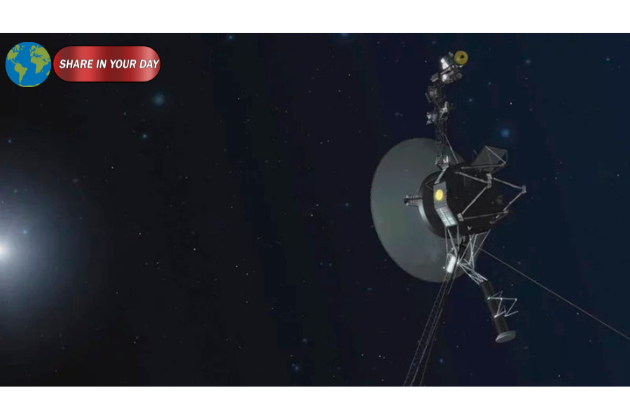
A Spacecraft Unlike Any Other
Launched in 1977, Voyager 1 is no ordinary spacecraft. It is the most distant human-made object ever created, currently traveling far beyond the boundaries of our solar system.
The probe made history in 2012 when it became the first spacecraft to enter interstellar space, crossing the heliopause—the boundary where the Sun’s influence ends.
Today, Voyager 1 continues to send back data from a region no other spacecraft has explored, offering scientists a rare glimpse into the interstellar medium.
NASA’s Critical Decision: Shutting Down Instruments
In the latest Voyager 1 update, NASA engineers powered down the Low-Energy Charged Particles (LECP) instrument to extend the spacecraft’s life.
This instrument had been operating almost continuously since launch, collecting valuable data about cosmic rays and charged particles in deep space.
However, Voyager 1’s power supply—generated by a radioisotope thermoelectric generator—is steadily declining. The spacecraft loses about 4 watts of power each year, forcing engineers to make difficult decisions about which systems to keep running.
Why Voyager 1 Is Running Out of Power
The issue is simple but unavoidable: Voyager 1 is powered by radioactive decay. Over time, that energy source weakens.
At launch, the spacecraft had ample power to operate multiple instruments. Today, only a handful remain active.
To prevent a total shutdown, NASA has been gradually turning off systems, including heaters and scientific instruments, to conserve energy while keeping the spacecraft operational.
5 Powerful Survival Moves Keeping Voyager 1 Alive
1. Strategic Instrument Shutdowns
NASA is carefully selecting which instruments to deactivate. By turning off non-essential systems like LECP, engineers can extend the mission’s lifespan without losing critical data collection.
2. Energy Conservation Engineering
Voyager 1’s team is reducing power consumption across the spacecraft. This includes shutting off heaters and optimizing system performance to use less electricity.
3. The “Big Bang” Power Plan
NASA is working on a more aggressive solution known internally as the “Big Bang.” This strategy involves reconfiguring multiple systems at once to maximize efficiency and extend operations.
4. Remote Repairs Across Billions of Miles
Engineers have repeatedly fixed Voyager 1 from Earth, despite the enormous distance. Signals take more than 23 hours to travel one way, making every command a high-stakes operation.
5. Prioritizing Core Scientific Data
NASA is focusing on keeping the most valuable instruments active—those that study magnetic fields and plasma waves in interstellar space. These measurements are crucial for understanding the environment beyond our solar system.
A Mission That Defied Expectations
Voyager 1 was never expected to last this long. Originally designed for a mission lasting just a few years, it has now been operational for nearly 50 years.
Its achievements include:
- First detailed images of Jupiter and Saturn
- Discovery of new moons and planetary features
- First direct measurements of interstellar space
The spacecraft’s longevity is a testament to engineering excellence and careful mission planning.
The Challenges of Deep Space Communication
Communicating with Voyager 1 is no easy task. The spacecraft is so far away that even light takes nearly a full day to travel between Earth and the probe.
This delay means that every command must be precise. Engineers cannot make real-time adjustments, making troubleshooting incredibly complex.
Despite these challenges, NASA has successfully restored communications after multiple glitches, including a major computer issue in recent years.
How Long Can Voyager 1 Survive?
According to current estimates, Voyager 1 could continue sending scientific data for several more years. Some projections suggest limited operations may continue into the 2030s.
However, the gradual loss of power means that more instruments will need to be shut down over time. Eventually, the spacecraft will fall silent.
Why Voyager 1 Still Matters Today
Even after decades in space, Voyager 1 remains scientifically valuable. It is the only spacecraft currently studying the interstellar medium directly.
Its data helps scientists understand:
- The structure of space beyond the solar system
- Cosmic radiation and magnetic fields
- The boundary between solar and interstellar environments
This information is essential for future deep-space missions and our understanding of the universe.
A Symbol of Human Achievement
Beyond its scientific contributions, Voyager 1 represents something larger: humanity’s curiosity and ambition.
The spacecraft carries the famous Golden Record, a collection of sounds and images representing life on Earth. It is a message to any potential extraterrestrial civilization that might encounter it in the distant future.
What Comes Next for NASA’s Voyager Mission?
NASA engineers are racing against time to extend the mission as long as possible. The current strategy focuses on:
- Conserving power
- Maintaining communication
- Maximizing scientific output
Each decision is carefully calculated, balancing risk and reward.
Conclusion
The latest Voyager 1 update reveals a mission at a critical crossroads. As power dwindles, NASA is making bold and innovative choices to keep the spacecraft alive.
Nearly 50 years after launch, Voyager 1 continues to push the boundaries of exploration, proving that even aging technology can achieve extraordinary things.
While its eventual silence is inevitable, its legacy will endure—both in the data it provides and the inspiration it offers to future generations of explorers.