Full Article (1200+ words)
Antarctic Winter Heatwave Revealed: 5 Shocking Facts Scientists Can’t Ignore
An unprecedented Antarctic winter heatwave has stunned scientists, raising urgent questions about the future of Earth’s coldest continent. In what experts describe as a once-in-decades—or even once-in-centuries—event, temperatures in parts of Antarctica surged dramatically during the darkest and coldest months of the year.
This extraordinary warming event is not just a scientific curiosity. It is increasingly being viewed as a warning signal of accelerating climate change and shifting atmospheric patterns that could reshape the polar region in the decades ahead.
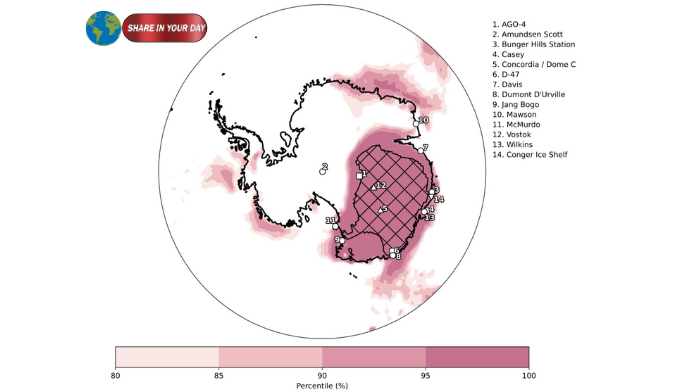
1. Temperatures Soared 28°C Above Normal
During July and August 2024, at the peak of the Antarctic winter, temperatures in East Antarctica rose by as much as 28°C above average—a staggering anomaly in a region where winter temperatures typically plunge below −30°C.
To put this into perspective, scientists noted that a similar anomaly in the United Kingdom would push winter temperatures into summer-like highs exceeding 30°C.
Such an extreme shift is virtually unheard of in the Antarctic winter, making this one of the most dramatic temperature anomalies ever recorded on Earth.
2. A Rare Breakdown of the Polar Vortex
The primary driver behind the Antarctic winter heatwave was a disruption in the polar vortex—a powerful ring of winds that normally traps cold air over the continent.
In 2024, this vortex weakened and became distorted. As a result, unusually warm air entered the upper atmosphere, raising stratospheric temperatures by more than 15°C.
This atmospheric instability triggered a cascade of events, ultimately allowing warm air to penetrate deep into Antarctica—something that rarely happens during winter.
3. “Atmospheric River” Delivered Warm Air Deep Inland
One of the most surprising aspects of the Antarctic winter heatwave was the role of an atmospheric river—a long, narrow band of moisture-laden air that transported heat from lower latitudes into the frozen continent.
This system created a persistent high-pressure zone over East Antarctica, enabling warm, moist air to flow inland for an extended period.
Cloud cover associated with this system acted like a thermal blanket, trapping heat near the surface and preventing it from escaping into space. As a result, the warming lasted for more than two weeks instead of dissipating quickly.
4. Climate Change Made It More Likely—and More Intense
Scientists emphasize that this Antarctic winter heatwave was not just a random weather anomaly. Advanced climate simulations show that human-driven climate change significantly increased both its intensity and likelihood.
According to the study, such extreme events would have been extraordinarily rare in the past. However, in today’s warming world, they are already becoming more probable—and could occur up to 20 times more frequently by the end of the century under high emissions scenarios.
This finding aligns with broader research showing that climate change is altering weather patterns even in regions once considered stable and isolated.
5. Part of a Growing Pattern of Extreme Events
The 2024 winter heatwave did not occur in isolation. It follows a series of alarming climate events in Antarctica, including a 2022 heatwave where temperatures soared nearly 40°C above normal—one of the largest anomalies ever recorded globally.
Together, these events suggest a troubling trend: extreme warming episodes are becoming more frequent in Antarctica, challenging long-held assumptions about the continent’s climate stability.
Why Antarctica Matters to the Whole Planet
Although Antarctica may seem remote, its climate plays a critical role in regulating global systems. The continent stores about 70% of the world’s freshwater in ice form, making it a key factor in sea-level rise.
It is also surrounded by the Southern Ocean, which absorbs vast amounts of heat and carbon dioxide, helping to stabilize global temperatures.
When Antarctica changes, the effects ripple across the planet—from rising sea levels to shifts in weather patterns.
The Role of Ocean and Ice Conditions
The Antarctic winter heatwave was further amplified by unusual ocean and ice conditions. During the event, sea ice levels were near record lows, and surrounding ocean waters were warmer than usual.
This combination likely helped sustain the influx of warm air and prevented rapid cooling, extending the duration of the heatwave.
Scientists have increasingly warned that warming oceans are a major driver of Antarctic change. Heat stored beneath the ocean surface can melt ice shelves from below, destabilizing glaciers and accelerating ice loss.
A Shift in the “Coldest Place on Earth”
Antarctica has long been known as the coldest, driest, and windiest continent on Earth.
However, recent findings suggest that this stability is beginning to erode. While parts of East Antarctica were once considered relatively immune to climate change, events like the 2024 heatwave indicate that even these regions are becoming vulnerable.
This shift challenges decades of scientific understanding and highlights the need for updated climate models.
What This Means for the Future
The Antarctic winter heatwave offers a glimpse into what the future could hold if global temperatures continue to rise.
Researchers warn that:
- Extreme heat events could become more frequent
- Ice shelves may weaken faster than expected
- Sea-level rise could accelerate
- Global weather patterns could become more unpredictable
In addition, disruptions to Antarctic ecosystems—home to species such as penguins, seals, and krill—could have cascading effects on marine food chains.
Global Implications Beyond Antarctica
The consequences of Antarctic warming extend far beyond the polar region. Changes in the continent’s ice and atmosphere can influence global ocean circulation and weather systems.
For example, melting ice contributes directly to rising sea levels, threatening coastal cities worldwide. Meanwhile, shifts in atmospheric patterns can affect rainfall, storms, and temperature extremes in distant regions.
In short, what happens in Antarctica does not stay in Antarctica.
Scientists Urge Immediate Action
The study underscores the urgency of addressing climate change. While natural variability still plays a role in extreme events, the influence of human activity is becoming increasingly clear.
Reducing greenhouse gas emissions, improving climate monitoring, and strengthening international cooperation will be essential to limit future risks.
Scientists also stress the importance of continued research in Antarctica, as the region remains one of the most critical—and least understood—components of the global climate system.
Conclusion
The Antarctic winter heatwave is more than a shocking anomaly—it is a powerful warning. With temperatures rising by up to 28°C during the coldest time of year, the event highlights how rapidly Earth’s climate is changing.
As extreme events become more frequent, the stakes are rising—not just for Antarctica, but for the entire planet. The question is no longer whether change is happening, but how quickly the world will respond.