7 Reasons Pluto Could Become a Planet Again
The Pluto planet debate is back in the spotlight as the icy world marks 20 years since astronomers officially changed its classification. On Aug. 24, 2006, the International Astronomical Union (IAU) voted to classify Pluto as a dwarf planet, reducing the recognized number of planets in our solar system from nine to eight. Two decades later, scientists and space enthusiasts are still asking whether that decision should be reconsidered.
The question is more complicated than a simple campaign to restore Pluto’s old title.
Since the 2006 decision, scientists have learned much more about Pluto and the distant Kuiper Belt. NASA’s New Horizons spacecraft delivered spectacular observations when it flew past Pluto in 2015, revealing mountains, glaciers, a complex atmosphere and the enormous heart-shaped region now known as Tombaugh Regio.
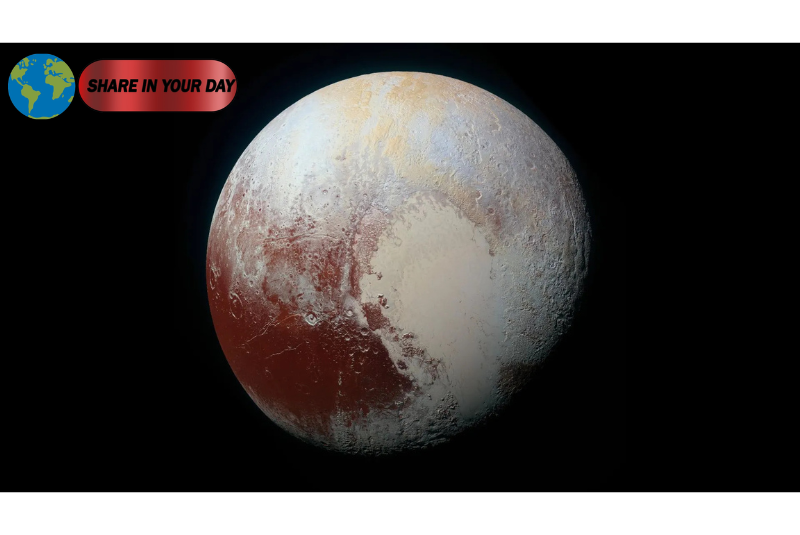
Those discoveries strengthened the argument that Pluto is a fascinating and dynamic world. At the same time, the fundamental problem behind the 2006 decision has not disappeared: Pluto has not cleared its orbital neighborhood.
That leaves astronomy with a compelling question. Could Pluto become a planet again?
1. The Pluto Planet Debate Began With New Discoveries
The story of Pluto’s demotion did not begin in 2006.
For decades after Clyde Tombaugh discovered Pluto in 1930, it was widely recognized as the ninth planet. However, astronomers eventually discovered that Pluto belongs to a much larger population of icy bodies beyond Neptune.
These objects occupy the Kuiper Belt, a vast region containing remnants from the early solar system.
The discovery of increasingly large objects created a serious classification problem. If Pluto was a planet, should similarly sized bodies also receive planetary status?
The discovery of Eris in 2005 made the problem especially urgent. Eris is roughly comparable in size to Pluto, and its discovery forced astronomers to confront an important question: either the solar system might gain several additional planets, or the definition of “planet” needed to change.
The IAU eventually chose the second option.
The result was a new classification system that formally separated planets from dwarf planets.
2. The IAU Definition Put Pluto in a Different Category
The official Pluto planet question comes down largely to one scientific criterion.
According to the IAU’s 2006 definition, a planet must orbit the Sun, have enough mass for gravity to make it nearly round, and have cleared the neighborhood around its orbit. A dwarf planet meets the first two conditions but has not cleared its orbital neighborhood.
Pluto satisfies the first two requirements.
It orbits the Sun, and its own gravity has shaped it into a roughly spherical world.
The problem is the third requirement.
Pluto shares its distant region of the solar system with numerous other objects. Because it has not gravitationally dominated its orbital neighborhood, the IAU classified it as a dwarf planet.
That definition remains the official position today.
The IAU specifically states that Pluto is a dwarf planet and recognizes it as the prototype of a category of trans-Neptunian objects.
So, under the current rules, Pluto has not regained planet status.
3. New Horizons Changed How We See Pluto
If the 2006 debate was largely about orbital dynamics, the 2015 New Horizons mission transformed the public understanding of Pluto itself.
Before the spacecraft’s flyby, Pluto was little more than a distant point of light. Scientists knew its size, orbit and some basic characteristics, but they had never seen its surface up close.
New Horizons changed that dramatically.
The spacecraft revealed a world with towering mountains, broad plains, complex geological structures and a striking heart-shaped feature. Scientists also discovered evidence of active processes that continue to shape Pluto’s surface.
The result was one of the most remarkable planetary encounters in modern space exploration.
For many researchers, these observations reinforced the idea that Pluto is not an insignificant frozen rock. It is a complex world with a fascinating geological history.
That distinction matters because the word “planet” has always carried cultural and scientific meaning.
Pluto’s supporters argue that a classification system should recognize the complexity of these worlds rather than placing them in a category that can sound secondary.
The scientific discoveries did not automatically change Pluto’s classification, but they made the debate much more interesting.
4. Some Scientists Believe Pluto Is Still a Planet
There is no universal agreement among planetary scientists that the IAU’s definition is the best possible way to classify worlds.
Paul Byrne, a planetary astronomer at Washington University in St. Louis, told Space.com that he considers Pluto a planet and believes other dwarf planets should also qualify. He argues that the distinction is ultimately partly semantic and says there is limited scientific benefit in excluding Pluto from the planetary category.
This argument is important because it highlights a fundamental question:
What exactly should the word “planet” describe?
One approach emphasizes orbital dynamics.
Under that framework, a planet must dominate its neighborhood gravitationally. Earth qualifies because it is overwhelmingly dominant in its orbit. Pluto does not.
Another approach focuses more on the physical nature of the object.
Under a geophysical definition, a world that has become round through its own gravity could qualify as a planet regardless of whether it has cleared its orbit.
That alternative would dramatically increase the number of objects considered planets.
Pluto would be joined by several other dwarf planets, including Ceres, Eris, Haumea and Makemake.
The debate therefore extends far beyond Pluto itself.
5. A New Pluto Planet Definition Could Change the Solar System
Changing the definition of a planet would have enormous consequences.
The solar system might no longer contain eight planets.
Depending on the proposed definition, it could contain dozens of planets or potentially many more.
That is one reason astronomers have approached the issue cautiously.
A broader definition could make the term “planet” scientifically more inclusive. It could also make the classification system much more complicated.
Imagine a solar system with dozens of recognized planets. Students would need to learn a much longer list. Textbooks, educational materials and public science resources would need substantial revisions.
Supporters of a broader definition respond that complexity is not necessarily a scientific weakness.
Science often becomes more complicated as knowledge improves.
The solar system itself was once thought to contain only six known planets. Uranus was discovered in 1781, Neptune followed in 1846, and Pluto was discovered in 1930. The number of known worlds has continued to grow as observational technology has improved.
The classification of planets has changed before.
It could change again.
6. The Pluto Planet Debate Is Also About Public Science
The emotional reaction to Pluto’s reclassification is unusual for an astronomical classification decision.
Few people have strong feelings about whether an asteroid belongs to one technical category or another. Pluto is different.
Generations of people grew up learning that it was the ninth planet.
Its demotion became a cultural event.
That popularity can be both helpful and challenging for scientists.
On the positive side, Pluto gives astronomy an extraordinary gateway into public science. People who want to know whether Pluto is a planet often discover the Kuiper Belt, planetary formation, orbital dynamics and the history of space exploration along the way.
However, the debate can also distract from Pluto’s scientific significance.
Byrne told Space.com that when he discusses planets publicly, audiences often focus on why Pluto was demoted rather than asking about its remarkable geological features, including nitrogen glaciers and its giant heart-shaped region.
That observation highlights an important point.
Pluto does not need to be a planet to be scientifically extraordinary.
Its current classification does not make it less interesting.
7. Pluto Could Regain Its Title — But It Would Take a Major Scientific Shift
So, will Pluto become a planet again?
It is possible, but there is currently no indication that the IAU is preparing to reverse its 2006 decision.
For Pluto to regain official planet status, astronomers would need to revisit the definition or adopt a different classification framework.
That could happen if scientific opinion increasingly favors a geophysical definition or if researchers conclude that the existing orbital-clearance criterion does not adequately describe planetary worlds.
The debate has already received renewed public attention.
In 2026, NASA Administrator Jared Isaacman publicly expressed support for the “make Pluto a planet again” position, helping reignite the discussion among researchers and the public. Nature reported that scientists responded to his comments and that the issue remains divisive within planetary science.
However, public enthusiasm alone is unlikely to change the official classification.
Astronomy requires definitions that can be applied consistently across many objects.
If Pluto becomes a planet again, scientists would also have to decide what happens to Eris, Ceres, Haumea, Makemake and other worlds.
That is the real challenge.
What Makes Pluto So Special?
The strongest argument for Pluto may not be its planetary label at all.
It is a remarkably complex world.
Pluto has a thin atmosphere that changes as it travels along its elongated orbit around the Sun. Its surface contains nitrogen, methane and carbon monoxide ices. Its landscape includes mountains and broad plains, while its massive heart-shaped region has become one of the most recognizable features in the solar system.
New Horizons also revealed that Pluto is not alone.
The spacecraft discovered a fascinating system of moons, including Charon, Pluto’s largest companion. The relationship between Pluto and Charon is unusual because their sizes are relatively close compared with most planet-moon systems.
These features make Pluto an important laboratory for understanding the outer solar system.
The dwarf planet may preserve clues about the early history of planetary formation. Studying it can help scientists understand how icy worlds formed and evolved far from the Sun.
In that sense, Pluto’s scientific value is secure regardless of what appears next to its name in a textbook.
The Bigger Question: What Is a Planet?
The continuing Pluto planet debate ultimately raises a much larger scientific question.
A planet is not simply a large round object.
If size were the only requirement, the classification would be relatively straightforward. But planetary systems contain objects with different compositions, masses, orbital relationships and histories.
The IAU chose orbital dominance as one of its defining characteristics. Critics argue that this places too much emphasis on where an object is located rather than what the object physically is.
Both approaches offer useful insights.
The IAU’s definition creates a relatively manageable classification system. The geophysical approach emphasizes the physical characteristics of worlds.
Neither perspective makes Pluto less fascinating.
The debate is valuable precisely because it encourages scientists and the public to examine what classifications are supposed to accomplish.
Pluto’s Future Could Be Bright Regardless of Its Name
Twenty years after the IAU vote, Pluto remains one of the most recognizable objects in the solar system.
Its official status is still that of a dwarf planet. The IAU’s definition has not changed, and Pluto has not met the orbital-clearance criterion required for full planetary status.
Yet the conversation surrounding Pluto has evolved.
New Horizons demonstrated that this distant world is far more complex than scientists once imagined. New arguments about planetary definitions have challenged the assumption that there is only one obvious way to classify worlds. And renewed public debate has ensured that Pluto remains firmly in the scientific conversation.
Whether Pluto eventually regains its old title is uncertain.
What is much clearer is that Pluto has already earned something arguably more important: a permanent place in humanity’s exploration of the solar system.
The little world that once seemed to be the mysterious ninth planet is now a gateway to a much larger realm of icy bodies beyond Neptune.
And that makes Pluto’s story far from finished.
Related Reading
Internal link suggestions: Link this article to existing stories on your website about NASA’s New Horizons mission, the Kuiper Belt, dwarf planets, Eris, and the history of Pluto’s discovery.
External sources: For authoritative background, readers can explore the International Astronomical Union’s official 2006 planet definition, along with NASA’s resources on Pluto and the New Horizons mission.