Nancy Grace Roman Space Telescope: 5 Big Discoveries
The Nancy Grace Roman Space Telescope is preparing to begin one of NASA’s most ambitious astronomy missions of the decade. Scheduled for launch aboard a SpaceX Falcon Heavy rocket on August 30, 2026, the observatory is designed to investigate some of the biggest unanswered questions in modern science, including the nature of dark energy, the distribution of dark matter and the abundance of planets beyond our solar system.
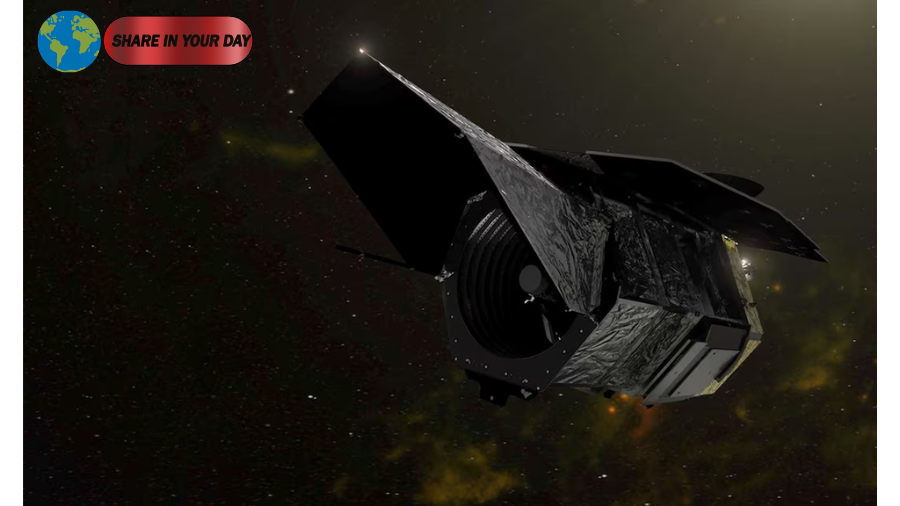
The telescope represents a new approach to space astronomy. Instead of focusing primarily on small areas of the sky in extraordinary detail, Roman is designed to capture enormous panoramic views. Its Wide Field Instrument will have a field of view at least 100 times larger than Hubble’s while maintaining comparable infrared resolution.
That combination could transform how scientists study the universe.
NASA expects Roman to survey billions of cosmic objects during its mission. Scientists will use that enormous dataset to investigate how galaxies formed, how the universe expanded, how planets are distributed throughout the Milky Way and whether fundamental theories of physics continue to work on the largest scales.
Nancy Grace Roman Space Telescope Targets Dark Energy
One of the most important objectives of the Nancy Grace Roman Space Telescope is to investigate dark energy, the mysterious phenomenon associated with the accelerating expansion of the universe.
Astronomers discovered in the late 1990s that the universe is not merely expanding. Its expansion is accelerating. The discovery fundamentally changed modern cosmology and raised a difficult question: What is causing the acceleration?
Dark energy is one possible explanation.
However, scientists still do not know exactly what dark energy is. It could behave like a constant property of space, or its influence could change over cosmic history. Another possibility is even more profound: perhaps our current understanding of gravity needs to be modified when it is applied across enormous cosmic distances.
Roman is designed to help distinguish between these possibilities.
Its wide surveys will allow astronomers to measure enormous populations of galaxies and other cosmic objects. By studying their distribution and evolution, researchers can reconstruct how the universe has changed over billions of years.
NASA says Roman will use its enormous survey capability to examine the cosmic structures that encode information about the universe’s expansion.
This is particularly important because cosmologists increasingly rely on multiple independent measurements to test the standard model of the universe.
Roman will therefore not simply produce spectacular astronomical images. Its larger contribution may be statistical: gathering enough observations to determine whether subtle patterns in the universe are real.
Roman Could Transform the Study of Dark Matter
Dark energy is not the only invisible mystery on Roman’s target list.
The telescope will also investigate dark matter, another substance that cannot be observed directly with conventional telescopes.
Scientists infer the existence of dark matter from its gravitational effects. Galaxies and galaxy clusters behave as though they contain substantially more mass than can be accounted for by stars, gas and other visible material.
Roman will help scientists map these effects across enormous portions of the sky.
One important technique is gravitational lensing. When light from a distant galaxy passes through regions containing massive amounts of matter, gravity can slightly distort the light’s apparent shape and position.
Those distortions can reveal information about otherwise invisible matter.
By measuring huge numbers of galaxies, Roman will provide researchers with a much larger statistical sample for studying how matter is distributed throughout the universe.
That matters because dark matter appears to play a central role in the formation of cosmic structures. Galaxies and galaxy clusters did not emerge randomly. Their development was influenced by the underlying distribution of matter in the early universe.
Roman’s observations could therefore help scientists understand how the cosmic web developed over billions of years.
The telescope’s ability to combine a large field of view with high-quality infrared observations makes it particularly valuable for this type of research. NASA says Roman will survey the sky far faster than Hubble while maintaining similar sensitivity and infrared resolution.
Nancy Grace Roman Space Telescope Will Hunt Thousands of Exoplanets
The Nancy Grace Roman Space Telescope will also turn its attention much closer to home.
Scientists have already confirmed thousands of exoplanets, or planets orbiting stars beyond the Sun. Yet the known population represents only a fraction of the planets believed to exist throughout the Milky Way.
Roman is expected to significantly expand that catalog.
One of its key techniques will be gravitational microlensing. This method can detect planets that are difficult to find using more familiar techniques such as the transit method.
Microlensing occurs when the gravity of a foreground star bends and magnifies light from a more distant star. If a planet is orbiting the foreground star, its gravitational influence can create a brief additional signal.
That signal can reveal the planet.
The technique is particularly useful because it can detect planets at relatively large distances from their host stars. It can also identify worlds that would otherwise be extremely difficult to observe.
NASA says Roman’s microlensing survey is expected to find more than 1,000 exoplanets, while the mission overall is expected to discover thousands of additional worlds.
This could give astronomers something they have never had before: a much broader statistical picture of planetary systems.
Instead of asking only whether a particular planet exists, researchers will be able to ask larger questions.
How common are planetary systems like our own?
How frequently do planets form far from their host stars?
How many small planets exist in the Milky Way?
And what kinds of planetary systems are most common?
Those questions could eventually influence the search for potentially habitable worlds.
Roman Will Complement Hubble and Webb
The arrival of the Nancy Grace Roman Space Telescope does not mean NASA is replacing Hubble or the James Webb Space Telescope.
Instead, Roman is designed to work alongside them.
Hubble remains famous for producing detailed observations across visible, ultraviolet and some infrared wavelengths. Webb, meanwhile, specializes in powerful infrared observations and is capable of examining extremely distant galaxies, stars and planetary systems.
Roman occupies a different niche.
Its greatest strength is its enormous field of view.
NASA says Roman’s primary mirror is approximately the same size as Hubble’s, at 2.4 meters, but its Wide Field Instrument can capture an area of sky at least 100 times larger.
That difference is critical.
Imagine Hubble as a powerful camera capable of examining a small section of a giant landscape in exceptional detail. Roman is designed more like a wide-angle camera capable of surveying a vast portion of that landscape while retaining impressive resolution.
The two approaches complement each other.
Roman can survey huge regions and identify interesting objects or phenomena. Hubble and Webb can then conduct more detailed follow-up observations.
NASA specifically describes Roman and Webb as complementary observatories, with Roman’s broad surveys helping identify targets that Webb can examine in greater detail.
A Telescope Built for an Era of Big Data
Another major feature of the Nancy Grace Roman Space Telescope is the sheer amount of information it is expected to produce.
Modern astronomy is increasingly becoming a big-data science. Powerful telescopes can now observe enormous numbers of galaxies, stars and transient events.
Roman is built for that environment.
Its Wide Field Instrument is a large-format camera with hundreds of millions of pixels. NASA says it will be capable of surveying huge portions of the sky rapidly, producing datasets that can be analyzed by scientists around the world.
That means Roman’s scientific impact could extend well beyond its primary mission objectives.
Astronomers may use its data to study galaxy formation, stellar evolution, black holes, transient objects and other phenomena that are not yet known.
In other words, some of Roman’s most important discoveries could be the ones scientists are not specifically looking for today.
Large surveys are particularly valuable because unexpected objects can emerge when billions of observations are combined.
Why the August 30 Launch Matters
NASA and SpaceX are currently targeting August 30, 2026, for the Roman launch from Launch Complex 39A at NASA’s Kennedy Space Center in Florida. The telescope will travel aboard a SpaceX Falcon Heavy.
The launch is notable for another reason.
NASA says the mission is launching roughly eight to nine months earlier than previously expected. The accelerated schedule reflects the completion of major preparation and readiness milestones. NASA and SpaceX completed a Flight Readiness Review on August 21, clearing the mission to proceed toward final launch preparations.
After launch, Roman will travel to the Sun-Earth Lagrange Point 2, commonly called L2.
The location is approximately one million miles from Earth. At L2, Roman will be positioned in a region that provides a stable observing environment and an unobstructed view of much of the universe.
The telescope is designed for a primary mission lasting about five years, with NASA planning for a possible extended mission of up to another five years.
The Legacy of Nancy Grace Roman
The telescope is named after Nancy Grace Roman, NASA’s first chief astronomer and one of the key figures responsible for advancing the agency’s space-based astronomy program.
Roman played an important role in developing the scientific and institutional foundation that eventually led to the Hubble Space Telescope.
Her legacy makes the name especially appropriate.
Hubble changed humanity’s understanding of the universe by showing that distant galaxies, stars and cosmic structures could be studied in extraordinary detail from space.
The Nancy Grace Roman Space Telescope is designed to take another step forward by giving scientists an enormous panoramic view of the cosmos.
NASA describes Roman as a next-generation observatory intended to answer fundamental questions about dark energy, exoplanets and infrared astrophysics.
What Could Roman Discover?
The most exciting aspect of the mission is that its results remain unknown.
Scientists have clearly defined the questions they want Roman to investigate. But the telescope could produce answers that challenge existing theories.
It could find evidence that dark energy changes over time.
It could improve scientists’ understanding of the invisible dark matter structure surrounding galaxies.
It could reveal thousands of previously unknown exoplanets.
It could identify unusual planetary systems.
It could uncover transient cosmic events that would otherwise go unnoticed.
And it could provide evidence that forces physicists to reconsider how gravity works across the universe.
That is the promise of a major astronomical survey.
The Nancy Grace Roman Space Telescope is not designed simply to take another set of beautiful space photographs. Its purpose is to collect an enormous amount of evidence about how the universe works.
A New Chapter in Space Astronomy
NASA’s upcoming Roman mission represents a major transition in astronomy.
Hubble demonstrated the extraordinary value of observing the universe from space. Webb expanded humanity’s ability to study faint and distant infrared objects. Roman will add something different: scale.
Its huge field of view will allow scientists to observe cosmic structures across enormous regions of the sky while maintaining high-quality infrared observations.
That combination could make Roman one of the most productive astronomical observatories of the next decade.
The telescope’s launch is now approaching rapidly. NASA says the mission is scheduled for August 30 aboard Falcon Heavy, with scientists preparing to use its surveys to investigate dark energy, dark matter, exoplanets and many other areas of astrophysics.
If everything proceeds as planned, Roman will soon begin a journey to L2 and eventually open a new panoramic window onto the universe.
The biggest discoveries may not come from a single spectacular image.
They may come from billions of measurements that reveal patterns scientists have never been able to see before.