Falcon 9 Jellyfish Cloud Lights Up the East Coast
A Falcon 9 jellyfish cloud created a spectacular pre-dawn display across parts of the U.S. East Coast on Tuesday, August 25, after a SpaceX rocket launched from Florida. The unusual glowing shape briefly appeared in the sky as the rocket’s exhaust expanded high above Earth and caught sunlight.
The phenomenon quickly attracted attention from early-morning observers. People in areas ranging from Florida to the Mid-Atlantic and New York reported seeing what looked like a giant glowing jellyfish drifting across the dark sky.
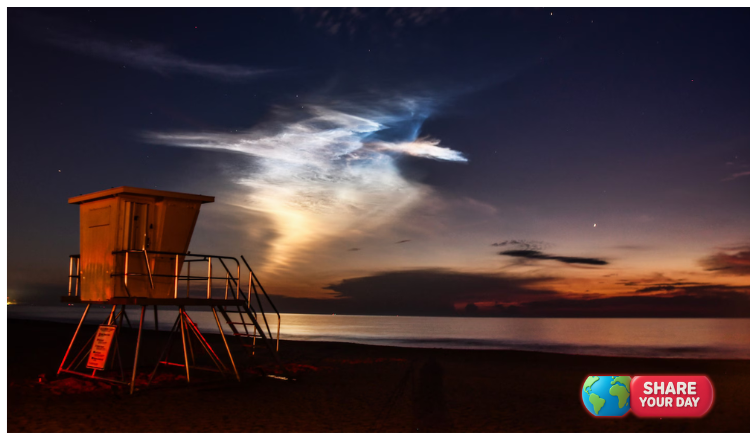
Although the sight appeared mysterious, scientists and meteorologists say the effect is a known consequence of rocket launches under the right atmospheric and lighting conditions.
The display was especially striking because the launch occurred before sunrise. While the ground remained dark, sunlight was already reaching the rocket’s exhaust at high altitude.
That combination created the brilliant contrast that made the plume resemble a massive jellyfish.
What Caused the Falcon 9 Jellyfish Cloud?
The Falcon 9 jellyfish cloud was not a conventional weather cloud.
Instead, it was created by the exhaust plume produced by the Falcon 9 rocket. As the rocket climbed through the atmosphere, its exhaust expanded dramatically at high altitude.
The plume then interacted with sunlight. Because the launch happened during the early morning hours, the Sun was below the horizon for people on the ground but was still illuminating material much higher in the atmosphere.
That helped produce the glowing appearance.
The Washington Post described the phenomenon as a human-made “noctilucent” cloud, noting that it was both rare and spectacular but visible for only a short period.
The effect can make the exhaust plume appear disconnected from the rocket itself. As it expands, the material can take on unusual shapes, including a broad head and trailing structure that resembles a jellyfish.
This is why rocket launches can sometimes produce some of the most unusual-looking objects in the night or early-morning sky.
SpaceX Falcon 9 Launch Created the Spectacular Display
The rocket responsible for Tuesday’s spectacle was a SpaceX Falcon 9 launched from Florida.
According to Reuters, the rocket carried 29 Starlink satellites and lifted off from Cape Canaveral on August 25. The mission’s first-stage booster completed its 37th flight, highlighting the increasingly routine use of reusable Falcon 9 hardware.
The launch took place shortly after 5:30 a.m. local time, creating ideal conditions for the dramatic visual effect.
The timing mattered.
Had the rocket launched in broad daylight, the plume would likely have been much less visible. If it had launched much later at night, there would have been less sunlight available to illuminate the exhaust at high altitude.
The pre-dawn window provided the unusual combination needed for the phenomenon.
Why the Cloud Looked Like a Giant Jellyfish
The shape of the plume was one of the most remarkable parts of the event.
Rocket exhaust does not simply form a straight line behind a vehicle. At high altitudes, where atmospheric pressure is much lower, exhaust gases can expand rapidly.
As the material spreads, winds and atmospheric conditions can further distort the plume.
From the ground, this can create a large illuminated structure with a bulbous upper section and long trailing extensions.
That shape can look remarkably similar to a jellyfish.
The effect has become informally known among skywatchers as a “space jellyfish” or “jellyfish cloud.” Similar displays have been observed after other rocket launches when lighting and atmospheric conditions align.
Tuesday’s event was particularly notable because the plume could be seen from a broad area of the East Coast.
The Falcon 9 Jellyfish Cloud Was Visible Across a Wide Area
Observers in multiple states were able to see the unusual display.
Reports and images showed the glowing plume over parts of Florida and farther north along the East Coast. Reuters also documented the jellyfish-shaped exhaust plume over New York City following the Florida launch.
The phenomenon was also visible around the Washington, D.C., region.
The Capital Weather Gang reported that the pre-dawn SpaceX launch produced a spectacular glowing display visible across much of the East Coast.
That wide visibility was possible because the plume formed high above the surface.
Objects at great altitude can remain visible over large distances, especially when they are illuminated against a dark background.
For people who happened to be awake before sunrise, the result looked almost otherworldly.
Why Early Morning Was Perfect for the Display
The timing of Tuesday’s Falcon 9 launch was crucial.
Before sunrise, the Earth’s surface can still be in darkness while the upper atmosphere is already exposed to sunlight. This creates a natural stage for high-altitude rocket exhaust to glow.
The situation is similar to why high-altitude clouds can remain brightly illuminated after sunset.
From the ground, observers see darkness. Higher up, however, sunlight can still reach the material.
The rocket’s exhaust therefore became visible as a glowing plume against the dark sky.
This contrast is what helped turn an ordinary launch into a dramatic atmospheric spectacle.
Not a Dangerous Weather Cloud
Despite its unusual appearance, the Falcon 9 jellyfish cloud was not a dangerous weather system.
It was a temporary plume created by the rocket launch.
The phenomenon also did not represent a new type of storm or atmospheric disturbance. Instead, it was a visual effect caused by rocket exhaust, altitude, sunlight and atmospheric conditions.
The display disappeared relatively quickly as the exhaust dispersed.
That short lifespan is another reason the phenomenon can seem mysterious to people who see it unexpectedly.
One moment the sky appears normal. Minutes later, a giant glowing structure can appear overhead.
Then it fades away.
SpaceX Launches Are Becoming More Frequent
The spectacle also highlights how frequently SpaceX is launching Falcon 9 rockets.
Falcon 9 has become one of the world’s most heavily used orbital launch vehicles, particularly because its first stage can be recovered and reused.
The August 25 mission continued that trend.
Reuters reported that the booster used in the launch completed its 37th flight, demonstrating how SpaceX has pushed rocket reuse to increasingly high levels.
The company is conducting frequent Starlink missions as it expands its satellite internet network.
That growing launch cadence means more opportunities for unusual rocket-plume displays.
However, not every launch produces a visible jellyfish.
The right combination of launch timing, trajectory, altitude, atmospheric conditions and sunlight is required.
Why Rocket Launches Can Create Strange Sky Effects
Rocket launches can produce a variety of unusual visual phenomena.
Depending on the time and location of a launch, observers may see glowing plumes, unusual spirals, bright streaks or expanding clouds.
The physics behind these effects is relatively straightforward.
Rocket engines release exhaust gases and other combustion products at extremely high speeds. As the rocket reaches thinner portions of the atmosphere, the exhaust can expand substantially.
At the same time, the position of the Sun determines whether the plume is illuminated.
When those factors line up, the exhaust can become visible from hundreds of miles away.
The resulting shapes can appear completely unfamiliar to people who have never watched a rocket launch.
The Falcon 9 Jellyfish Cloud Was a Short-Lived Event
One of the most striking characteristics of the August 25 display was how quickly it appeared and disappeared.
The Washington Post reported that the unusual cloud was visible for only a short period for early risers.
That limited window meant that many people likely missed the phenomenon entirely.
Others had only a few minutes to photograph or record it.
Social media images and videos quickly spread as observers shared their views of the glowing plume.
For people unfamiliar with rocket-launch effects, the images could easily look like something from science fiction.
But the explanation was much more terrestrial: a rocket, its exhaust and the rising Sun combined to create a remarkable atmospheric illusion.
A Reminder of How Spaceflight Changes the Night Sky
The Falcon 9 jellyfish cloud is also a reminder that modern spaceflight increasingly affects what people see in the sky.
Decades ago, unusual rocket plumes were relatively rare experiences for most people.
Today, frequent commercial launches mean more communities can witness these displays.
SpaceX’s reusable Falcon 9 system has contributed significantly to that change.
Regular launches carrying Starlink satellites and other payloads have made rocket activity a more familiar part of the modern sky.
Yet events like Tuesday’s remain special because the conditions have to be just right.
The rocket may be routine.
The resulting sky show is not.
What Makes a “Space Jellyfish” So Rare?
A rocket launch alone does not guarantee a jellyfish effect.
Several factors need to align.
First, the launch must occur when the upper atmosphere can still receive sunlight while the ground remains relatively dark. Second, the rocket needs to reach an altitude where its exhaust can expand significantly.
Atmospheric winds and temperature conditions can also influence the final shape.
Finally, the viewing angle matters.
Two observers located in different places can see very different shapes because they are looking at the same plume from different perspectives.
This combination makes spectacular jellyfish displays relatively uncommon.
The Viral Appeal of the Falcon 9 Jellyfish Cloud
The visual quality of the event also helped it spread rapidly online.
A glowing object resembling a giant jellyfish is naturally eye-catching.
For people unfamiliar with rocket launches, the first reaction may be confusion. Some observers might wonder whether they are seeing a strange cloud, an astronomical object or something else entirely.
Once the connection to the SpaceX launch becomes clear, however, the mystery quickly turns into fascination.
The event combines technology and atmospheric science in a way that is easy to appreciate even without specialist knowledge.
That makes rocket jellyfish displays particularly effective at capturing public attention.
What the August 25 Launch Means for Future Skywatchers
As SpaceX and other companies continue launching rockets at a high frequency, similar displays will likely occur again.
That does not mean every launch will produce a spectacular plume.
Instead, skywatchers can watch for launches scheduled near sunrise or sunset, when high-altitude exhaust has a greater chance of catching sunlight against a dark sky.
Launch forecasts and local weather conditions can help determine whether a display might be visible.
However, predicting the exact appearance remains difficult.
Atmospheric conditions can change the shape and brightness of the plume, making every event somewhat different.
Falcon 9 Jellyfish Cloud Turns Rocket Launch Into Sky Show
The Falcon 9 jellyfish cloud seen across the East Coast on August 25 was a striking example of how modern spaceflight can create unexpected beauty in the atmosphere.
A SpaceX Falcon 9 launched from Florida carrying Starlink satellites, but the rocket produced more than a routine trip to orbit. Its high-altitude exhaust expanded into a glowing, jellyfish-shaped formation that was visible to early risers across a wide region.
The science behind the phenomenon is straightforward, but the visual result was extraordinary.
Sunlight illuminated the expanding exhaust high above the Earth while the ground remained in darkness. That created the glowing effect that made the plume appear like a giant jellyfish floating through the sky.
For a few brief minutes, a routine commercial space launch became a spectacular public sky show.
As rocket launches become more frequent, such displays may become increasingly familiar. But each one remains dependent on a precise combination of timing, altitude, sunlight and atmospheric conditions.
Tuesday’s Falcon 9 launch delivered exactly that combination — creating one of the most memorable rocket-launch sights of the summer.