Taiwan Drone Spending: $7.6B Plan Approved
Taiwan drone spending is set for a major expansion after the island’s opposition-controlled parliament rejected the government’s proposed special budget for military drones and approved an alternative six-year funding plan.
Lawmakers on Thursday rejected the government’s proposed T$210 billion ($6.6 billion) special budget, which was designed to accelerate the purchase of roughly 210,000 military drones by 2031. Instead, parliament approved a separate plan totaling T$240 billion, or about $7.6 billion, with spending set at T$40 billion per year in principle.
The decision highlights a growing political dispute over how Taiwan should strengthen its defenses as tensions with China remain high. It also raises questions about how quickly Taiwan can build a large domestic drone industry and whether the parliament’s spending limits could slow military preparations.
Taiwan Drone Spending Faces Political Showdown
The government’s original proposal was presented as an urgent defense measure.
Officials argued that modern conflicts, particularly the wars in Ukraine and the Middle East, have demonstrated the growing importance of unmanned systems. Drones can provide surveillance, reconnaissance, targeting and strike capabilities while allowing militaries to deploy large numbers of relatively inexpensive systems.
Taiwan says that lesson is particularly important because of the military threat posed by China.
Beijing claims Taiwan as part of its territory and has not renounced the use of force to bring the island under its control. Taiwan’s government rejects Beijing’s sovereignty claims and says the island’s future can be decided only by its people.
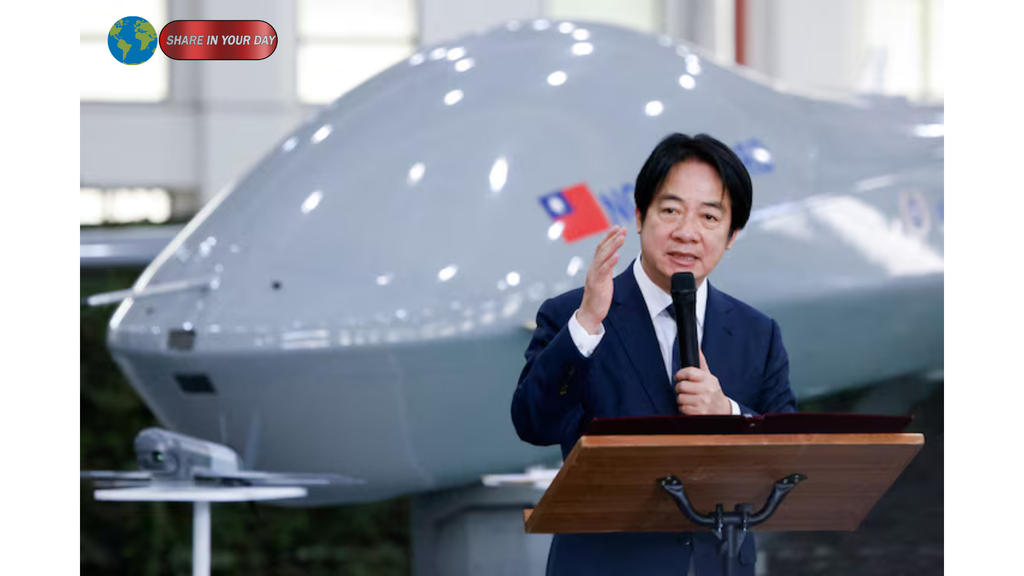
President Lai Ching-te had urged lawmakers to approve the government’s T$210 billion package.
The proposal would have financed the acquisition of approximately 210,000 drones through 2031. The government viewed the special budget as a way to move faster than conventional annual appropriations would allow.
However, opposition lawmakers rejected that approach.
Parliament Approves a $7.6 Billion Alternative
Instead of the government’s special budget, the opposition-controlled parliament approved its own funding framework.
The alternative amounts to T$240 billion over six years. Spending would generally be capped at T$40 billion annually, although the legislation allows the amount to be increased if necessary.
The crucial difference is how the money will be allocated.
The government’s proposal relied on a special budget. The opposition plan draws the funding from Taiwan’s regular annual budget, giving lawmakers greater opportunity to scrutinize and supervise spending.
That distinction has become central to the political battle.
Opposition lawmakers say large-scale defense spending should not be approved without adequate oversight. Hsu Chiao-hsin, a lawmaker from the Kuomintang, argued that the government should not be able to repeatedly request large sums without sufficient parliamentary supervision.
The government, however, says the issue is not simply about accounting or political control.
Officials argue that the security situation requires rapid investment.
Why Taiwan Wants So Many Military Drones
The proposed scale of the program is striking.
Taiwan’s government wants to build or acquire a large fleet of unmanned systems capable of supporting its armed forces across multiple missions.
The emphasis reflects the changing character of warfare.
In Ukraine, drones have become an essential component of battlefield operations. Small unmanned aircraft can conduct reconnaissance, locate targets and provide real-time information to troops. Larger systems can carry weapons or operate over longer distances.
The conflicts have also demonstrated that drones can be produced and deployed in very large numbers.
Taiwan is studying those lessons as it prepares for a potential conflict with a much larger military power.
President Lai has described drones as an important part of Taiwan’s effort to develop an asymmetric defense capability. The strategy is intended to allow Taiwan to use comparatively inexpensive and widely distributed systems to complicate the operations of a more powerful adversary.
Defense Minister Warns of a Spending Gap
Taiwan’s Defense Minister Wellington Koo has warned that the T$40 billion annual limit could create problems for the military’s plans.
According to Reuters, Taiwan’s defense ministry had already planned to spend T$42.1 billion on drones in 2027 alone.
That figure is higher than the annual amount specified in the opposition-backed proposal.
Koo has therefore argued that the cap could prevent Taiwan from developing its drone combat capabilities as quickly as planned.
The disagreement illustrates a larger problem.
Taiwan wants to accelerate military modernization, but lawmakers are divided over how much money should be committed and how quickly it should be released.
The dispute is particularly significant because the island’s broader defense budget is already increasing.
Taiwan’s Wider Defense Budget Is Rising
The drone dispute comes as Taiwan prepares for a major increase in overall military spending.
Taiwan has proposed a 2027 defense budget of T$1.1225 trillion, according to Reuters. That would represent an increase of about 16% and push defense spending above 3% of gross domestic product.
The proposed budget includes funding for drones and other weapons systems.
Taiwan has increasingly emphasized military preparedness as Chinese military activity around the island continues.
President Lai has repeatedly argued that stronger defenses can help preserve peace by making any potential attack more difficult and costly.
The government has also sought to increase domestic defense production rather than relying entirely on foreign suppliers.
Taiwan Wants a Domestic Drone Supply Chain
The drone program is not only about buying military equipment.
It is also about developing an industrial base capable of producing unmanned systems at scale.
Taiwan’s government has been working to establish a domestic drone supply chain that can support military requirements while reducing dependence on potentially vulnerable foreign sources.
That objective has become increasingly important because Taiwan sits at the center of tensions between China and the United States.
The United States has strongly supported Taiwan’s efforts to develop military drones, according to Reuters.
Building a domestic industry could also create economic benefits.
A successful drone sector could involve manufacturers of aircraft, sensors, communications equipment, batteries, software and other components. It could also strengthen Taiwan’s broader technology and manufacturing capabilities.
However, creating such an industry requires more than government funding.
Companies need long-term contracts, production capacity, skilled workers, reliable components and access to advanced technologies.
Opposition Demands Greater Oversight
The parliamentary vote also reflects Taiwan’s increasingly divided domestic politics.
The Democratic Progressive Party controls the presidency, but opposition parties control parliament. That division has repeatedly produced disputes over government budgets.
Opposition lawmakers have argued that the government’s proposed special budget would give the executive branch too much freedom over defense spending.
Their alternative seeks to place drone funding within the regular budget process.
From the opposition’s perspective, that approach provides greater transparency and allows lawmakers to examine spending on an annual basis.
The government sees the issue differently.
Officials fear that ordinary budget negotiations could create delays at a time when Taiwan wants to rapidly expand its military capabilities.
That concern is based partly on recent experience.
Budget Delays Create New Concerns
Taiwan’s ruling Democratic Progressive Party has warned that parliamentary delays could affect both national security and the drone industry.
Lawmakers previously delayed approval of the island’s annual budget for months.
Fan Yun, a lawmaker from the ruling party, said there was no guarantee that next year’s budget process would move smoothly. If the overall budget review is delayed again, she warned, it could create uncertainty for companies developing drone technology as well as for urgent defense requirements.
That concern matters because defense manufacturers often need predictable funding.
Companies may hesitate to expand factories or hire workers if they cannot be certain that government contracts will be approved on schedule.
For Taiwan, the issue is therefore larger than a single budget vote.
It involves whether the island can build a reliable defense-industrial ecosystem quickly enough to meet its strategic objectives.
China Watches Taiwan’s Military Expansion
The drone spending dispute is unfolding against the backdrop of increasingly tense relations between Taiwan and China.
Beijing considers Taiwan part of China and strongly opposes moves it interprets as supporting permanent independence.
Taiwan, meanwhile, has expanded its military preparations and emphasized its determination to defend itself.
President Lai has described stronger defense capabilities as necessary to protect peace.
In recent remarks commemorating the 1958 Taiwan Strait crisis, Lai said peace must be actively safeguarded and highlighted Taiwan’s commitment to defense spending. Reuters reported that Taiwan’s 2027 military budget is expected to exceed T$1 trillion.
The increased focus on drones fits into this broader strategy.
Unmanned systems could potentially allow Taiwan to distribute military capabilities across a large number of relatively inexpensive platforms, making it harder for an adversary to eliminate Taiwan’s capabilities with a limited number of attacks.
The Ukraine Lesson Is Central to Taiwan’s Strategy
One reason drones have become such a priority is the experience of the war in Ukraine.
Both sides have used drones extensively for surveillance and attacks. The technology has evolved rapidly, with militaries and private companies continuously developing new systems.
Taiwanese officials have studied those developments closely.
The lesson is not simply that drones are useful.
It is that modern militaries may need thousands or even hundreds of thousands of unmanned systems, along with the industrial capacity to replace losses quickly.
That is one reason the government’s proposed target of approximately 210,000 drones is so significant.
The objective suggests Taiwan wants to treat drones as a major component of its military inventory rather than as a limited specialist capability.
What the Vote Means for Taiwan
The parliamentary decision does not eliminate Taiwan’s drone ambitions.
Instead, it changes how those ambitions will be financed.
The approved alternative provides more total funding over six years than the government’s original T$210 billion proposal, but it places greater emphasis on annual budget allocations and parliamentary oversight.
That could give lawmakers more control.
At the same time, the annual T$40 billion framework could make it harder for the Defense Ministry to execute its original plans if spending needs rise above that level.
The result could be a slower or more complicated procurement process.
Much will depend on how future annual budgets are approved and whether lawmakers agree to increase funding when military requirements change.
A Critical Test for Taiwan’s Defense Industry
Taiwan’s drone program has become an important test of the island’s ability to combine technology, industry and national security.
Taiwan already possesses a world-class technology sector. But military production involves different requirements from commercial electronics manufacturing.
Defense companies must meet strict military specifications, maintain secure supply chains and produce equipment reliably over long periods.
The government also wants to avoid excessive dependence on China-linked supply chains.
That means Taiwan must develop domestic sources for critical components while maintaining access to trusted foreign technologies.
The success or failure of the drone program could therefore have implications beyond the military.
It could influence Taiwan’s emerging defense industry and its position in the wider global unmanned-systems market.
What Happens Next?
The immediate question is whether Taiwan’s government will accept the parliament’s alternative funding framework.
Premier Cho Jung-tai said after the vote that the government would carefully consider the legislation in terms of national requirements, defense self-reliance and development of the drone and unmanned-vehicle industry.
Taiwan’s Defense Ministry has already expressed regret that the original government proposal was rejected.
The ministry said its plan was developed after extensive internal assessments and coordination with unnamed allied countries.
The debate is therefore unlikely to end with Thursday’s vote.
Further negotiations may determine how much money is ultimately available each year and whether additional funding can be released when required.
Taiwan’s Drone Strategy Enters a New Phase
The latest parliamentary decision sends a complicated message.
On one hand, Taiwan has approved T$240 billion over six years for drone-related military spending. That represents a substantial commitment to unmanned warfare.
On the other hand, lawmakers rejected the government’s preferred mechanism for spending the money and imposed a principle of T$40 billion in annual funding.
The disagreement reflects a fundamental tension between speed and oversight.
Taiwan’s government wants to move quickly because it believes the military balance across the Taiwan Strait requires urgent preparation. Opposition lawmakers want stronger parliamentary control over major expenditures.
Both concerns are likely to remain central as Taiwan expands its defense capabilities.
For now, the island’s drone ambitions remain firmly in place.
The question is how quickly Taiwan can turn billions of dollars in planned spending into factories, supply chains and operational military capabilities.
As modern warfare continues to demonstrate the growing importance of unmanned systems, Taiwan’s answer could have consequences far beyond its own defense industry.
Source: Reuters, August 27, 2026. The article has been independently cross-checked against additional Reuters reporting on Taiwan’s defense budget and drone strategy.
Suggested external links: Reuters coverage of Taiwan’s drone spending vote · U.S. Office of the Secretary of Defense
Suggested internal link: Add a link to your site’s existing article about Taiwan-China tensions, Taiwan’s 2027 defense budget, or military drone technology.