
Northern Lights Forecast Puts 11 States on Alert
The Northern Lights Forecast is giving skywatchers across the northern United States another reason to look up this week. Multiple coronal mass ejections, or CMEs, are moving through space after a period of heightened solar activity, creating the possibility of aurora displays across parts of the country.

The latest forecast points to increased geomagnetic activity around Sept. 8 and into Sept. 9. Alaska and several northern states could have opportunities to see the aurora if the skies remain dark and clear. However, the exact visibility will depend on how the incoming solar material interacts with Earth’s magnetic field.
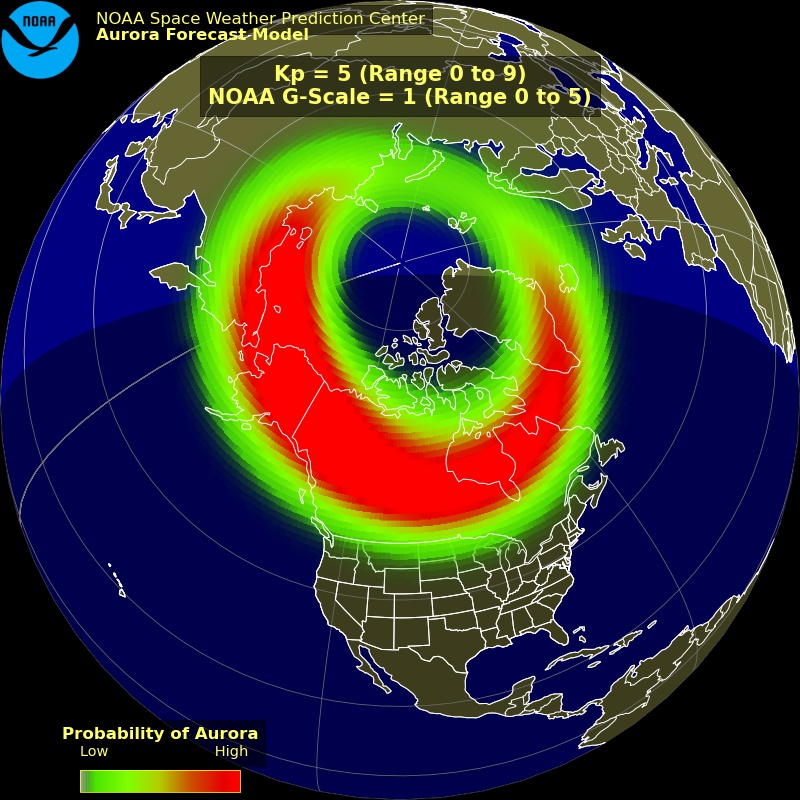
According to the National Oceanic and Atmospheric Administration’s Space Weather Prediction Center, geomagnetic conditions could reach at least G1, or minor storm, levels as several CMEs approach Earth. NOAA’s forecasts also indicate that the timing and strength of individual impacts can change as more observations become available. FForbes
For skywatchers, that means the forecast is promising but not a guarantee.
Northern Lights Forecast: Which States Could See Aurora?
The current Northern Lights Forecast places several northern-tier states in a favorable position for aurora viewing.
The 11 states highlighted in the forecast are:
- Alaska
- North Dakota
- Maine
- Minnesota
- Vermont
- Montana
- New Hampshire
- South Dakota
- Washington
- Wisconsin
- Michigan
The strongest opportunities generally favor locations farther north, particularly areas close to the Canadian border. Alaska remains one of the best-positioned states because of its proximity to the auroral oval.
However, geography is only one part of the equation. Local weather conditions, light pollution and the strength of the geomagnetic disturbance can determine whether the aurora is actually visible from a particular location.
A city under cloudy skies could miss the display entirely, while someone several miles away under clear, dark skies may have a much better view.
That is why aurora watchers should treat the forecast as a guide rather than a promise.
Multiple CMEs Are Driving the Aurora Forecast
The reason behind the heightened Northern Lights Forecast is activity on the Sun.
A coronal mass ejection is a large release of plasma and magnetic field from the Sun. When an Earth-directed CME reaches our planet, it can interact with Earth’s magnetic environment and increase geomagnetic activity.
The latest situation is particularly interesting because more than one CME may influence Earth during the same period.
The forecast discussed by Forbes indicates that eruptions occurring between Sept. 2 and Sept. 6 could arrive at different times, with some potentially interacting or merging. NOAA modeling has suggested that several CMEs could reach Earth around Sept. 8. FForbes
That makes the timing difficult to predict with complete precision.
Space-weather forecasters monitor solar wind speed, magnetic-field strength and the direction of the interplanetary magnetic field as the solar material approaches Earth. Those measurements become increasingly important as a CME gets closer.
For the latest official information, skywatchers can monitor NOAA’s Space Weather Prediction Center and its aurora forecasting products.
What Does a G1 Geomagnetic Storm Mean?
The Northern Lights Forecast currently includes the possibility of G1 geomagnetic storm conditions.
G1 is classified as a minor geomagnetic storm on NOAA’s five-level G-scale. It corresponds to a planetary K index, or Kp, of 5.
A G1 storm is not an indication of dangerous conditions for most people on the ground. Instead, it describes a measurable disturbance in Earth’s magnetic environment caused by solar activity.
One of the most visible consequences can be an expansion of the auroral oval toward lower latitudes.
As geomagnetic activity becomes stronger, the aurora can potentially move farther south and become brighter. During weaker events, the display tends to remain concentrated at higher latitudes.
NOAA explains that the Kp index is a useful indicator of auroral activity and that stronger geomagnetic activity can push the auroral oval toward lower latitudes.
That does not mean a Kp 5 automatically guarantees a spectacular show. Other factors matter, including cloud cover, darkness and the orientation of Earth’s magnetic field at the time the solar wind arrives.
Northern Lights Forecast Could Improve Later This Week
The latest outlook suggests that the opportunity may not be limited to one night.
The UK’s Met Office says geomagnetic activity could increase on Sept. 8 and Sept. 9 as several CMEs potentially affect Earth. Its forecast gives a chance of G1 to G2 geomagnetic storm conditions, with a smaller possibility of G3-level activity. MMet Office+1
That is significant for aurora watchers because stronger geomagnetic activity can make the auroral oval expand farther from the poles.
The Met Office describes the current space-weather forecast as complex, with several potential CME arrivals and uncertain arrival times. Its latest forecast also indicates that geomagnetic activity could remain elevated through the middle of the week. MMet Office
In practical terms, anyone hoping to see the northern lights should continue monitoring the forecast rather than assuming the opportunity ends after one night.
Why September Can Be a Good Month for Northern Lights
September is traditionally an interesting month for aurora enthusiasts.
One reason is the proximity of the September equinox. Around the equinoxes, the geometry between Earth’s magnetic field and the magnetic field carried by the solar wind can make geomagnetic energy transfer more efficient.
This seasonal effect is commonly associated with the Russell-McPherron effect.
The September equinox arrives on Sept. 22 this year, meaning the current period falls within a season that can offer favorable conditions for auroral activity. FForbes
Of course, the equinox does not create an aurora by itself. Solar activity remains the critical ingredient.
When strong solar eruptions send charged particles and magnetic fields toward Earth at the right time, September’s seasonal conditions can help produce stronger geomagnetic responses.
How to Check the Northern Lights Forecast in Real Time
The most important advice for aurora watchers is to check the forecast shortly before heading outside.
A prediction made many hours in advance can change as a CME approaches Earth. Real-time measurements provide a better indication of whether conditions are actually becoming favorable.
NOAA provides an aurora forecast that can help viewers determine where auroral activity may be visible.
Watchers should pay particular attention to:
- Kp index: A general indicator of geomagnetic activity.
- Bz: The north-south component of the interplanetary magnetic field.
- Solar wind speed: Faster solar wind can contribute to stronger geomagnetic activity.
- Cloud cover: Even a strong aurora is difficult to see through thick clouds.
- Light pollution: Dark rural locations provide significantly better viewing conditions.
- Local timing: Aurora activity can change rapidly during the night.
Bz is especially important. When the magnetic field’s Bz component turns southward, energy can transfer more efficiently from the solar wind into Earth’s magnetosphere.
A prolonged southward Bz can therefore improve the chances of a stronger auroral display.
The Best Time to Watch the Northern Lights
There is no single guaranteed minute when the aurora will appear.
However, viewing opportunities generally improve after dark and can become particularly interesting around local midnight and the hours surrounding it.
The current forecast suggests that geomagnetic activity could increase overnight and into Sept. 8, with additional CME effects potentially arriving later.
Because the timing of CME impacts can shift, viewers should avoid relying on a single forecast timestamp.
Instead, check the latest space-weather conditions shortly before going outside.
A dark location away from city lights is also important. Even when an aurora is technically visible, light pollution can make a faint display difficult to detect with the naked eye.
Can a Phone Capture the Northern Lights?
Yes. A modern smartphone can sometimes photograph an aurora that looks faint to the naked eye.
Cameras are often more sensitive to low levels of light than human vision. As a result, a phone photograph may reveal green, red or purple colors that are difficult to see directly.
For the best results, use a tripod or another stable surface. Night Mode can help, while manual camera controls may allow experienced photographers to adjust exposure and focus.
Longer exposures can capture more light, but excessively long exposures may blur moving auroral structures.
Forbes recommends stable support, Night Mode or Pro Mode, exposure times of roughly five to 10 seconds in suitable conditions, and RAW capture when available. FForbes
The key is experimentation. Start with a moderate exposure and adjust according to how bright the aurora is.
What Causes the Northern Lights?
The aurora is ultimately a product of interactions between the Sun and Earth’s upper atmosphere.
The Sun continuously releases a stream of charged particles known as the solar wind. During periods of solar activity, the Sun can also release large amounts of plasma and magnetic field through CMEs.
When those particles interact with Earth’s magnetosphere, some energetic electrons are directed along magnetic field lines toward the polar regions.
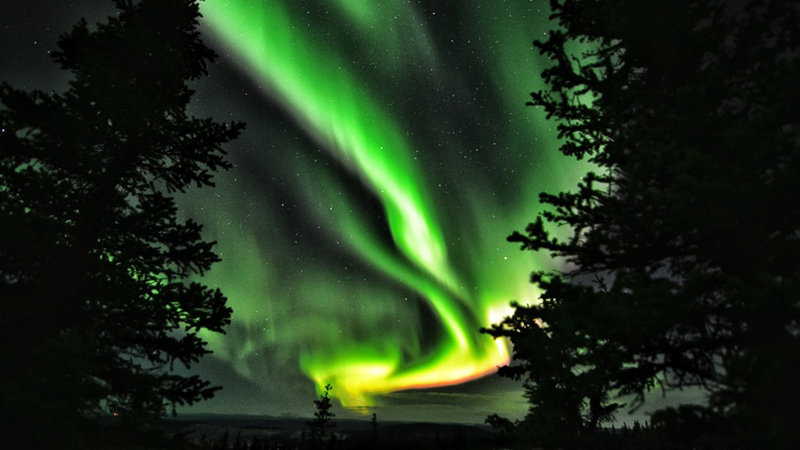
Those particles collide with gases in Earth’s upper atmosphere. The resulting energy release produces the colored lights known as the aurora.
NOAA’s aurora tutorial explains that oxygen and nitrogen in the upper atmosphere contribute to different auroral colors. Green is particularly common and is associated with excited atomic oxygen.
The result can range from faint glowing arcs to dramatic curtains of rapidly moving light.
Northern Lights Forecast: What Skywatchers Should Do
For people living in the 11 states identified in the current forecast, the best strategy is simple: watch the sky and monitor the data.
There is no need to travel immediately based solely on a broad forecast. Instead, viewers should first check their local cloud conditions and the latest aurora information.
Those living in or near cities may want to drive to a darker location with a clear view toward the northern horizon.
It is also worth allowing time for the eyes to adjust to darkness. Bright phone screens and nearby artificial lights can make faint auroral activity harder to see.
Most importantly, expectations should remain realistic.
A forecast for geomagnetic activity means the ingredients for an aurora may be present. It does not guarantee that every location will receive a bright display.
More Aurora Opportunities May Follow
The current solar activity could produce additional viewing opportunities beyond Sept. 8.
The Met Office expects geomagnetic activity to remain unsettled to active, with potential G1 and G2 conditions and a smaller chance of G3 activity during the period surrounding Sept. 8-9. MMet Office
That means the current Northern Lights Forecast could evolve as new solar-wind measurements and CME observations become available.
For aurora enthusiasts, this is exactly why monitoring the forecast is important.
The Sun is constantly changing, and space weather can move from quiet to active relatively quickly. A night that initially looks unremarkable can become interesting if solar-wind conditions strengthen.
For now, northern U.S. skywatchers have a genuine opportunity to see the aurora. Alaska and northern communities in states such as North Dakota, Minnesota, Michigan, Wisconsin and Maine are among the locations worth watching.
With clear skies, low light pollution and favorable geomagnetic conditions, the northern sky could offer a spectacular natural display.