China Exports Jump 25% as Global Demand Holds Strong
China exports accelerated sharply in August, rising 25% from a year earlier, as strong overseas demand for automobiles, high-tech products and other manufactured goods continued to support the world’s second-largest economy.
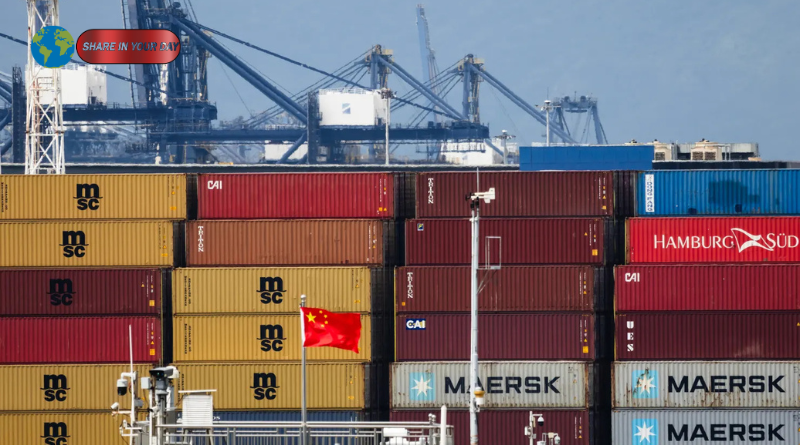
The latest trade data released Tuesday showed that Chinese exports increased at a faster pace than the 23.9% annual growth recorded in July. At the same time, imports rose 28.2%, helping narrow the imbalance between export and import growth while still leaving China with a massive trade surplus.
China’s August trade surplus reached approximately $119.1 billion, up from about $112.5 billion in July. The figure highlights the continued strength of China’s manufacturing sector even as domestic consumption and investment remain relatively subdued.
The latest figures also arrive at a sensitive moment for global trade. Beijing and Washington remain locked in a broader economic and technology rivalry, while European governments are increasingly concerned about China’s growing presence in strategic manufacturing industries.
China Exports Benefit From High-Tech Demand
One of the most important features of the latest trade figures is the strength of China’s high-tech exports.
Global demand for products connected to artificial intelligence, electric vehicles, semiconductors, batteries and other advanced manufacturing equipment has helped Chinese manufacturers maintain strong overseas sales.
Reuters reported that China’s export performance has been supported by demand for high-tech and AI-related products, as well as electric vehicles, solar cells and lithium-ion batteries.
That trend is significant because China’s traditional export model is changing.
For decades, the country became known primarily as a major supplier of consumer electronics, clothing, machinery and other mass-market goods. Today, Chinese manufacturers are increasingly competing in higher-value industries.
This shift has allowed exporters to tap into some of the fastest-growing areas of the global economy.
The rapid expansion of AI infrastructure is particularly important. Data centers, power equipment, batteries, electronics and related industrial products require enormous amounts of hardware. Chinese manufacturers are positioned to supply many components at competitive prices.
As a result, China’s export growth is no longer dependent entirely on traditional consumer demand.
China Trade Surplus Nears $120 Billion
The combination of strong exports and rising imports produced a monthly trade surplus of approximately $119.09 billion in August.
That was higher than July’s $112.5 billion surplus and broadly in line with market expectations.
The cumulative figure is even more striking.
China’s trade surplus for the first eight months of 2026 reached approximately $805.51 billion, putting the country on course for another exceptionally large annual surplus. Reuters reported that China could be heading toward a second consecutive year in which its trade surplus exceeds $1 trillion.
The size of the surplus is likely to attract additional attention from China’s major trading partners.
A large surplus means China is exporting substantially more goods than it imports. While this provides foreign-exchange earnings and supports manufacturers, it can also create political tensions with countries that compete with Chinese producers.
Those tensions are already visible in the United States and Europe.
China Imports Also Show Strong Growth
While the headline focus is on China exports, the August import figures are equally important.
Chinese imports increased 28.2% year over year, according to the latest customs data. That was slightly below the roughly 30% growth economists had expected but still represented a powerful increase.
Strong import growth can indicate that Chinese companies are purchasing more raw materials, components and advanced products needed for manufacturing.
It can also suggest that domestic industrial activity is stronger than some other economic indicators imply.
In particular, China’s technology industries require imported components and materials even as the country works to reduce its dependence on foreign suppliers.
The increase in imports therefore provides a more balanced picture of the economy.
Nevertheless, the overall trade numbers still point to a country that remains heavily dependent on external demand.
Domestic Demand Remains a Major Challenge
The strength of China’s export sector stands in contrast to persistent weakness in parts of the domestic economy.
Consumer spending, property investment and some areas of fixed-asset investment have remained under pressure. Reuters noted that sluggish retail activity, property-sector weakness and soft investment have continued to weigh on China’s domestic economy.
That creates an important policy challenge for Beijing.
A healthy economy cannot rely indefinitely on exports to compensate for weak domestic demand. If household spending and private investment fail to strengthen, policymakers may face growing pressure to introduce additional measures to support consumers and businesses.
China has already been using targeted fiscal and financial measures to support economic activity.
However, policymakers also have to balance stimulus against concerns about debt, property-sector risks and excess industrial capacity.
The latest export numbers may therefore give Beijing some breathing room, but they do not eliminate the need to address structural weaknesses at home.
Southeast Asia Becomes More Important for China Exports
Another important development is the changing geographical pattern of China’s exports.
While the United States and Europe remain major markets, Chinese companies have increasingly expanded sales across Southeast Asia, Latin America, Africa and other emerging markets.
This diversification has become particularly important as trade restrictions and tariffs complicate access to some Western markets.
Southeast Asia is emerging as a particularly important destination for Chinese clean-technology products. Reuters reported that ASEAN countries collectively spent more than $20 billion on Chinese clean-tech products in 2026, including batteries, electric vehicles, solar equipment and grid components.
That expansion could become a major long-term feature of regional trade.
For Chinese manufacturers, Southeast Asia provides rapidly growing consumer and industrial markets. For countries in the region, Chinese technology can offer relatively affordable access to electric vehicles, renewable energy systems and industrial equipment.
However, increased Chinese exports can also create competitive pressure for local manufacturers.
U.S.-China Trade Tensions Remain in Focus
The latest China exports data arrive ahead of another important period in U.S.-China economic relations.
Trade tensions between Washington and Beijing have expanded beyond tariffs into technology restrictions, semiconductor controls, industrial policy and strategic supply chains.
The United States has imposed restrictions on China’s access to certain advanced technologies, while China has increasingly emphasized its own industrial capabilities and supply-chain security.
At the same time, the two countries have maintained a fragile trade truce.
The strength of China’s August exports could complicate negotiations because a widening trade surplus is likely to remain a central issue for U.S. policymakers.
China’s surplus with the United States alone rose to about $29.18 billion in August, compared with approximately $28 billion in July.
That figure is likely to receive attention as both sides discuss future trade arrangements.
Washington has repeatedly called for a more balanced trading relationship, while Beijing has argued that its exports reflect competitiveness, technological development and international demand rather than simply government support.
Europe Faces Similar Concerns
The issue extends beyond the United States.
European policymakers have also become increasingly concerned about the impact of Chinese exports on domestic industries.
Chinese companies have become major global competitors in electric vehicles, batteries, solar technology, industrial equipment and other strategic sectors.
For consumers, lower-cost Chinese products can provide clear benefits.
For manufacturers in Europe and elsewhere, however, intense competition can create pressure on prices, investment and employment.
This creates a difficult policy dilemma.
Governments want access to affordable technology and global supply chains while also trying to protect domestic manufacturing capacity.
China’s rapidly expanding export surplus could therefore become an increasingly important issue in international economic policy.
Why the August Trade Data Matter
The August figures tell a complicated story about China’s economy.
On one hand, China exports are performing exceptionally well. Growth of 25% is far stronger than many major economies are currently experiencing, and the strength of high-tech exports demonstrates the increasing competitiveness of Chinese manufacturers.
On the other hand, the continuing reliance on exports reveals weaknesses in domestic demand.
A stronger domestic consumer sector would allow China to generate more balanced growth rather than depending so heavily on foreign buyers.
That distinction will be important in the months ahead.
If exports remain strong while domestic demand gradually improves, China’s economic outlook could become significantly more stable.
If exports continue to grow but domestic consumption remains weak, policymakers may face a more difficult balancing act between supporting manufacturing and stimulating household demand.
AI and Technology Could Keep Supporting China Exports
The global AI investment cycle may provide another source of support for Chinese manufacturers.
The construction of data centers and expansion of AI infrastructure require large quantities of electrical equipment, batteries, computing hardware and industrial components.
China’s manufacturing ecosystem gives its companies a strong position in several of these supply chains.
At the same time, technology restrictions could limit access to certain advanced semiconductor markets.
That means China’s future export performance may depend partly on how successfully domestic companies develop alternative technologies and how effectively Chinese manufacturers expand into markets outside the United States.
The shift is already visible.
Instead of relying on a single major export destination, Chinese businesses are increasingly building broader networks across Asia, the Middle East, Africa and Latin America.
China’s Trade Outlook for the Rest of 2026
The latest figures suggest that China’s external trade is likely to remain an important source of economic momentum through the rest of 2026.
The key question is whether the pace of export growth can remain this strong.
Global demand can change quickly. Tariff policies, geopolitical conflicts, currency movements and consumer spending trends could all affect Chinese shipments.
There are also questions about whether other countries will introduce additional measures to protect their domestic industries from a growing flow of Chinese manufactured goods.
For now, however, the data remain favorable for Chinese exporters.
Exports accelerated to 25% growth in August, imports increased 28.2%, and the cumulative trade surplus reached more than $805 billion during the first eight months of the year.
That performance gives Beijing an important economic cushion.
Yet it also highlights the central challenge facing China’s economy: transforming strong industrial and export capacity into stronger domestic demand.
Bottom Line
China’s August trade data delivered a powerful message about the resilience of the country’s export sector.
China exports surged 25% year over year, while imports rose 28.2%. The result was a trade surplus of roughly $119.1 billion, pushing the cumulative surplus for the first eight months of 2026 above $805 billion.
High-tech products, electric vehicles, batteries and other advanced manufactured goods are playing an increasingly important role in that performance.
However, the figures also underline China’s dependence on overseas demand at a time when domestic consumption and investment remain comparatively weak.
For global markets, the implications are significant.
A stronger Chinese export machine could help keep global manufacturers and consumers supplied with relatively affordable goods. But it could also intensify trade tensions as the United States, Europe and other economies attempt to protect their own industries.
The next stage of China’s economic story will therefore depend not only on whether China exports continue to rise, but also on whether Beijing can strengthen domestic demand and maintain access to major international markets.