U.S. Stocks Fall as Warsh Speech Raises Rate Concerns
U.S. stocks closed lower Friday after Federal Reserve Chair Kevin Warsh delivered a closely watched speech at the Jackson Hole Economic Policy Symposium, reinforcing concerns that interest rates may need to rise again to bring inflation under control.
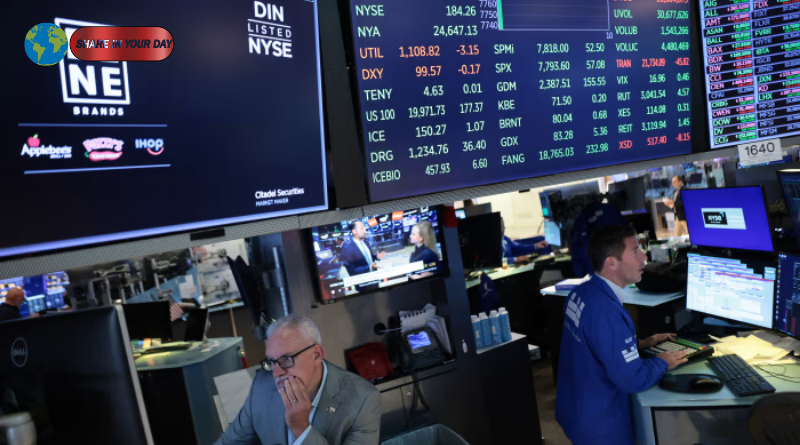
The Dow Jones Industrial Average slipped 9.45 points, or 0.02%, while the S&P 500 fell 19.23 points, or 0.25%. The Nasdaq Composite performed worse, dropping 138.93 points, or 0.52%, as technology shares came under additional pressure from rising borrowing costs.
The market reaction followed a sharp move in Treasury yields. Investors interpreted Warsh’s remarks as a signal that the Federal Reserve remains prepared to tighten monetary policy if inflation fails to make sufficient progress toward the central bank’s 2% target.
The result was a difficult session for stocks, particularly growth-oriented technology companies whose valuations are more sensitive to changes in interest rates.
U.S. Stocks React to Warsh’s Inflation Warning
Warsh’s speech was closely watched because it represented his first major Jackson Hole address as Federal Reserve chair.
Rather than promising a specific rate decision, Warsh emphasized principles that he said would guide monetary policy. He argued that the Fed must focus on current economic conditions and remain willing to act when inflation does not move toward its target quickly enough.
The central bank’s official transcript shows that Warsh described the 2% PCE inflation objective as a firm target and said short-term interest rates remain the Fed’s primary monetary-policy tool.
That message mattered because investors had been looking for evidence that the Fed might cut rates or at least remain on hold.
Instead, Warsh left open the possibility of additional tightening.
Markets responded quickly.
Federal-funds futures indicated roughly a 58% probability of a rate increase at the Fed’s mid-September meeting, up significantly from the previous day.
For investors, the shift was important because higher interest rates can increase the cost of borrowing, reduce the attractiveness of riskier assets and put pressure on corporate valuations.
Treasury Yields Jump as Rate-Hike Bets Increase
The biggest financial-market reaction came from the bond market.
The yield on the two-year Treasury note, which is particularly sensitive to expectations for Federal Reserve policy, climbed sharply. Data reported after Warsh’s speech showed the two-year yield rising toward 4.36%, while the 10-year yield moved to roughly 4.73%.
The two-year yield posted its largest one-day increase since March, according to reports surrounding Friday’s trading session.
Bond yields and prices move in opposite directions. When investors sell Treasury securities, their prices fall and yields rise.
That relationship is especially important for stocks because Treasury yields help determine the baseline return investors can demand from other assets.
When government bond yields increase, investors may become less willing to pay very high valuations for companies whose profits are expected far in the future.
That creates an additional challenge for technology and growth stocks.
Why Technology Stocks Were Hit Hard
Technology shares were among the biggest losers as investors adjusted to the prospect of higher interest rates.
The Nasdaq Composite declined 0.52%, significantly more than the Dow’s 0.02% decline.
Marvell Technology was one of the most notable decliners, falling about 10% following its latest earnings report despite otherwise solid results. Nvidia and PayPal also declined during the session.
The weakness comes at a sensitive moment for the technology sector.
Investors have poured enormous amounts of capital into artificial intelligence infrastructure, semiconductor companies and cloud computing businesses. Many of those companies have benefited from expectations of strong long-term growth.
But higher interest rates can change the mathematics behind those valuations.
When the discount rate rises, future earnings become less valuable in today’s dollars. Therefore, companies with high valuations and distant expected cash flows can experience greater pressure than mature businesses with stable near-term earnings.
Warsh himself discussed artificial intelligence in his Jackson Hole speech, describing the technology as a potentially transformative force for productivity and economic growth. He noted that capital investment related to AI has become a major contributor to business investment.
However, optimism about AI did not prevent investors from reassessing the short-term implications of tighter monetary policy.
U.S. Stocks Face a Complicated Inflation Picture
The Federal Reserve’s concern is rooted in inflation that remains well above its 2% target.
According to the U.S. Bureau of Economic Analysis, the PCE price index increased 3.7% in July from a year earlier. Core PCE inflation, which excludes food and energy, rose 3.3%.
Those figures remain significantly above the Fed’s stated objective.
Warsh argued that recent improvements in inflation have not been strong enough to demonstrate that underlying price pressures are moving decisively toward 2%.
He pointed to the broad distribution of price increases across the economy as another reason for caution. According to his speech, almost half of the individual goods and services components in the PCE basket were still experiencing annualized price increases above 3% over the most recent six-month period.
That leaves policymakers facing a difficult balancing act.
The economy has shown resilience, but inflation remains too high.
If the Fed keeps rates high for longer, it risks slowing economic activity. If policymakers ease too quickly, inflation could remain elevated or become harder to control.
Warsh Rejects Traditional Forward Guidance
One of the most significant elements of Warsh’s speech was not an explicit rate decision.
It was his criticism of traditional forward guidance.
For years, Federal Reserve officials have frequently attempted to communicate their likely policy path so that investors, businesses and households can anticipate future decisions.
Warsh argued that this approach can sometimes become counterproductive.
He said excessive guidance can restrict policymakers’ ability to respond when economic conditions change. Instead, he wants markets to interpret incoming economic information and form their own expectations.
The Fed chair described his preferred approach as a “quieter Fed,” with less emphasis on signaling future policy decisions.
That strategy could have important consequences for financial markets.
Investors accustomed to closely following every sentence from Federal Reserve officials may have less certainty about the timing of future rate decisions.
For Wall Street, uncertainty itself can increase volatility.
September Fed Meeting Becomes the Next Big Test
The Federal Reserve’s September meeting is now one of the most important events on the market calendar.
The central bank’s policy rate currently sits in a 3.50% to 3.75% target range, according to Federal Reserve information.
Investors had previously expected the Fed to remain cautious, but Warsh’s remarks have shifted attention toward the possibility of another rate increase.
That does not mean a September hike is guaranteed.
Warsh did not announce a decision or provide a specific timetable.
Instead, he stressed that monetary policy would depend on economic developments and whether inflation is moving toward the Fed’s objective quickly enough.
That distinction is important.
The market is pricing a probability, not a certainty.
Incoming inflation data, employment figures, consumer spending and financial conditions could all change expectations before policymakers meet.
The Economy Remains Stronger Than Some Investors Expected
Despite Friday’s market decline, Warsh offered a relatively positive assessment of the broader U.S. economy.
He said business investment was rising rapidly and pointed to strong growth in equipment and intangible investment.
He also noted that S&P 500 profits had increased by more than 20% over the previous year and that corporate credit conditions remained relatively favorable.
Consumer spending has also remained resilient.
The latest BEA data showed personal consumption expenditures increased 0.2% in July, while disposable personal income rose 0.5%. Real consumer spending was essentially unchanged during the month.
This combination creates an unusual policy environment.
The economy is not showing the kind of widespread weakness that would automatically justify aggressive monetary easing.
At the same time, inflation has not returned to the Fed’s target.
That gives policymakers room to keep rates elevated or potentially increase them if price pressures remain persistent.
Rising Oil Prices Add Another Inflation Risk
Another concern for markets is the price of energy.
Oil prices have remained elevated amid geopolitical tensions and disruptions surrounding the Strait of Hormuz. Higher energy costs can feed into headline inflation and increase pressure on consumers and businesses.
Energy prices are particularly important because they can affect inflation expectations.
If households and businesses begin to anticipate sustained increases in fuel, transportation and other costs, those expectations can influence wage demands and pricing decisions.
For the Federal Reserve, that creates another reason to monitor inflation carefully.
Higher oil prices do not automatically require a rate hike. However, if energy costs contribute to broader and more persistent inflation, policymakers could face greater pressure to respond.
What the Market Reaction Means for Investors
The decline in U.S. stocks on Friday was relatively modest.
The S&P 500 fell only 0.25%, while the Dow was nearly unchanged.
That suggests investors were not reacting with panic.
Instead, the session reflected a recalibration of expectations.
Markets had to absorb a more hawkish interpretation of Federal Reserve policy while also dealing with higher Treasury yields and weakness in several major technology companies.
The key question is whether Friday’s move becomes the beginning of a larger correction or simply a short-term adjustment.
Much will depend on economic data.
If inflation continues to run above target, expectations for higher interest rates could strengthen further. That could put additional pressure on high-growth stocks and other rate-sensitive assets.
On the other hand, if inflation begins to cool more convincingly, investors could again price in a less restrictive Fed.
U.S. Stocks Enter a New Phase of Fed Uncertainty
The market’s reaction to Warsh’s speech highlights a broader change in the relationship between the Federal Reserve and Wall Street.
Investors can no longer assume that Fed officials will provide detailed signals about the next policy move.
Warsh wants markets to focus more heavily on actual economic conditions rather than attempting to predict every decision through central-bank communications.
That could make economic releases even more important.
Inflation reports, employment data, consumer spending and business investment may carry greater weight as investors attempt to determine the Fed’s next move.
For now, the message from Jackson Hole is clear enough: The Federal Reserve remains concerned about inflation, and another rate increase is firmly back in the market conversation.
That is a challenging backdrop for U.S. stocks, especially technology companies that depend heavily on expectations for strong future growth.
Wall Street will therefore enter September watching two numbers closely: inflation and Treasury yields.
If both continue moving higher, investors could face another period of pressure.
If inflation finally shows convincing progress toward the Fed’s 2% target, the market could regain confidence that the current tightening fears are temporary.
Until then, Friday’s decline serves as a warning that the era of assuming lower interest rates will automatically support stock valuations may be coming to an end.