Washington Manufacturing Faces a Difficult Road Ahead
Washington manufacturing is facing a difficult test as employment data show little evidence of a broad industrial revival. Manufacturing employment declined across Washington state in 2025, while Spokane County experienced an even sharper drop.
The latest figures raise questions about whether tariffs and state policies can deliver the large manufacturing employment gains policymakers have hoped for.
According to an analysis published by The Spokesman-Review, Washington lost about 3,500 manufacturing jobs in 2025, a decline of roughly 1%. Spokane County performed somewhat worse, with manufacturing employment falling 1.4%.
The numbers are particularly important because Washington has set an ambitious goal of doubling its manufacturing employment base over the 2021-31 decade.
At the same time, manufacturing remains one of the state’s better-paying sectors. That makes the industry’s performance important not only for factories and industrial companies but also for workers, communities and the broader Washington economy.
Here are five key facts behind the state’s manufacturing slowdown.
1. Washington Manufacturing Lost 3,500 Jobs in 2025
The clearest sign of the industry’s struggle came from employment data covering 2025.
Washington manufacturing employment declined by approximately 3,500 positions, or about 1%, according to the analysis by Patrick Jones, executive director of the Institute for Public Policy & Economic Analysis at Eastern Washington University.
The decline was broad rather than concentrated in just one part of the industry.
Several of the state’s largest manufacturing categories reduced their workforces. Those included food and beverage products, wood products, fabricated metal products, machinery and electronic products, including computers.
Transportation equipment manufacturing was the notable exception.
That category, which includes Washington’s enormous aerospace industry, added several hundred jobs during the year. The result suggests that aerospace continues to play an important role in supporting the state’s industrial base.
Washington’s manufacturing picture therefore is not uniformly weak. Some specialized industries remain competitive and continue to add workers.
However, the overall employment numbers show that those gains have not been enough to offset losses elsewhere.
2. Spokane Manufacturing Fell Even Faster
The situation was somewhat more pronounced in Spokane County.
Spokane manufacturing employment declined 1.4% in 2025, with all four of the county’s largest manufacturing industries reporting negative growth, according to the analysis. Those industries include food production, primary metals, fabricated metals and machinery.
There was one notable exception.
Wood product manufacturing increased its workforce by several dozen employees, representing an 8% gain. But because wood products are a smaller segment of the local manufacturing base, the increase was not large enough to reverse the overall decline.
The contrast becomes clearer when manufacturing is compared with the broader Spokane County economy.
Total county employment increased by about 0.3% in 2025. That was modest, but it was still growth while manufacturing employment was moving in the opposite direction.
That divergence matters.
It indicates that Spokane’s economy is not necessarily contracting. Instead, manufacturing is growing more slowly than other parts of the local economy.
For businesses and policymakers hoping to make manufacturing a larger economic engine, that distinction is significant.
Internal link suggestion: Add a link here to your website’s related article about Spokane County economic growth.
3. Manufacturing Jobs Still Pay More
The weakness in manufacturing employment should not obscure an important advantage: manufacturing jobs tend to provide relatively strong earnings.
In 2025, average annual earnings for manufacturing workers were about $102,900 statewide and $78,600 in Spokane County, according to the figures cited in the analysis. Those levels were substantially higher than average earnings across the broader state and county economies.
That makes manufacturing strategically important even if the industry does not produce large numbers of new jobs every year.
Manufacturing also offers a potential pathway into relatively well-paid work for people who do not want to pursue a traditional four-year college degree.
That is one reason governments continue to focus on factory investment, technical education and industrial development.
The benefits extend beyond direct employees as well.
Factories purchase materials, engineering services, transportation, maintenance and other services from businesses throughout their regions. This creates a ripple effect that can support additional employment.
Washington’s manufacturing strategy is therefore about more than counting factory jobs.
It is also about maintaining an industrial ecosystem capable of supporting suppliers, skilled workers and high-value production.
4. Washington’s Goal of Doubling Manufacturing Jobs Looks Difficult
Washington adopted an ambitious manufacturing goal earlier this decade.
The state has sought to double its manufacturing employment base during the 2021-31 period. The policy framework was established through legislation designed to retain and expand Washington’s manufacturing and research-and-development sectors.
The goal reflects a straightforward economic argument.
Manufacturing companies can generate significant economic activity through supply chains. They can also create relatively high-paying jobs while helping diversify regional economies.
But recent employment data suggest that doubling manufacturing employment will be extremely difficult.
Statewide manufacturing employment from 2020 through 2025 was essentially unchanged, despite the industry’s scale of nearly 270,000 jobs, according to the analysis.
That does not necessarily mean manufacturing output has stopped growing.
Employment and production are different measurements.
A factory can increase its production without adding workers if it invests in better equipment, automation and technology. In fact, that dynamic is one of the biggest reasons manufacturing employment can remain flat even while industrial output increases.
This distinction could become increasingly important as Washington considers how to measure the success of its manufacturing policies.
5. Automation May Be Changing What Manufacturing Growth Looks Like
One of the most important points in the analysis is that manufacturing has become increasingly productive.
Machines, computers and automated systems can perform tasks that previously required large numbers of workers.
That means a modern factory can potentially produce more goods without proportionally increasing its workforce.
For policymakers, this creates a difficult contradiction.
The goal may be to increase manufacturing employment, while manufacturers themselves have strong economic incentives to increase productivity through automation.
Companies that can produce more efficiently may become more competitive. But those efficiency gains do not necessarily translate into more factory jobs.
The result is a manufacturing sector that can remain economically important while employing fewer people than it did decades ago.
That trend is visible in Spokane.
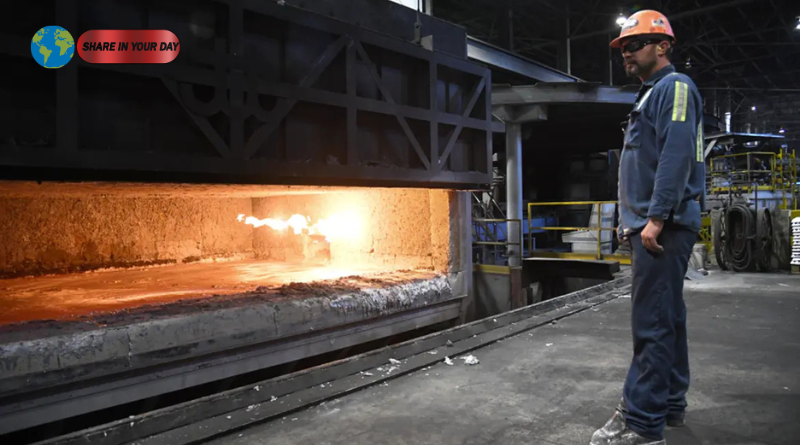
Kaiser Aluminum’s Trentwood facility remains a major industrial operation in the region, but its workforce is far smaller than the employment levels associated with the company’s historical operations. At the same time, the plant continues to invest in advanced equipment and specialized production.
Kaiser completed a $25 million expansion at Trentwood in 2025. The project expanded a heat-treatment furnace and was expected to increase production capacity by about 5% while maintaining approximately 1,000 full-time jobs.
That is an important example of how manufacturing investment can strengthen a company without necessarily producing a large increase in employment.
Tariffs Have Yet to Produce a Clear Manufacturing Jobs Boom
The employment data also provide an early test of the Trump administration’s tariff strategy.
One of the administration’s stated economic objectives has been to encourage domestic production and strengthen American manufacturing.
Yet the Washington numbers provide little evidence so far that tariffs have produced a major manufacturing employment surge in the state.
Some tariffs specifically target industries such as steel, aluminum, copper, computer chips and automobiles.
Washington has important connections to several of those sectors, particularly aerospace and aluminum.
However, the state’s manufacturing economy is much broader than the industries directly protected by tariffs.
Food production, machinery, fabricated metals, wood products and electronics also form important parts of the state’s industrial base.
That means trade policy alone may not be enough to transform Washington’s manufacturing employment trends.
Other forces may prove more important.
A recovery in aerospace production, investment in advanced manufacturing facilities, improved infrastructure and access to skilled workers could have a larger influence on the state’s industrial performance.
Aerospace Remains a Critical Piece of the Puzzle
Washington’s aerospace industry stands apart from many other manufacturing sectors.
Transportation equipment manufacturing was the only major Washington manufacturing category highlighted in the analysis to add jobs during 2025.
That is significant because aerospace is one of the state’s most recognizable high-value industries.
The industry’s performance can affect suppliers across Washington, from metal producers to precision manufacturers and engineering companies.
The future of Washington manufacturing may therefore depend partly on whether aerospace companies continue expanding production and maintaining strong supplier networks.
This is especially relevant for Spokane, where manufacturers such as Kaiser Aluminum supply products connected to aerospace and defense markets.
Kaiser says its Trentwood rolling mill produces aluminum plate and sheet for aerospace and general engineering applications.
The company has also invested heavily in the facility over the past two decades, demonstrating that individual manufacturers can remain competitive through specialization and modernization.
Spokane’s Manufacturing Future May Be About Productivity, Not Headcount
Spokane’s manufacturing experience illustrates a larger national trend.
A region does not necessarily need thousands of new factory jobs to benefit from a strong manufacturing sector.
A smaller workforce operating highly productive facilities can generate substantial wages, tax revenue, supplier demand and investment.
The key question is therefore not simply how many people work in factories.
It is also how much economic value those workers and factories create.
The latest Spokane data provide an interesting example.
Manufacturing employment in the county has increased by more than 500 jobs, or about 3.5%, since 2020. Primary metals accounted for much of that increase, while plastic and rubber products manufacturing recorded some of the largest losses.
Meanwhile, overall county employment increased by 11.8% during the same period.
Manufacturing has therefore grown, but at a substantially slower rate than the broader economy.
That may make the state’s goal of doubling manufacturing employment increasingly difficult to achieve.
Manufacturing Output Tells a More Complicated Story
Employment figures alone do not tell the entire story.
Washington’s manufacturing sector recorded essentially no net employment growth from 2020 through 2025, according to the analysis. But manufacturing output, measured through value-added, increased by about 1.4% from 2020 through 2024.
Spokane County performed somewhat better on output.
Real manufacturing output increased approximately 4.3% from 2020 through 2024.
That suggests manufacturers have been able to expand economic activity even without significantly increasing the number of employees.
For policymakers, that creates a challenge in defining success.
If manufacturing becomes more productive, employment may not rise dramatically even though the industry becomes more valuable.
Therefore, future economic strategies may need to balance job creation with productivity, wages, investment and output.
What Comes Next for Washington Manufacturing?
The latest data do not suggest that Washington manufacturing is disappearing.
Instead, they point toward an industry undergoing a structural transformation.
Some traditional manufacturing jobs are disappearing. Other specialized industries are growing. Automation is changing factory operations. And companies are increasingly focusing on high-value products where productivity, technology and specialized expertise can provide a competitive advantage.
That could be especially important for Spokane.
The region’s manufacturing base may not return to the employment levels of previous generations. But companies such as Kaiser Aluminum demonstrate that large industrial facilities can remain important regional economic engines even with more technology-intensive operations.
The state’s broader challenge is determining how to encourage that type of investment while also creating pathways for workers to benefit.
Workforce training, technical education, infrastructure, energy costs and business investment are likely to remain central to that discussion.
Tariffs may influence individual industries, but they are unlikely to determine the entire future of Washington manufacturing by themselves.
Bottom Line
Washington manufacturing is not experiencing the employment boom that policymakers once envisioned.
State manufacturing employment declined by about 3,500 jobs in 2025, while Spokane County’s manufacturing workforce fell 1.4%. At the same time, manufacturing remains one of the region’s strongest sources of relatively high-paying employment and continues to generate significant economic activity.
The bigger story may be that manufacturing is changing rather than simply shrinking.
Automation and productivity allow companies to produce more with fewer workers. Specialized industries such as aerospace and advanced aluminum production remain important. And facilities such as Kaiser Aluminum’s Trentwood plant continue to invest in technology and capacity.
For Washington, the question is no longer simply whether the state can create more factory jobs.
It is whether policymakers can build an environment where high-productivity manufacturers can invest, compete and provide well-paid opportunities for workers.
That distinction could ultimately determine whether Washington’s ambitious manufacturing goals become achievable — or remain out of reach.