Humanoid Robots Half Marathon: 5 Shocking Advances
The humanoid robots half marathon in Beijing has captured global attention, offering a striking glimpse into the future of artificial intelligence and robotics. In a remarkable display of technological progress, human-like machines competed alongside human runners in a 21-kilometer race—achieving results that would have seemed impossible just a year ago.
The event was not merely a spectacle. Instead, it served as a powerful demonstration of how quickly robotics is evolving, particularly in China, where innovation in artificial intelligence is accelerating at an unprecedented pace. Meanwhile, experts caution that while the progress is impressive, it does not necessarily translate into immediate real-world applications.
A Race That Redefines Human vs Machine
The humanoid robots half marathon took place in Beijing under controlled conditions, featuring multiple robots designed to mimic human movement. Some machines operated autonomously using advanced AI systems, while others relied partially on remote human guidance.
One standout robot completed the race in just over 50 minutes—a time comparable to elite human runners. For context, many experienced human athletes struggle to achieve such speeds, making the result both surprising and controversial.
However, the comparison is not entirely straightforward. Robots benefit from consistent pacing, optimized mechanics, and the absence of fatigue in the traditional human sense. Nevertheless, the achievement signals a turning point in robotics performance.
Rapid Progress in Just One Year
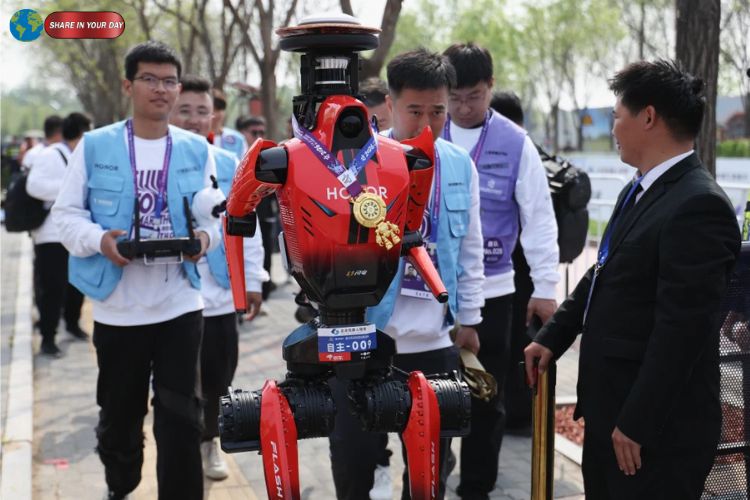
Perhaps the most astonishing aspect of the humanoid robots half marathon is the pace of improvement. In 2025, similar robots required approximately 2 hours and 40 minutes to complete a half marathon distance. Just one year later, that time dropped dramatically to under an hour.
This leap highlights breakthroughs in several key areas:
- Motion control and balance
- Energy efficiency and battery systems
- Real-time decision-making powered by AI
- Mechanical design and joint flexibility
As a result, robots are no longer limited to slow, rigid movements. Instead, they are becoming agile, adaptive, and capable of sustained physical activity.
Why China Is Leading the Charge
The humanoid robots half marathon also reflects China’s broader strategy to dominate the robotics and AI sectors. Government-backed initiatives and private sector investment have created a highly competitive environment, driving rapid innovation.
Events like this race serve multiple purposes. On one hand, they showcase technological capability to the world. On the other, they attract investors and accelerate development within the domestic tech ecosystem.
Moreover, China’s focus on humanoid robots aligns with its long-term goals of addressing labor shortages and increasing automation across industries.
The Technology Behind the Machines
At the core of the humanoid robots half marathon lies a combination of advanced technologies working in harmony. These include:
Artificial Intelligence Systems
AI enables robots to process environmental data, adjust their pace, and maintain balance. Machine learning algorithms allow continuous improvement over time.
Sensors and Perception
Robots are equipped with cameras, LiDAR, and other sensors to navigate the racecourse. This allows them to respond to curves, inclines, and obstacles.
Actuators and Mechanics
High-performance actuators replicate human muscle movements, providing the power and flexibility needed for running.
Energy Management
Efficient battery systems ensure that robots can sustain long-distance activity without overheating or shutting down.
Together, these technologies make the humanoid robots half marathon possible, illustrating how integrated systems are pushing robotics forward.
Experts Urge Caution
Despite the excitement, many experts emphasize that the humanoid robots half marathon should not be overinterpreted. Running in a controlled environment is vastly different from operating in unpredictable real-world conditions.
For example, robots still struggle with tasks that humans perform effortlessly, such as:
- Handling delicate objects
- Navigating cluttered environments
- Adapting to unexpected changes
In addition, some robots in the race relied on external control systems, raising questions about how autonomous they truly were.
Therefore, while the progress is real, it does not mean robots are ready to replace human workers on a large scale.
A Glimpse Into the Future
Even with its limitations, the humanoid robots half marathon provides valuable insight into what the future may hold. As robotics technology continues to improve, machines could eventually take on roles that require physical endurance and precision.
Potential applications include:
- Disaster response and search-and-rescue operations
- Industrial automation in hazardous environments
- Healthcare assistance for elderly populations
- Logistics and delivery services
Meanwhile, advancements in mobility and coordination could lead to entirely new industries centered around humanoid robots.
Ethical and Social Implications
The rise of events like the humanoid robots half marathon also raises important ethical questions. As robots become more capable, concerns about job displacement, privacy, and safety are likely to intensify.
Governments and organizations will need to establish clear regulations to ensure that these technologies are used responsibly. Transparency in AI decision-making and accountability in robotics development will be crucial.
Furthermore, public perception will play a significant role in shaping the future of humanoid robots. While some view them as exciting innovations, others remain skeptical or even concerned.
The Global Robotics Race
The humanoid robots half marathon is part of a broader global competition in AI and robotics. Countries around the world are investing heavily in these technologies, recognizing their potential to reshape economies and societies.
However, China’s rapid progress suggests that it may currently hold a significant advantage. By combining government support with private sector innovation, the country has created an environment where breakthroughs can happen quickly.
As a result, other nations may need to accelerate their own efforts to remain competitive.
Conclusion: Progress With Perspective
The humanoid robots half marathon is undeniably a milestone in the evolution of robotics. It demonstrates how far technology has come in a short period and hints at what may be possible in the future.
However, it is important to maintain perspective. While robots can now run impressive distances at high speeds, they are still far from matching the versatility and adaptability of humans.
In the end, the event is less about robots replacing people and more about expanding the boundaries of what machines can achieve. As innovation continues, the line between human and machine capabilities may become increasingly blurred—but it is not disappearing anytime soon.