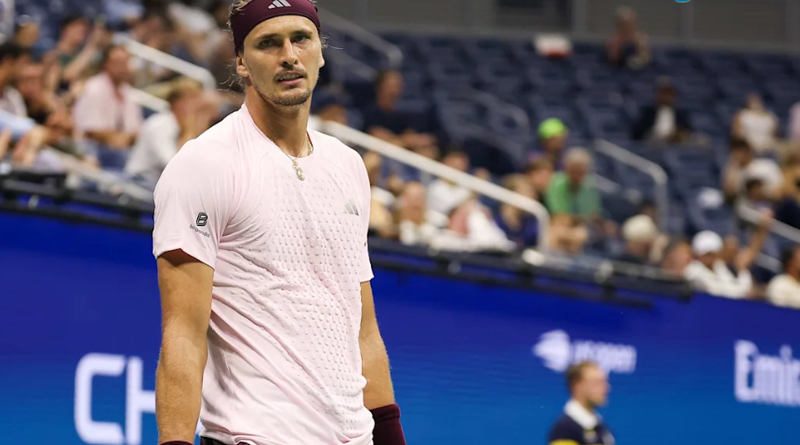
The Zverev US Open campaign is still alive, but the tournament’s top seed has already endured two punishing five-set battles in New York. Alexander Zverev defeated Quentin Halys 6-4, 4-6, 7-6(7-3), 6-7(3-7), 6-3 in the second round, reaching the third round after another marathon that finished at 2:15 a.m. local time. Yahoo Sports+1
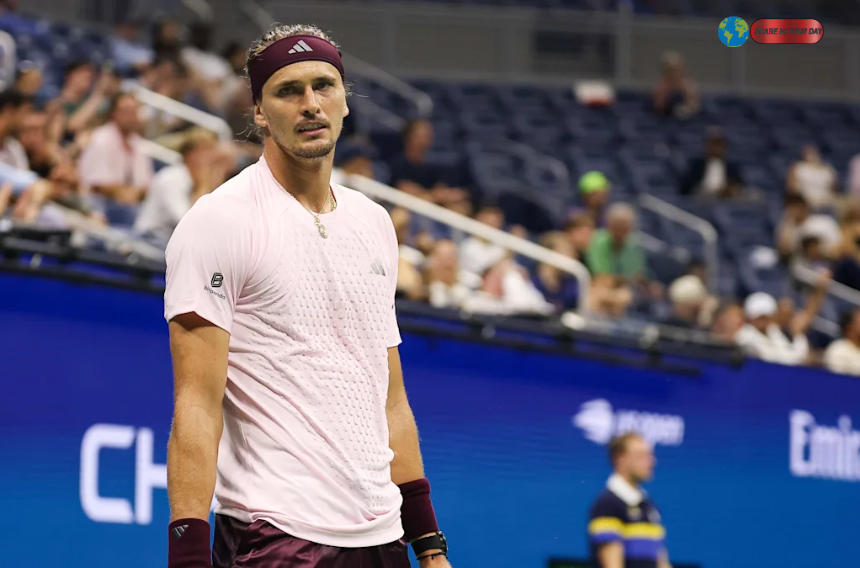
The victory was important. The warning signs were impossible to ignore.
Zverev entered the 2026 US Open as the No. 1 seed for the first time at a Grand Slam. He also arrived as the reigning French Open champion and one of the leading favorites in a draw that has opened dramatically.
Yet instead of cruising through his first two matches, the German has spent more than nine hours on court and played 10 sets.
That combination of resilience and vulnerability makes his Zverev US Open story one of the most fascinating narratives of the tournament.
Zverev US Open Run Starts With Two Marathons
Zverev’s tournament began with a dramatic comeback against Italy’s Lorenzo Sonego.
The German won the opening set 6-4 but then surrendered the next two. He eventually recovered to win 6-4, 3-6, 6-7(7-9), 7-5, 6-4 after nearly five hours of tennis.
The match ended at 1:55 a.m. local time.
Two days later, Zverev was back in another battle that went the full five sets.
This time, Halys pushed him relentlessly. Zverev again won the opening set before dropping the second. He recovered to take the third-set tiebreak but could not close the match in four, allowing Halys to force another deciding set.
Zverev finally pulled away in the fifth.
The second-round match lasted four hours and 33 minutes, meaning his first two matches alone consumed roughly nine and a half hours. RReuters+1
Zverev Makes Unwanted US Open History
The most remarkable statistic is not simply the amount of time Zverev has spent on court.
It is what those matches represent historically.
According to ESPN’s statistic cited by Yahoo Sports, Zverev became the first top seed in the Open Era to begin a Grand Slam with consecutive five-set victories. YYahoo Sports
That is an extraordinary distinction.
Five-set matches are normal at men’s Grand Slam tournaments. Two consecutive five-setters are much less common for a top seed, particularly at the beginning of a major when the highest-ranked player is expected to control the early rounds.
For Zverev, however, the record has two sides.
On one hand, it demonstrates exceptional physical and mental resilience.
On the other, it raises serious questions about whether he can maintain this level of survival tennis deep into a Grand Slam.
Winning marathon matches is impressive.
Needing them repeatedly is exhausting.
His Serve Is Still a Major Weapon
There are reasons for optimism in the Zverev US Open campaign.
His serve remains one of the most dangerous weapons in the tournament.
Against Halys, Zverev hit 29 aces and won 82 of 103 points behind his first serve, an impressive 80 percent. YYahoo Sports
That kind of serving gives him an enormous margin for error.
Even when his baseline game becomes inconsistent, Zverev can use his serve to escape dangerous situations. It was particularly valuable during the decisive stages against Halys.
His height, reach and serving rhythm also make him difficult to break when he is confident.
The problem is that his serve cannot solve every issue.
Break-Point Problems Are Becoming Concerning
One of the biggest statistical concerns is Zverev’s inability to consistently convert break opportunities.
Against Halys, he went just 5-for-20 on break points.
That means he created 20 opportunities but converted only five.
His numbers against Sonego were similarly inefficient at 5-for-22. YYahoo Sports
That is a pattern worth watching.
Against weaker opponents, missed break points can be overcome. Against elite players, however, those opportunities may not return.
A player such as Daniil Medvedev, Carlos Alcaraz or another late-round contender could punish Zverev much more severely for failing to capitalize.
Zverev’s ability to create chances is therefore encouraging.
His ability to finish them remains a concern.
Zverev’s Baseline Game Has Looked Unusually Passive
Another issue has been the German’s level from the back of the court.
Yahoo Sports noted that Zverev was often passive against Halys and appeared to lose significant power on his forehand at points during the match. YYahoo Sports
That is not the version of Zverev that won the French Open earlier this year.
When Zverev is playing at his best, his baseline game can overwhelm opponents.
His two-handed backhand is among the most reliable shots in men’s tennis, while his forehand can generate enormous pace when he commits fully to it.
Against Halys, however, there were periods when Zverev appeared reluctant to attack.
That allowed his opponent to remain in the contest longer than expected.
The good news is that Zverev found a way through.
The bad news is that he will eventually face an opponent capable of turning those passive stretches into decisive momentum.
Halys Helped Keep the Door Open
Zverev deserves credit for surviving.
But Halys also played a major role in the outcome.
The Frenchman finished with 63 unforced errors compared with 49 from Zverev. YYahoo Sports
That difference ultimately mattered.
Halys repeatedly found himself in promising positions but could not maintain his level consistently enough to finish the upset.
At several critical moments, Zverev benefited from errors that prevented the match from completely slipping away.
That should give the German confidence.
But it should also serve as a warning.
If Zverev continues playing at this level, he cannot expect every future opponent to donate so many points.
The Draw Has Suddenly Opened for Zverev
There is another reason the Zverev US Open story is attracting so much attention.
The draw has become significantly more favorable.
Several high seeds have already departed.
No. 3 seed Felix Auger-Aliassime and No. 6 seed Alex de Minaur were eliminated on Thursday. No. 13 Lorenzo Musetti also exited, while No. 4 seed Novak Djokovic was knocked out in the first round. RReuters+1
That changes Zverev’s potential path to the semifinals.
According to Yahoo Sports, the highest seed Zverev could face before the semifinals is now No. 21 Luciano Darderi in the fourth round, with No. 31 Zizou Bergs potentially waiting in the quarterfinals. YYahoo Sports
For a No. 1 seed, that is an attractive situation.
But there is a catch.
Zverev needs to survive long enough to take advantage of it.
Jannik Sinner’s Absence Could Be Huge
The tournament also looks different because Jannik Sinner is not competing.
Sinner withdrew from the US Open with a knee injury.
That is particularly significant for Zverev because the Italian has dominated their recent rivalry.
Sinner has won their last 10 meetings, according to the Yahoo Sports report. YYahoo Sports
With Sinner gone, Zverev no longer has to solve that particular problem in New York.
That creates a major opportunity.
Zverev has already reached the French Open summit this season. A strong run in New York could turn 2026 into the most successful Grand Slam season of his career.
But his physical workload is already becoming a factor.
Carlos Alcaraz Remains a Major Threat
Carlos Alcaraz remains in the draw and represents one of the biggest obstacles between Zverev and another Grand Slam final.
Alcaraz entered the tournament after more than four months away from competitive singles action because of injury concerns.
He nevertheless began his campaign with a straight-sets victory over Roman Safiullin. YYahoo Sports
That makes Alcaraz an intriguing threat.
Unlike Zverev, he has not been forced into two consecutive five-set battles.
If both players eventually meet in the latter stages, the physical difference could become significant.
Zverev may have accumulated close to 10 hours of high-intensity tennis before even reaching the third round.
Alcaraz could potentially arrive later in the tournament with considerably less mileage.
Zverev vs Tabilo Is the Next Test
Zverev’s next opponent is No. 25 seed Alejandro Tabilo.
The matchup will provide an immediate test of whether the German can finally produce a more comfortable victory.
Tabilo is left-handed and possesses the kind of variety that can create uncomfortable rallies.
For Zverev, the priority should be straightforward.
Start faster.
Convert break points.
Stay aggressive from the baseline.
And, above all, avoid another marathon.
After spending so many hours on court already, another five-setter would increase the physical pressure dramatically.
The third round therefore carries more significance than a normal early-round match.
It is a chance for Zverev to reset his tournament.
The French Open Champion Has a Huge Opportunity
There is no question that Zverev has the talent to win the US Open.
He has already demonstrated that he can win a Grand Slam.
His French Open triumph earlier this year removed one of the biggest questions surrounding his career.
Now he has an opportunity to prove that his breakthrough was not an isolated achievement.
The conditions in New York could hardly be more favorable.
Sinner is absent.
Djokovic is gone.
Several seeded players have already fallen.
Alcaraz is returning from a long injury layoff.
The draw is opening.
Yet Zverev’s own performances are keeping the door from swinging completely open.
He is surviving rather than dominating.
The Biggest Question Is Physical Recovery
The Zverev US Open campaign now enters a completely different phase.
The first two rounds were about survival.
The next rounds will be about sustainability.
Zverev has shown that he can play for hours.
The question is whether he can recover quickly enough to keep doing it.
His first-round match ended around 1:55 a.m.
His second-round match finished around 2:15 a.m.
Those late finishes disrupt sleep, recovery routines and preparation schedules.
They also reduce the amount of time available for the body to recover before the next match.
That could become increasingly important as the tournament progresses.
Why This Could Still Become Zverev’s Best US Open
Despite all the warning signs, it would be a mistake to write Zverev off.
There is something valuable about winning when your tennis is not at its best.
Champions rarely win every match comfortably.
Sometimes they have to survive.
Sometimes they have to find solutions when their forehand disappears.
Sometimes they have to endure when their opponent is playing the better tennis.
Zverev has done all three.
That resilience could ultimately become one of the defining features of his tournament.
If his level improves, he suddenly becomes extremely dangerous.
What Zverev Must Fix Before the Next Round
There are five obvious areas Zverev needs to improve.
1. Convert Break Points
Going 5-for-20 against Halys and 5-for-22 against Sonego is not sustainable.
He needs to turn pressure into scoreboard separation.
2. Attack More Aggressively
Passive baseline tennis allows opponents to stay comfortable.
Zverev needs to dictate more points with his forehand and backhand.
3. Protect His Energy
Another five-set marathon would be costly.
The German needs to find ways to finish matches earlier.
4. Maintain First-Serve Efficiency
His first-serve numbers against Halys were excellent.
That weapon must remain central to his game.
5. Start Matches With Greater Authority
Zverev has repeatedly found himself in dangerous positions.
A stronger opening could prevent those situations from developing.
Zverev’s US Open Opportunity Is Too Big to Waste
The strange thing about Zverev’s tournament is that the same matches that create concern are also evidence of his strength.
He has looked vulnerable.
But he has not lost.
He has been pushed.
But he has responded.
He has struggled to close matches.
But he has eventually found a way.
That combination makes the Zverev US Open campaign impossible to predict.
The draw is opening at precisely the moment his form appears shaky.
That creates an unusual situation for the No. 1 seed.
He may not be playing his best tennis, yet he may have a better opportunity than ever to reach the latter stages of the tournament.
The key will be whether he can transform survival into dominance.
Conclusion
Alexander Zverev remains alive at the 2026 US Open after surviving two consecutive five-set battles against Lorenzo Sonego and Quentin Halys. The German has already made unwanted history as the first top seed in the Open Era to begin a Grand Slam with back-to-back five-set victories. YYahoo Sports
His resilience is impressive.
His current level, however, is concerning.
Zverev’s serve remains elite, but his break-point conversion, baseline aggression and overall consistency need improvement. Meanwhile, the early exits of several major contenders have created a potentially golden path through the draw.
His next challenge is Alejandro Tabilo.
If Zverev can win that match without another marathon, his US Open hopes could suddenly look much brighter.
If another four- or five-hour battle follows, the physical cost could become the biggest threat to his title ambitions.
For now, the message is simple: Zverev is still standing — and that alone may be more important than how he got there.
Suggested External Links
- Yahoo Sports — Zverev US Open report
- Reuters — Zverev survives Halys to reach third round
- Reuters — US Open Day Five report
Suggested Internal Links
Add links to existing articles on your website covering:
- US Open 2026
- Alexander Zverev
- French Open 2026
- Carlos Alcaraz
- Jannik Sinner
- US Open tennis results
- Grand Slam tennis news