ASUS Ascent QN10 Launches With Snapdragon X2 Elite
The ASUS Ascent QN10 has officially arrived as one of the first ultra-compact desktop PCs built around Qualcomm’s new Snapdragon X2 Elite platform. ASUS is positioning the machine primarily as an AI-focused system for developers, creators, professionals and edge-computing applications rather than as a traditional gaming mini PC.
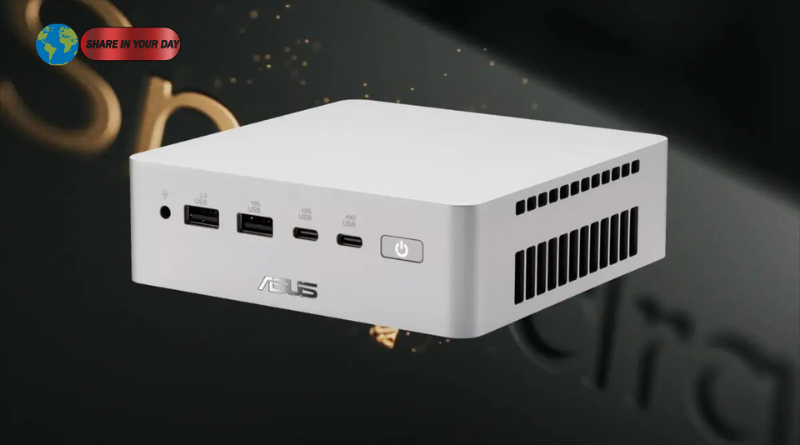
The headline specification is the system’s 80 TOPS Qualcomm Hexagon NPU, which is designed to accelerate artificial intelligence workloads directly on the device. The computer combines that NPU with an 18-core third-generation Qualcomm Oryon CPU and an integrated Adreno X2-90 GPU.
In the United States, the entry configuration is listed at $1,349.99, according to current retail information reported by VideoCardz. That configuration includes 16GB of memory and a 512GB SSD.
The launch puts ASUS into a rapidly expanding category of compact computers designed around local AI processing. Instead of depending entirely on cloud services, the QN10 is designed to handle supported AI workloads locally while maintaining a very small desktop footprint.
ASUS Ascent QN10 Packs Snapdragon X2 Elite Into a Tiny Chassis
The most striking feature of the ASUS Ascent QN10 may be how much hardware ASUS has managed to fit into its compact enclosure.
The system measures approximately 130 × 130 × 40 millimeters, giving it a volume of less than 0.7 liters. ASUS lists the weight at about 620 grams on its product page.
That makes the QN10 considerably smaller than a conventional desktop PC.
Despite the compact footprint, ASUS has equipped the system with an extensive selection of connectivity options. Users get three USB4 Type-C connections capable of up to 40Gbps, three USB Type-A ports supporting 10Gbps speeds, an additional USB 2.0 Type-A port, HDMI 2.1 and a 2.5Gbps Ethernet connection.
Wireless connectivity includes Wi-Fi 7 and Bluetooth 6.0.
ASUS also says the machine can drive up to four 4K displays simultaneously, giving the compact computer a potentially useful role in multi-monitor offices, development environments and digital-signage applications.
Image suggestion: ASUS Ascent QN10 product image showing the compact chassis and connectivity ports.
Image ALT text: ASUS Ascent QN10 Snapdragon X2 Elite AI mini PC
Snapdragon X2 Elite Brings 18 CPU Cores
At the heart of the ASUS Ascent QN10 is Qualcomm’s Snapdragon X2 Elite platform.
The specific platform listed by ASUS is the X2E-88-100, featuring an 18-core third-generation Qualcomm Oryon CPU. The processor is paired with integrated Qualcomm Adreno X2-90 graphics.
The move is significant because Qualcomm has been expanding its Windows on Arm strategy beyond notebooks.
The QN10 takes the same general concept into the desktop space: a highly integrated processor platform designed to combine CPU performance, graphics and dedicated AI acceleration in a compact and power-conscious package.
ASUS says the integrated Adreno GPU provides a substantial improvement over the previous generation, while the system’s processor architecture is designed to handle multitasking and AI-assisted workloads efficiently.
However, the QN10 is not being marketed as a high-end gaming replacement.
Instead, ASUS emphasizes AI development, productivity, edge computing and professional workloads.
That distinction is important because the integrated GPU does not occupy the same performance class as a dedicated desktop graphics card. Buyers interested primarily in demanding PC gaming will therefore have different priorities from the developers and professionals ASUS is targeting.
The 80 TOPS NPU Is the Big AI Feature
The defining feature of the ASUS Ascent QN10 is its dedicated Qualcomm Hexagon NPU.
ASUS rates the NPU at up to 80 TOPS of AI processing performance. The company describes the system as the world’s first AI mini PC featuring an 80 TOPS NPU.
TOPS, or trillion operations per second, is commonly used to describe the theoretical AI processing capability of dedicated neural-processing hardware.
For everyday users, however, the number itself is not a complete measure of real-world AI performance.
Actual results depend on the software, model, precision, memory bandwidth and how effectively applications use the NPU.
Still, the 80 TOPS rating places the QN10 firmly in the current Copilot+ PC category. ASUS says the machine supports on-device AI experiences and developer workflows through Qualcomm’s AI software ecosystem.
This could make the QN10 particularly interesting for users who want to experiment with local AI without building a large desktop workstation.
ASUS Targets Developers and Local AI
ASUS is clearly targeting the ASUS Ascent QN10 at more than basic office computing.
The company describes the machine as suitable for creators, developers, AI model builders, technology innovators and enterprise edge-computing applications.
That positioning explains the emphasis on the NPU.
A traditional mini PC might prioritize CPU performance, storage and general-purpose graphics. The QN10 instead puts AI acceleration near the center of its product identity.
ASUS says the computer gains access to the Qualcomm AI Hub, where users can work with optimized AI models and deploy applications to the system. The company also highlights support for agentic AI applications, including OpenClaw and Hermes Agent.
For developers, this could make the QN10 a compact experimentation platform.
Rather than dedicating an entire desktop workstation to certain AI development tasks, users could potentially use a small system that sits quietly on a desk or operates as an edge device.
Internal link suggestion: Link to your website’s latest article covering AI PCs, local AI models or Qualcomm Snapdragon processors.
Up to 32GB of LPDDR5X Memory
Memory is another important component of the QN10’s AI-focused design.
ASUS lists configurations with up to 32GB of LPDDR5X memory, with supported memory speeds reaching 8533MHz or 9600MHz depending on configuration and specification.
The system is therefore positioned to handle substantially more demanding multitasking than many basic mini PCs.
However, prospective buyers should pay close attention to the exact configuration.
The first US retail configuration reported by VideoCardz is equipped with 16GB of memory and a 512GB SSD for $1,349.99. ASUS’s broader specifications identify higher-end configurations, but US pricing for every version has not been confirmed.
That means the $1,349.99 price should not automatically be interpreted as the cost of a fully loaded QN10.
Buyers interested in 32GB of RAM or larger storage should check the configuration offered by their retailer before purchasing.
Dual SSD Support Adds Flexibility
Storage is another area where ASUS has attempted to give the QN10 more flexibility than its tiny size might suggest.
The system supports two M.2 SSD positions according to ASUS’s specifications. ASUS lists PCIe NVMe storage configurations and support for expanding the system’s storage capacity.
VideoCardz reports that ASUS specifies one PCIe Gen5 M.2 2280 slot and another PCIe Gen4 M.2 slot, with support for up to 4TB of combined storage in the broader specification.
This is potentially useful for AI developers.
Local AI models can consume significant storage space, particularly when users maintain multiple models, datasets, development environments and application files.
A system that can accommodate more than one SSD therefore provides greater flexibility than a basic mini PC with a single storage slot.
It also allows users to separate operating-system files from larger datasets or development projects.
Seven USB Ports and 2.5Gb Ethernet
The QN10 is unusually well equipped for a machine this small.
ASUS lists seven USB ports across the system, including three USB4 connections. The high-speed USB4 ports can provide up to 40Gbps bandwidth and support display and power-delivery functions.
There are also multiple USB Type-A ports for conventional peripherals.
That means users should have enough connectivity for keyboards, mice, external storage, cameras, development hardware and other accessories without immediately needing a hub.
The inclusion of 2.5Gb Ethernet is also important for professional environments.
For local servers, development systems and network storage, faster wired connectivity can be more useful than relying exclusively on wireless networking.
Wi-Fi 7 is available when wireless access is preferred.
Four 4K Displays From a Mini PC
Multi-monitor support is another area where the ASUS Ascent QN10 stands out.
ASUS says the system can support up to four simultaneous 4K displays.
For developers, that could provide enough screen space for source code, documentation, terminals and testing environments.
For business users, the same capability could support large desktop workflows without requiring a conventional tower PC.
ASUS also identifies digital signage and smart-kiosk applications as potential use cases.
The compact dimensions could make the QN10 suitable for environments where space is limited but multiple displays or local computing capabilities are required.
Windows 11 Pro and Copilot+ PC Support
The ASUS Ascent QN10 runs Windows 11 Pro and is positioned as a Copilot+ PC.
That means the machine is designed around Microsoft’s requirements for PCs with dedicated AI acceleration hardware. ASUS specifically highlights on-device AI features and developer tools alongside the QN10’s NPU capabilities.
The Windows on Arm platform does introduce an important consideration, however.
Software compatibility can vary between native Arm applications and x86 or x64 applications running through Microsoft’s compatibility layers.
For users who rely on specialized Windows software, checking application compatibility before purchasing remains important.
Developers who already work with Arm-compatible software may find the architecture particularly interesting.
The QN10 is therefore not simply a conventional x86 desktop placed inside a smaller enclosure. Its Arm-based design is a central part of the product.
ASUS Ascent QN10 Price Starts at $1,349.99
The US price is one of the most attention-grabbing aspects of the launch.
Best Buy has listed an ASUS Ascent QN10 configuration for $1,349.99, with 16GB of memory and a 512GB SSD. VideoCardz identified this configuration as the currently available US model.
That puts the QN10 firmly into premium mini-PC territory.
The price reflects more than the physical size of the machine. Buyers are paying for the new Snapdragon X2 Elite platform, dedicated 80 TOPS NPU, high-speed connectivity and a system designed specifically around local AI workloads.
Still, the value proposition will depend heavily on the user’s workload.
Someone looking for an inexpensive web-browsing or media PC can find much cheaper mini PCs.
The QN10’s main appeal is instead its combination of compact design, Arm architecture and dedicated AI acceleration.
Is the ASUS Ascent QN10 a Gaming Mini PC?
Despite its powerful processor, the ASUS Ascent QN10 is not primarily a gaming machine.
ASUS’s own messaging focuses on creators, developers, enterprise users and AI workloads.
The integrated Adreno X2-90 GPU can handle graphics workloads, but the machine does not include a discrete NVIDIA, AMD or Intel desktop graphics card.
That makes the QN10 fundamentally different from high-end gaming mini PCs that incorporate dedicated GPUs.
For casual gaming or supported titles, the integrated graphics may be sufficient depending on resolution and settings.
But buyers seeking maximum gaming performance should not confuse the QN10’s impressive NPU specification with dedicated gaming GPU performance.
The 80 TOPS figure relates to AI acceleration, not traditional 3D rendering performance.
Compact AI Computing Could Be the QN10’s Biggest Advantage
The strongest argument for the ASUS Ascent QN10 is its combination of size and specialized computing capabilities.
At less than 0.7 liters, the computer can fit into spaces where a conventional workstation would be impractical. At the same time, it offers an 18-core CPU, integrated graphics, a dedicated 80 TOPS NPU, fast networking and extensive I/O.
That combination could make it useful in offices, laboratories, classrooms, development environments and edge-computing deployments.
The machine could also appeal to enthusiasts who want to experiment with local AI applications without purchasing a much larger system.
Local processing has another potential advantage: data can remain on the device for supported workloads rather than being sent to a remote cloud service.
Of course, local AI capabilities do not eliminate the need for cloud computing.
Large models and demanding workloads can still require substantially more memory and compute resources than a compact mini PC can provide.
The QN10 is better viewed as another option in the expanding local-AI ecosystem.
ASUS Ascent QN10 vs Traditional Mini PCs
The QN10 also highlights how the mini-PC market is changing.
Earlier generations of mini PCs were often designed around low-power processors intended for office productivity, streaming and basic desktop tasks.
Modern systems are increasingly adding dedicated AI accelerators.
The ASUS Ascent QN10 takes that approach further by making its NPU one of the main reasons to buy the machine.
Its 80 TOPS AI capability, Qualcomm AI Hub integration and support for agentic applications give the system a much different identity from a conventional small desktop.
At the same time, the machine retains features expected from a modern professional desktop, including fast USB connectivity, 2.5Gb Ethernet, Wi-Fi 7, multiple displays and expandable NVMe storage.
That combination could help make AI acceleration a more practical feature for everyday desktop computing.
What Buyers Should Know Before Purchasing
There are several points potential buyers should consider before ordering the QN10.
First, the $1,349.99 price applies to a specific US configuration, rather than necessarily representing every version of the system.
Second, memory is LPDDR5X, so users should select the appropriate RAM configuration when purchasing rather than assuming a conventional desktop memory upgrade path.
Third, Windows on Arm compatibility should be checked for specialized applications.
Finally, the QN10’s value is closely tied to AI workloads.
If a buyer does not use local AI applications, the system’s dedicated NPU may provide less practical benefit than its headline specifications suggest.
For developers and AI enthusiasts, however, the combination becomes considerably more relevant.
ASUS Ascent QN10 Signals a New Era for AI Mini PCs
The ASUS Ascent QN10 represents a notable step in the evolution of compact Windows computers.
It combines Qualcomm’s Snapdragon X2 Elite platform with an 18-core Oryon CPU, Adreno X2-90 integrated graphics and an 80 TOPS Hexagon NPU inside a chassis measuring roughly 130mm square.
The machine also provides modern connectivity, Wi-Fi 7, Bluetooth 6.0, 2.5Gb Ethernet, multiple USB4 ports, dual-display connectivity and support for as many as four 4K monitors.
The starting US retail configuration is priced at $1,349.99, making it a premium product aimed at users who can take advantage of its specialized capabilities.
Rather than competing directly with every budget mini PC on the market, ASUS appears to be targeting a more specialized segment: users who want compact Windows on Arm computing with dedicated local AI acceleration.
The next important question will be real-world performance.
Specifications such as 80 TOPS, 18 CPU cores and high-speed memory provide an impressive foundation, but practical results will ultimately depend on software optimization and the applications users run.
For now, the QN10 gives the rapidly developing AI-PC market another distinctive form factor: a tiny desktop that puts dedicated local AI processing at the center of the experience.
ASUS Ascent QN10 Specifications at a Glance
| Specification | ASUS Ascent QN10 |
|---|---|
| Processor | Snapdragon X2 Elite X2E-88-100 |
| CPU | 18-core Qualcomm Oryon |
| GPU | Qualcomm Adreno X2-90 |
| NPU | Qualcomm Hexagon, up to 80 TOPS |
| Operating System | Windows 11 Pro / Copilot+ PC |
| Memory | Up to 32GB LPDDR5X |
| Storage | NVMe SSD, dual-drive support |
| Networking | 2.5Gb Ethernet |
| Wireless | Wi-Fi 7, Bluetooth 6.0 |
| USB | 7 USB ports, including 3 USB4 |
| Display Support | Up to four 4K displays |
| Dimensions | 130 × 130 × 40mm |
| Volume | Under 0.7 liters |
| US Starting Price | $1,349.99 |
Specifications can vary by configuration and market. ASUS’s official specifications list different memory and storage configurations, while the $1,349.99 US price currently refers to the 16GB/512GB configuration reported by VideoCardz.