Iran Ukraine UN: 5 Key Moments at Assembly
The Iran Ukraine UN discussions took center stage at the United Nations General Assembly on September 23, 2026, as Iranian President Masoud Pezeshkian and Ukrainian President Volodymyr Zelenskyy used the global forum to present sharply different arguments about two major wars.
The speeches came one day after U.S. President Donald Trump addressed the General Assembly and discussed both the conflict with Iran and Russia’s war against Ukraine. Trump said he believed a settlement with Iran could eventually be reached while also declaring that the United States was working with Russia and Ukraine to end their war.
By Wednesday, attention had shifted to Tehran and Kyiv. Pezeshkian defended Iran’s position after months of conflict with the United States and Israel, while Zelenskyy warned that Russia’s war could have consequences extending beyond Ukraine.
The result was a day of high-stakes diplomacy in which war, sanctions, negotiations, energy security and artificial intelligence were closely connected.
Iran Ukraine UN talks reflect a wider global crisis
The 2026 General Assembly is taking place against a backdrop of multiple simultaneous conflicts. The United States and Iran remain locked in a confrontation, while Russia’s war against Ukraine continues and fighting elsewhere in the Middle East remains a major international concern.
The United Nations gathering therefore provides an unusual diplomatic setting: governments involved directly in conflicts are appearing in the same international institution while attempting to influence countries that are not directly involved.
Reuters reported that the wider General Assembly agenda has also been shaped by questions about the future role of the United Nations, artificial intelligence regulation, climate change and growing geopolitical competition.
For Iran and Ukraine, however, the immediate focus remained security.
Pezeshkian delivers a defiant Iran UN speech
Iranian President Masoud Pezeshkian used his September 23 address to reject the idea that military pressure would force Tehran to surrender.
According to reporting from the New York Times carried by other outlets, Pezeshkian displayed photographs of people killed in U.S. and Israeli strikes and argued that Iran had been subjected to violations of international law. He also maintained that Iran’s nuclear program was peaceful and rejected demands that would place limits on it.
His appearance followed Trump’s address the previous day, when the U.S. president warned that he could take further military action against Iran if an agreement was not reached. Trump subsequently said that he believed a settlement could be possible.
That contrast illustrated the central diplomatic problem facing negotiators.
Washington has emphasized preventing Iran from obtaining a nuclear weapon, while Tehran has rejected what it considers unacceptable restrictions and has questioned the prospects for negotiations after previous diplomatic efforts broke down.
Iran Ukraine UN diplomacy takes place alongside talks
Despite the harsh rhetoric, diplomatic contacts have not disappeared.
U.S. and Iranian representatives communicated through intermediaries during the General Assembly meetings, according to reporting on the diplomatic activity surrounding the gathering. Iran’s Foreign Minister Abbas Araghchi and U.S. representatives including special envoy Steve Witkoff were involved in contacts facilitated by mediators.
Earlier, Secretary of State Marco Rubio said Washington was open to discussions with Iranian officials at the United Nations, although he said at the time that no meeting had been formally scheduled. Rubio said the U.S. objective was to ensure Iran could not acquire a nuclear weapon.
Those developments are significant because direct U.S.-Iran communication has remained difficult during the conflict.
The General Assembly consequently serves two purposes. Publicly, leaders use the podium to defend their national positions. Privately, diplomats can use New York as a convenient location for indirect or direct contacts.
Why the Iran negotiations remain difficult
The major disagreements go beyond whether fighting should stop.
Iran wants its sovereignty and nuclear rights recognized, while Washington has emphasized nuclear nonproliferation. The two governments also have fundamentally different interpretations of how the conflict developed and which side bears responsibility.
Meanwhile, other countries in the region have economic and security interests tied to the outcome.
The war has also affected important transportation and energy routes. Earlier UN discussions highlighted concerns over regional instability, including navigation through strategically important waterways.
A diplomatic settlement would therefore have consequences far beyond Iran and the United States.
Zelenskyy warns Russia’s war could spread
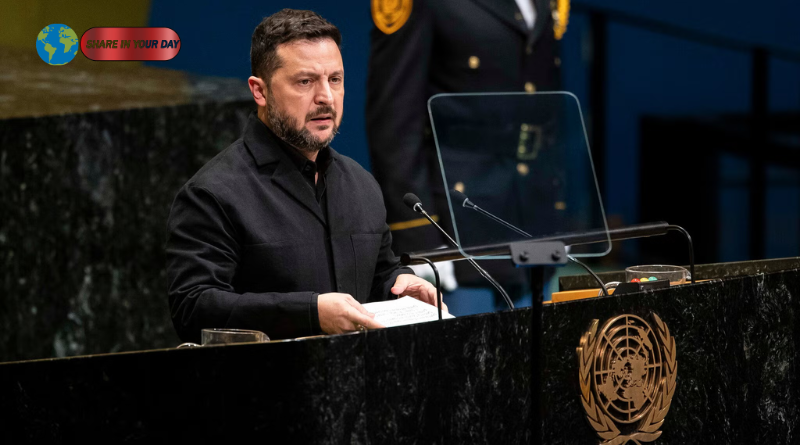
Ukraine’s President Volodymyr Zelenskyy brought the second major conflict into the spotlight during his address.
Zelenskyy argued that Russia’s war against Ukraine could eventually affect other European countries and called for continued economic pressure against Moscow.
His message was built around the argument that Russia’s ability to finance and sustain its military campaign must be constrained.
Zelenskyy also connected the Ukraine conflict to rapidly developing military technology.
According to reporting from the September 23 General Assembly proceedings, he warned that artificial intelligence could increasingly influence battlefield decisions and said the international community needed to address the issue before technological development moved beyond effective human control.
That concern reflects a broader discussion taking place at this year’s United Nations meeting.
AI becomes part of the Iran Ukraine UN debate
Artificial intelligence might appear unrelated to the wars in Iran and Ukraine, but the technology has become increasingly relevant to modern warfare.
Drones, automated systems, intelligence analysis and battlefield decision-making are already transforming military operations.
Zelenskyy highlighted the possibility that AI could play a much larger role in determining battlefield outcomes in the near future. His remarks came as technology executives were also addressing the United Nations about AI governance.
OpenAI CEO Sam Altman told the UN Security Council that the rapid development of AI required international cooperation and caution. Anthropic CEO Dario Amodei similarly said his company would slow development when necessary to address safety concerns.
The convergence of these discussions suggests that future international diplomacy may increasingly connect traditional security questions with technology regulation.
For Ukraine, AI is not merely a theoretical issue. The country has become one of the world’s most closely watched environments for drone warfare and battlefield technology.
Iran, meanwhile, has also developed and supplied drones and other military technologies that have become part of broader geopolitical debates.
Russia’s international support becomes a focus
Another important element of Zelenskyy’s speech was his discussion of foreign nationals fighting for Russia.
He said Russia was using citizens from dozens of countries in its war against Ukraine. He also pointed to Russia’s relationship with North Korea and said Ukrainian forces had captured North Korean soldiers fighting on the Russian side.
These claims form part of Kyiv’s broader argument that the Ukraine conflict is no longer simply a confrontation involving Russia and Ukraine.
Moscow has developed relationships with countries that provide military, economic or diplomatic support, while Ukraine has strengthened its own network of international partnerships.
The competing alliances make the conflict harder to isolate.
They also explain why the United Nations remains important to both sides. The General Assembly gives governments an opportunity to put their positions before a broad international audience, even when the organization itself cannot directly end a war.
Iran Ukraine UN meeting highlights pressure on global institutions
The events of September 23 also underscored a larger question: what can the United Nations actually accomplish when major powers disagree?
Secretary-General António Guterres has repeatedly called for stronger international cooperation and warned that global institutions are under increasing pressure.
In his final year as secretary-general, Guterres has pushed for reform of international institutions and greater international oversight of artificial intelligence. He has also called for de-escalation in conflicts across the Middle East.
The challenge is that the UN’s diplomatic role depends heavily on cooperation from member states.
When major powers disagree, the organization can provide a forum for negotiations, humanitarian coordination and public diplomacy. But its ability to impose solutions is much more limited.
That tension was visible throughout this year’s General Assembly.
What happens next for Iran and Ukraine?
The next phase will depend on whether public confrontation can be converted into sustained negotiations.
For Iran, the key question is whether diplomatic channels with Washington can produce a framework acceptable to both sides. Previous efforts have broken down, and the continuing military confrontation makes negotiations more difficult.
For Ukraine, the central issue remains whether diplomatic pressure can persuade Russia to accept a settlement while Kyiv seeks security guarantees and continued international support.
Trump’s September 22 remarks indicated that Washington continues to pursue diplomacy with both Moscow and Kyiv. However, statements that a settlement is possible do not themselves constitute an agreement.
The same distinction applies to Iran.
Contacts between officials can create an opening, but a durable agreement would require difficult decisions on military operations, sanctions, nuclear policy and security guarantees.
Why the UN General Assembly matters
The Iran Ukraine UN developments demonstrate how interconnected today’s international crises have become.
The conflicts are geographically separate, but they share several underlying themes: military technology, sanctions, energy security, alliances, diplomacy and the limits of international institutions.
The General Assembly also provides an opportunity for countries outside the major power blocs to express their positions.
That matters because neither the Iran conflict nor the Ukraine war exists in isolation. Their consequences extend into energy markets, shipping routes, food security, defense spending and international trade.
At the same time, the growing importance of drones and AI means the security environment is changing faster than traditional diplomatic institutions were designed to handle.
Five key takeaways from the Iran Ukraine UN developments
1. Iran rejected the idea that military pressure had forced it to surrender.
Pezeshkian used his UN appearance to defend Tehran’s position and reject restrictions on its nuclear program.
2. U.S.-Iran diplomatic contacts remain possible.
Officials have communicated through intermediaries, keeping diplomacy alive despite continuing disagreements.
3. Ukraine is pressing for continued economic pressure on Russia.
Zelenskyy argued that Russia’s revenues should remain a target of international policy.
4. AI is becoming a central security issue.
Ukraine’s president and technology leaders have warned that AI could reshape warfare and international security.
5. The UN faces a major test of its diplomatic role.
The organization remains a venue for negotiations and international debate while confronting deep divisions among powerful member states.
The bigger picture
The September 23 discussions showed that the world’s major security crises cannot easily be separated.
Iran’s confrontation with the United States affects energy and regional security. Russia’s war against Ukraine continues to reshape European defense policy and international alliances. Meanwhile, advances in AI and autonomous military technology are introducing questions that could affect both conflicts.
The United Nations General Assembly cannot independently resolve those disputes.
But it remains one of the few places where the countries involved can publicly present their positions while diplomats search for openings behind the scenes.
For now, the Iran Ukraine UN discussions point to a difficult combination of confrontation and diplomacy. Leaders continue to issue warnings, defend their policies and accuse opponents of wrongdoing, while negotiators look for ways to prevent further escalation.
Whether those diplomatic efforts produce agreements will depend on decisions made well beyond the General Assembly chamber.