Trump AfD Germany election reaction targets immigration
Trump’s response focused heavily on immigration.
After the AfD’s victory, Trump argued that Germany’s immigration policies had contributed to the party’s success. He praised the election result and linked it to public dissatisfaction with the government’s approach to migration. Reuters
The message closely resembles Trump’s own political strategy in the United States.
Immigration has been one of the central themes of his political movement. His administration has pursued a hard-line approach to border enforcement and deportation, while repeatedly arguing that uncontrolled immigration threatens national security, economic stability and social cohesion.
The AfD has adopted a similarly restrictive position in Germany.
Its campaign in Saxony-Anhalt emphasized migration, security and dissatisfaction with the established political parties. The party’s candidate for state premier, Ulrich Siegmund, has called for tougher measures against illegal immigration, including rapid deportations. RReuters
That ideological overlap helps explain why Trump reacted so enthusiastically to the result.
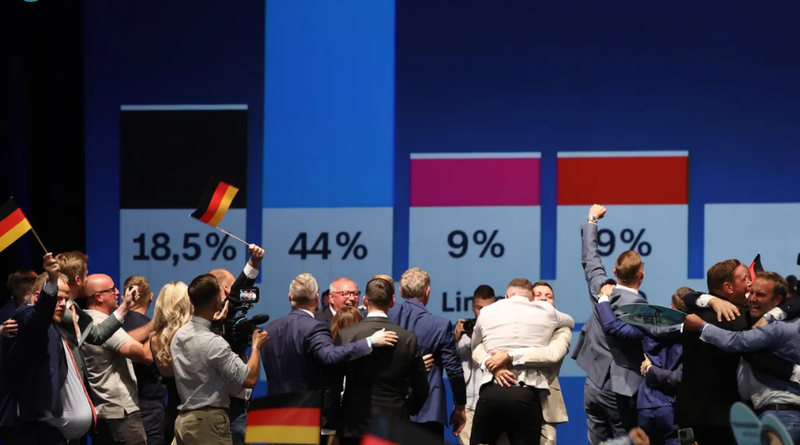
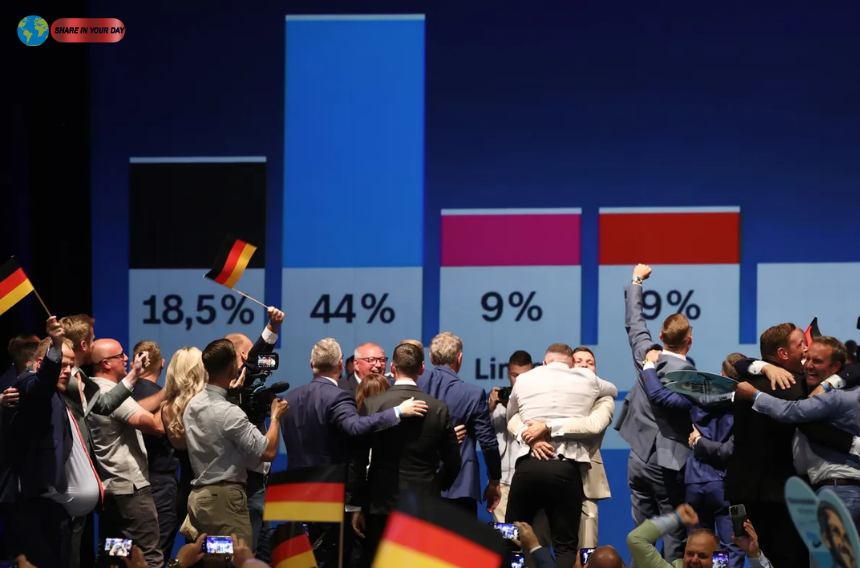
AfD wins a historic 44% of the vote
The scale of the AfD’s victory is what has attracted the most attention.
The party received approximately 43.8% of the vote in Saxony-Anhalt, more than doubling its previous result and leaving the CDU far behind. AAP News+1
The CDU, traditionally one of Germany’s dominant parties, suffered a dramatic setback.
The result is particularly damaging for Merz because his party governs Germany at the federal level.
Instead of strengthening the CDU’s position in eastern Germany, the state election demonstrated how effectively the AfD can capitalize on dissatisfaction with the political establishment.
The AfD did not win enough seats for an outright majority.
However, its enormous vote share means other parties must decide how to respond.
That creates a difficult political problem because mainstream German parties have maintained what is commonly known as a “firewall” against cooperation with the AfD.
Germany’s political firewall faces a major test
The Trump AfD Germany election story is ultimately about more than one state.
For decades after World War II, Germany’s mainstream political parties have been extremely cautious about working with far-right movements.
The AfD’s rise has repeatedly tested that principle.
The party’s growing electoral support means that excluding it from government can become increasingly difficult in regions where it attracts a very large share of voters.
In Saxony-Anhalt, the AfD’s result puts pressure on other parties to form a government without it.
That could require complicated coalition arrangements.
The alternative is potentially even more controversial: cooperation with the AfD.
So far, Germany’s mainstream parties have generally rejected that option.
The latest result, however, shows how difficult maintaining the firewall could become if AfD support continues to rise.
The Associated Press reported that the result could give the AfD a path toward forming Germany’s first far-right state government since World War II, depending on coalition negotiations and possible support from other parties. AAP News
Friedrich Merz suffers a major political setback
For Chancellor Friedrich Merz, the election is a serious warning.
The CDU’s poor performance suggests that dissatisfaction with the federal government is increasingly benefiting the AfD.
Merz has attempted to combine tougher migration policies with economic reforms designed to revive Germany’s competitiveness.
But those policies have not prevented the AfD from gaining ground.
The election result also creates questions about Merz’s political authority.
If voters in eastern Germany continue moving toward the AfD, CDU leaders may face pressure to reconsider their strategy.
Some conservatives may argue that the party needs to adopt tougher positions on immigration and security.
Others may worry that moving too far toward the AfD would undermine the CDU’s identity and strengthen the far right rather than weaken it.
That debate is likely to become more intense after Saxony-Anhalt.
Why immigration is driving the political shift
Immigration was one of the most important themes in the campaign.
Germany has experienced years of political debate over asylum, integration and migration.
The issue became especially divisive after the large influx of migrants into Europe during the 2010s.
The AfD has built much of its political identity around opposition to what it considers overly permissive immigration policies.
Its supporters argue that mainstream parties have failed to respond adequately to concerns about border control, crime, public services and cultural integration.
Opponents argue that the AfD’s policies are discriminatory and that its rhetoric threatens Germany’s democratic norms.
That divide is now reflected directly in electoral results.
The Saxony-Anhalt vote demonstrates that immigration remains an extremely powerful issue for a substantial part of the German electorate.
Economic frustration is also helping the AfD
Immigration alone does not explain the result.
Germany has faced significant economic challenges in recent years, including weak growth, industrial pressure and uncertainty surrounding its traditional manufacturing model.
The country’s automobile and industrial sectors have faced intense competition from China and other international markets.
Energy costs have also become a major political issue.
For voters experiencing economic uncertainty, frustration with established parties can translate into support for political alternatives.
The AfD has benefited from that dissatisfaction.
Its campaign presents the party as an alternative to Germany’s political establishment and connects immigration, economic policy and national sovereignty.
That combination has proven especially effective in parts of eastern Germany.
Trump sees the result as part of a wider movement
Trump’s enthusiasm for the AfD reflects his broader relationship with European nationalist and populist movements.
His political message has increasingly emphasized national sovereignty, immigration restrictions and opposition to what he sees as globalist institutions.
The AfD shares some of those positions, although Germany’s political system and historical circumstances are very different from those of the United States.
Trump’s response nevertheless suggests that he views the German election as part of a broader political realignment.
He has previously praised European politicians who campaign against high immigration and established political elites.
The AfD’s performance gives that movement another major electoral success to celebrate.
Berlin pushes back against Trump’s intervention
Trump’s comments have not been welcomed by Germany’s government.
A spokesperson for Merz said that interference or commentary from foreign leaders on Germany’s domestic political affairs was unacceptable. RReuters
The reaction highlights the sensitivity surrounding the AfD.
Germany’s political establishment views the party through the country’s unique historical experience.
The AfD rejects accusations that it represents a return to Germany’s Nazi past and argues that it is a legitimate political force responding to voter concerns.
But German authorities and mainstream political parties have repeatedly expressed concern about extremist tendencies within parts of the movement.
That makes Trump’s public endorsement especially controversial.
Trump and Merz already face tensions
The election dispute comes amid broader disagreements between Washington and Berlin.
Relations between Trump and the German government have been strained over several issues, including trade, foreign policy and European support for Ukraine. RReuters
Trump’s support for the AfD adds another layer to the relationship.
The German government is attempting to maintain close relations with the United States while also protecting its own political independence.
That becomes more complicated when the American president publicly celebrates the electoral success of a German party that the government considers unacceptable as a coalition partner.
The disagreement could become a recurring source of tension.
The AfD still faces a difficult path to power
Despite its historic result, the AfD has not automatically taken control of Saxony-Anhalt.
Winning 44% of the vote is not the same as controlling the government.
The party still needs a governing majority.
That creates several possible scenarios.
Other parties could attempt to form a coalition that excludes the AfD.
The AfD could seek support from smaller parties.
Individual lawmakers could potentially defect from other groups.
Or political negotiations could produce an unconventional arrangement.
The outcome will determine whether the election becomes merely an extraordinary electoral victory or a genuine breakthrough in the AfD’s ability to govern.
The BSW could become important
One of the most closely watched parties in the coalition negotiations is the Sahra Wagenknecht Alliance, or BSW.
The party occupies a different ideological position from the AfD but shares some views on immigration and Russia.
The BSW crossed the threshold needed to enter the state parliament, giving it potential influence over coalition calculations. AAP News
Whether the BSW would actually cooperate with the AfD remains uncertain.
However, its presence demonstrates how Germany’s traditional political divisions are becoming more complicated.
The old left-right framework is increasingly being challenged by disputes over immigration, nationalism, Russia and Germany’s relationship with the European Union.
Why the result matters beyond Germany
The Trump AfD Germany election development has consequences far beyond Saxony-Anhalt.
Germany is the European Union’s largest economy and one of its most influential political powers.
A sustained rise of the AfD could affect Germany’s positions on immigration, European integration, defense and relations with Russia.
It could also influence debates in neighboring countries.
Far-right parties are already influential in several European states.
An AfD breakthrough would therefore add momentum to a broader political shift that has been visible across Europe.
The result could be particularly important ahead of other major elections.
Political parties across Europe are likely to study the campaign closely, especially the AfD’s ability to turn concerns about immigration and economic dissatisfaction into electoral gains.
Europe’s far right is not following one simple path
The AfD’s victory does not mean every European country is moving in the same direction.
The political fortunes of far-right parties vary significantly from one country to another.
Some have entered government.
Others have suffered electoral setbacks.
Some have moderated their rhetoric after gaining power, while others have become more confrontational.
The Associated Press noted that recent European elections show both the growing strength of far-right movements and significant examples of voters rejecting them. AAP News
That makes Germany particularly important.
The country has historically maintained one of Europe’s strongest political barriers against the far right because of its Nazi past.
The AfD’s success therefore carries symbolic significance well beyond its percentage of the vote.
What happens next for Germany?
The immediate question is whether the AfD can turn its election victory into governing power.
The longer-term question is whether the party can reproduce its success elsewhere.
Germany has several important regional elections ahead, creating additional opportunities for the AfD to demonstrate whether Saxony-Anhalt was an isolated breakthrough or part of a broader national trend.
For Merz, the challenge is equally significant.
He must address voters’ concerns about immigration and the economy without destroying the CDU’s political center.
He must also defend the firewall against the AfD while ensuring that voters do not interpret that position as ignoring their concerns.
That will be an extremely difficult balancing act.
Trump’s role could become increasingly controversial
Trump’s intervention could further complicate Germany’s political debate.
Supporters of the AfD are likely to welcome his endorsement.
Opponents may use it as evidence that the party has become part of a broader international populist network.
That creates an unusual dynamic.
Foreign political support can energize a domestic movement, but it can also strengthen arguments from opponents who portray the party as influenced by forces outside Germany.
The German government is likely to remain cautious about Trump’s involvement.
At the same time, the AfD has little reason to distance itself from a U.S. president who has publicly praised its political success.
Conclusion
The Trump AfD Germany election reaction has transformed a dramatic regional vote into an international political story.
The AfD’s roughly 44% result in Saxony-Anhalt represents a historic breakthrough and a severe setback for Chancellor Friedrich Merz’s CDU. AAP News+1
Trump’s decision to celebrate the result and connect it to Germany’s immigration policies adds another dimension to the political shock.
For the AfD, the election demonstrates that its message can attract an enormous share of voters in an important German state.
For Merz and the mainstream parties, it is a warning that the traditional political firewall is under increasing pressure.
And for Europe, the result raises a larger question: is the German vote another step in the continent’s rightward political shift, or an unusually strong regional protest that will prove difficult to reproduce?
The answer will depend on what happens next.
If the AfD manages to enter government in Saxony-Anhalt, the political significance of the result could increase dramatically.
If mainstream parties successfully prevent it from governing, the election will still remain a landmark demonstration of the party’s electoral strength.
Either way, Germany’s political landscape has changed.
And Trump’s enthusiastic response has ensured that the consequences of that change will be debated far beyond Germany’s borders.