Moon City: 5 Shocking Water Limits Revealed
Elon Musk’s vision for a Moon city could face a major resource problem long before the lunar settlement becomes truly self-sustaining. A new study examining the Moon’s available water suggests that even a highly efficient settlement could eventually exhaust its most important resource.
Musk said earlier this year that SpaceX had shifted its near-term focus toward building a “self-growing city” on the Moon in less than 10 years. The idea represents a significant change in emphasis from the company’s long-standing focus on Mars. Musk has argued that the Moon offers a faster path because spacecraft can travel there far more frequently than they can make the journey to Mars.
But a Moon city would need more than rockets, habitats and power systems. It would need reliable access to water.
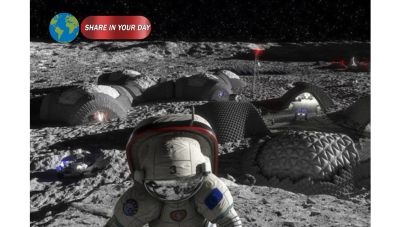
A new report published in Frontiers in Space Technologies examines exactly that challenge. Researchers Martin Elvis and Jonathan McDowell calculated how long lunar water resources could support settlements of different sizes. Their findings suggest that a million-person lunar city would face severe sustainability limits, even under unusually optimistic assumptions.
Moon City Depends on a Limited Water Supply
Water is one of the most valuable resources on the Moon.
Unlike Earth, the lunar surface has no rivers, lakes or readily accessible reservoirs. However, spacecraft observations have identified evidence of water ice in permanently shadowed regions near the lunar poles.
These areas are inside deep craters where sunlight has been blocked for billions of years. Temperatures can remain extremely low, creating what scientists call “cold traps.” Under those conditions, water ice can remain stable for extraordinarily long periods.
The discovery of lunar water changed the conversation about permanent human settlements.
If astronauts can extract water locally, they would not need to transport every kilogram of drinking water from Earth. Water could also potentially be processed into oxygen and hydrogen, making it useful for life support and possibly rocket propellant.
That makes lunar water central to almost every serious proposal for a permanent settlement.
The problem is quantity.
The researchers note that earlier estimates have suggested as much as 1 billion metric tons of water could exist in lunar polar regions. However, current estimates may be substantially lower. The study says some estimates could be around 20 to 30 times smaller than that optimistic figure.
That uncertainty creates a major challenge for any large Moon city.
Elon Musk’s 10-Year Moon City Vision
Musk’s proposal puts the resource question into sharper focus.
In February 2026, Musk said SpaceX was prioritizing a self-growing lunar city because a Moon settlement could potentially be developed much faster than a comparable city on Mars.
He argued that missions to the Moon can be launched much more frequently. Mars, by comparison, has launch opportunities roughly every 26 months because of the orbital relationship between Earth and Mars. Musk said the shorter distance and more frequent lunar launch opportunities would allow SpaceX to develop and test lunar infrastructure more rapidly.
Musk has not said that Mars has been abandoned. Instead, he has described lunar development as the nearer-term priority, while Mars development could continue in parallel.
The phrase “self-growing” is particularly important.
A settlement that depends entirely on regular deliveries from Earth would not truly be self-sustaining. A self-growing settlement would need to manufacture infrastructure, process local materials and expand its capabilities without requiring every major component to be shipped from Earth.
That means the Moon would need to provide not only living space but also raw materials, energy and water.
The new research highlights why water may become one of the biggest limits.
How Long Could a Million-Person Moon City Survive?
The researchers examined a hypothetical city with up to one million residents.
Without highly effective recycling, even the optimistic estimate of 1 billion metric tons of lunar water would support such a population for only a few years, according to the study.
Water recycling changes the calculation dramatically.
The researchers considered a recycling efficiency of 98%, comparable to the level achieved aboard the International Space Station. Under that extremely demanding scenario, a city of one million people could theoretically survive for just over a century using the optimistic water estimate.
That may sound like a long time.
For a truly permanent civilization, however, 100 years is not an unlimited supply. A self-growing city would need to survive across generations and continue expanding its industrial base.
The situation becomes even more difficult if the actual amount of accessible lunar water is significantly below the optimistic estimate.
The researchers point out that current estimates may be roughly 30 times smaller than the billion-ton assumption. If that proves accurate, the available supply would be depleted far sooner.
The difference demonstrates why knowing exactly how much water is available may be more important than simply knowing that water exists.
Smaller Moon Settlements Could Last Much Longer
The study does not mean that lunar settlements are impossible.
Instead, population size appears to be critical.
The researchers estimate that a village of about 1,000 people, or a larger settlement of roughly 10,000, could potentially use the available water for centuries under the modeled conditions.
That creates an important distinction between a research base and a city.
A small lunar community could focus on scientific research, exploration, resource extraction and technological development. It could also serve as a testing ground for systems that might eventually support a much larger population.
A million-person Moon city, however, would require an entirely different level of infrastructure.
Such a settlement would need extensive agriculture, sanitation, manufacturing, energy generation, construction and water-processing systems.
Every additional resident would add demand to a resource that is already difficult to locate and extract.
Water Is Not the Only Lunar Challenge
Water may be the most immediate concern highlighted by the study, but building a Moon city would involve many other technical challenges.
The lunar environment is hostile to humans.
There is no breathable atmosphere. Temperatures vary dramatically. The surface is exposed to radiation and micrometeorites. Lunar dust is also a major engineering and health concern because it is abrasive and can become difficult to control inside habitats.
Gravity presents another long-term uncertainty.
The Moon has only about one-sixth of Earth’s surface gravity. Humans have extensive experience living in microgravity for months, but the long-term effects of living for decades or generations in lunar gravity remain uncertain.
A permanent settlement would therefore require technologies that go well beyond simply landing astronauts.
Solar Power Could Be a Lunar Advantage
Interestingly, the new study suggests that energy may not be the biggest obstacle.
Near some lunar polar craters, elevated regions receive sunlight for much longer periods than most locations on the Moon. Researchers describe these areas as highly favorable for solar power generation.
The study suggests that large solar installations could potentially generate several gigawatts of electricity.
That could provide power for habitats, industrial equipment and resource-processing systems.
The researchers even discuss the possibility of lunar data centers operating near locations with strong and relatively continuous solar exposure.
This creates an interesting contrast.
A future lunar settlement could potentially have access to substantial energy while still struggling to obtain enough water.
In other words, producing electricity may be easier than maintaining the human population that uses it.
Could Better Recycling Save the Moon City?
The researchers identify several possible ways to extend the lifetime of lunar settlements.
The first is better water recycling.
If future technology can recover a greater percentage of water from wastewater, humidity and other sources, the amount of new water required by each resident could decline substantially.
The second is reducing water consumption.
Advanced agricultural systems could potentially grow food using less water than traditional farming. Controlled-environment agriculture could become especially important because transporting food from Earth would be expensive and vulnerable to supply interruptions.
The third option is importing water.
Asteroids contain water and other potentially useful resources. Future spacecraft could theoretically extract water from suitable near-Earth objects and transport it to lunar facilities.
However, asteroid resource extraction remains an emerging technology rather than an established supply chain.
The fourth option may be the most straightforward: find more water on the Moon.
Scientists Still Need Better Lunar Water Maps
The amount of lunar water remains uncertain because scientists cannot simply inspect the entire polar subsurface.
Current surveys provide important information, but they do not necessarily reveal all of the water buried beneath the surface.
The researchers note that current water surveys generally reach only a few meters below the lunar surface. Lunar regolith, however, can extend much deeper. That leaves open the possibility that additional water could exist below the areas already studied.
Future missions could therefore play a critical role.
Instead of immediately attempting to build a million-person city, space agencies and private companies could first focus on mapping, drilling and extracting lunar resources.
The results would provide a much clearer picture of what a permanent settlement could realistically support.
What the New Study Means for SpaceX
The research does not directly determine whether SpaceX can build a Moon city within 10 years.
Musk’s timeline is a company ambition, while the scientific study addresses resource sustainability. Those are different questions.
A settlement could potentially begin construction within a decade while still requiring decades of additional development before it becomes self-sustaining.
The bigger issue is whether local lunar resources can keep pace with population growth.
If the settlement remains small, water may support it for a very long period. If the population grows rapidly toward hundreds of thousands or millions, resource consumption becomes much more difficult to manage.
That makes the meaning of “self-growing” crucial.
If growth depends heavily on robots and automated construction while the human population remains relatively small, the water problem could look very different from a scenario involving millions of permanent residents.
The Moon City Question Is Really a Water Question
The discovery of lunar water made permanent human settlement seem far more plausible than it did decades ago.
But discovering water and having enough accessible water are two different things.
The latest research provides a useful reminder of that distinction. Even the study’s generous assumptions produce serious constraints for a large lunar population. At the same time, the researchers conclude that smaller settlements could potentially remain sustainable for centuries.
For Musk and SpaceX, that could mean the first stage of a Moon city looks very different from a traditional Earth city.
Instead of millions of residents arriving quickly, lunar development could begin with relatively small communities supported by extensive automation.
Those communities could gradually build solar farms, mining systems, manufacturing facilities and larger habitats while scientists continue searching for additional water.
The ultimate test will be whether the Moon contains enough usable resources to allow that process to continue without permanent dependence on Earth.
For now, the answer remains uncertain.
What is clear is that water will be one of the defining resources of any future lunar economy. Before humanity can build a truly self-growing city beyond Earth, it may first need to answer a much simpler question: How much water is actually there?
That question could determine how far the next great lunar expansion can go.