Greenland Welcomes New U.S. Military Pact as Trust in Washington Remains Fragile
Greenland’s government and residents have reacted with a mixture of relief and caution to a new security agreement allowing the United States to expand its military presence on the Arctic island. The deal, signed by the United States, Denmark and Greenland, appears to have eased months of diplomatic tension, but concerns about Washington’s intentions remain strong among parts of the Greenlandic population.
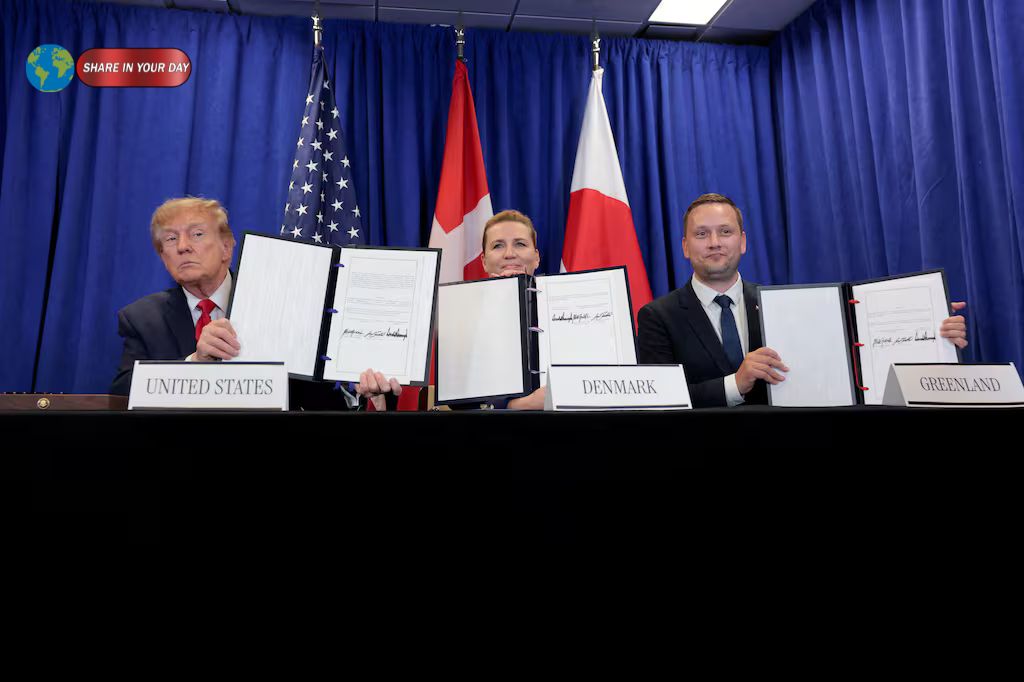
The agreement was signed Sept. 22 on the sidelines of the United Nations General Assembly in New York by U.S. President Donald Trump, Danish Prime Minister Mette Frederiksen and Greenland Prime Minister Jens-Frederik Nielsen. It expands the framework governing U.S. military activity in Greenland while reaffirming the territory’s place within the Kingdom of Denmark and its right to self-determination.
For Greenland, the agreement represents a significant change from the uncertainty that followed Trump’s earlier calls for the United States to acquire the island. Those demands created tensions between Washington, Copenhagen and Nuuk and raised concerns about Greenland’s political future.
The new pact does not transfer Greenland to the United States. Instead, it provides a framework for a larger American military role while maintaining Danish sovereignty over the territory. The agreement also opens the way for additional American military facilities and defense infrastructure.
U.S. Military Presence Set to Expand
Under the agreement, the United States can expand its military presence in Greenland and reopen facilities associated with the American military presence during the Cold War. The locations identified include Narsarsuaq and Mestersvig.
The agreement also provides for the possible deployment of a “Golden Dome” missile-defense system, according to reporting on the pact. Greenland’s geographical position makes it strategically important for monitoring activity across the Arctic and for defending North America and Europe.
The United States already operates Pituffik Space Base in northwestern Greenland. During the Cold War, however, the American military maintained a much larger network of installations on the island. Reuters reported that the United States once had 17 military installations and more than 10,000 personnel in Greenland. Today, the American military presence is considerably smaller.
The planned expansion comes as Arctic security has become increasingly important to the United States and its European allies. Russia and China have expanded their economic, scientific and strategic interests in the Arctic, increasing attention on Greenland’s location and infrastructure.
Relief After Months of Tension
Some Greenlandic officials have welcomed the agreement because it offers a diplomatic alternative to the confrontation that followed Trump’s earlier statements about acquiring Greenland.
Naaja Nathanielsen, a Greenlandic member of Denmark’s parliament, described herself as relieved by the outcome and said the agreement represented a sensible result. Greenland’s parliamentary speaker, Kim Kielsen, also urged residents to display the Greenlandic flag as the territory welcomed its leaders home after the negotiations.
The reaction, however, has not been uniformly positive.
For some Greenlanders, the possibility of increased American military activity raises questions about the effect on communities, the environment and traditional livelihoods. Greenland has a population of roughly 57,000, with many communities relying on fishing and hunting.
Residents and local officials have therefore emphasized that military development must take Greenlandic society and traditional activities into account.
Malene Vahl Rasmussen, mayor of the Kujalleq municipality in southern Greenland, where the United States is expected to reopen the Narsarsuaq facility, said greater military activity would need to respect local ways of life. Concerns include the possible effect of increased aircraft and ship traffic on hunting and fishing areas.
Trust Remains a Major Issue
The biggest challenge facing the new agreement may be political rather than military.
Greenlandic officials have stressed that signing a security pact does not immediately erase the distrust created during the dispute over U.S. ambitions for the island. While some residents view a stronger American presence as additional protection, others remain concerned about what expanded military activity could mean for Greenland’s autonomy.
The issue is particularly sensitive because Greenland has its own government and parliament but remains part of the Kingdom of Denmark. Greenlandic independence has also been an important subject in the territory’s political debate.
The agreement therefore attempts to balance several interests at once: American strategic concerns, Denmark’s responsibility for Greenland’s defense and Greenland’s demand for greater control over its own affairs.
Greenlandic officials have indicated that security cooperation can continue while the territory’s political status and right to self-determination remain intact. Denmark has likewise increased its military activity in Greenland following the tensions with Washington, including additional personnel, defense spending and exercises with allied forces.
A New Chapter in Arctic Security
The agreement marks a major shift in the relationship between the United States, Denmark and Greenland. Rather than pursuing direct American control over Greenland, Washington will gain expanded access for military and security purposes through an agreement with Greenland and Denmark.
For the United States, the arrangement strengthens its ability to operate in a strategically important Arctic location. For Denmark and Greenland, it provides a formal structure for American military activity while preserving Greenland’s existing constitutional position.
Whether the agreement produces lasting confidence will depend on how it is implemented. Military construction, aircraft movements, naval activity and the potential return of American personnel could all affect Greenlandic communities.
For now, the agreement has reduced one source of diplomatic uncertainty, but it has not erased the concerns that emerged during the dispute. Greenland’s response shows that greater security cooperation and local trust will have to develop together.
The next phase will therefore focus not only on military infrastructure but also on maintaining communication with Greenlandic communities and ensuring that expanded defense activity respects local interests.