Near-Borderless iPhone Pro Design Reportedly Takes Shape
The near-borderless iPhone Pro could become one of Apple’s most significant smartphone redesigns in years if the latest reports about the company’s 2027 models prove accurate.
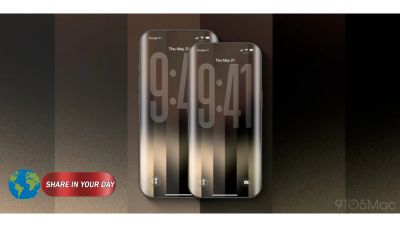
Apple is reportedly preparing a special generation of Pro iPhones for the 20th anniversary of the original iPhone. According to a new report cited by 9to5Mac, the company is still moving forward with a four-sided bending display designed to create an almost borderless appearance around the entire front of the device.
The timing would be significant. Apple introduced the original iPhone in 2007, making 2027 the device’s 20th anniversary. The company previously used a major anniversary to introduce the iPhone X in 2017, and current reports suggest Apple could again use the occasion for a more ambitious design.
However, the rumored redesign should be viewed as a developing project rather than a confirmed product specification. Apple has not announced its 2027 Pro iPhones, and several details remain subject to change.
Still, the latest reporting provides a clearer picture of what Apple may be planning.
1. The Near-Borderless iPhone Pro Could Use a Four-Sided Curved Display
The most important detail in the latest report is the display itself.
According to ETNews reporting cited by 9to5Mac, Apple is expected to continue developing a display that bends around all four edges of the smartphone. The objective is to create a near-borderless, full-screen appearance rather than simply reducing the thickness of the bezels.
This would represent a different approach to the current iPhone design.
Modern iPhones already use relatively thin bezels, but the display still stops before reaching the physical edges of the phone. A quad-curved design could make those boundaries visually less obvious.
The result could make the front of the device appear closer to a continuous sheet of glass.
That concept has been discussed in the smartphone industry for years. Several Android manufacturers have experimented with curved displays and extremely thin bezels, but Apple’s approach could place greater emphasis on integrating the display, glass and frame into one visual design.
Earlier 9to5Mac reporting also indicated that Apple’s 20th-anniversary iPhone could use an all-glass-oriented design, with glass extending toward the sides of the device and a metal band positioned between the front and rear sections.
If the reports are accurate, the display would therefore be only one part of a broader hardware redesign.
2. iPhone 20 Pro Models Could Have Larger Screens
The reported redesign may also bring larger displays.
A recent leak cited by 9to5Mac says Apple is testing an iPhone 20 Pro display measuring approximately 6.41 inches, while the iPhone 20 Pro Max could use a 6.96-inch panel.
For comparison, Apple’s current iPhone 18 Pro has a 6.27-inch physical display that the company markets as 6.3 inches. The iPhone 18 Pro Max has a 6.86-inch display, marketed as 6.9 inches.
That means the reported changes would not represent a dramatic jump in physical size.
The Pro model would gain roughly 0.14 inches diagonally, while the Pro Max would move closer to a true 7-inch display.
The larger screen could nevertheless feel more significant if it is combined with the reported near-borderless construction.
Instead of simply making the phone much larger, Apple could use the additional display area and redesigned edges to create a more immersive front surface.
A previous August report similarly claimed that Apple was testing approximately 6.4-inch and 7-inch displays for its next Pro models. That report also pointed to a quad-curved, bezel-free design.
3. The Dynamic Island May Become Smaller
The move toward a near-borderless iPhone Pro also raises another important question: what happens to the Dynamic Island?
Apple has continued to use the Dynamic Island on its latest Pro models, although the company has gradually refined the technology.
The iPhone 18 Pro and iPhone 18 Pro Max, announced in September 2026, feature a redesigned and smaller Dynamic Island that can display up to three Live Activities at once. Apple says the system continues to support Face ID while providing additional information at the top of the display.
The next generation could take another step toward reducing the visible interruption.
Reports suggest the 20th-anniversary models may use a smaller display cutout alongside the quad-curved panel. One recent leak described a smaller Dynamic Island as part of the broader borderless design.
That does not necessarily mean Apple is ready to eliminate the Dynamic Island entirely.
The front-facing camera and Face ID hardware still require space. Apple may therefore focus on reducing the physical footprint rather than immediately removing every visible cutout.
For users, even a smaller interruption could make the larger display feel more expansive.
4. Two Advanced Display Technologies May Be Delayed
Interestingly, the latest report suggests that not every display technology previously associated with Apple’s anniversary iPhone will make it into the final product.
According to ETNews, Apple is expected to postpone two technologies that had reportedly been under consideration: Color Filter on Encapsulation, known as COE, and LTPO+.
COE and LTPO+ could have offered technical benefits.
COE has been associated with thinner display construction, while LTPO+ could improve power efficiency and display control. However, the latest report says Apple is now expected to delay both technologies.
The reasons reportedly involve rising memory costs and Apple’s desire to pursue solutions that provide greater benefits than the current versions of those technologies.
This is an important reminder that early Apple rumors can change significantly before a product reaches mass production.
A technology may appear in early prototype discussions and later be removed because of manufacturing costs, reliability, efficiency or another engineering consideration.
In this case, the near-borderless display appears to be more central to Apple’s reported design direction than the specific display technologies that may sit underneath it.
5. Apple’s 20th Anniversary Could Bring a Major Visual Change
The timing of the rumored redesign may be just as important as the hardware itself.
Apple’s 10th anniversary produced the iPhone X, which introduced a radically different front design, Face ID and the removal of the traditional Home button.
The company’s 20th anniversary could provide another opportunity to mark an important milestone with a distinctive product.
Reports have increasingly pointed toward an iPhone 20 Pro or similarly positioned anniversary model featuring a more substantial visual redesign. The exact naming remains uncertain, although several reports have suggested Apple could move directly from the iPhone 18 generation to an iPhone 20 designation for the 20th anniversary.
Apple has not confirmed that naming strategy.
The company could instead use a special anniversary name, continue its existing numbering system or adopt another branding approach.
What appears more consistent across the reports is the expectation of a major design change.
Why a Near-Borderless iPhone Pro Matters
A near-borderless iPhone Pro would not simply be about making the screen look bigger.
It could change the way users interact with the physical device.
Thinner visual boundaries can make video, photographs, games and other full-screen content feel more immersive. A display that curves toward all four edges could also make the phone look more like a single piece of glass.
However, curved-edge displays have historically introduced practical challenges.
The edges can be more vulnerable to accidental touches, reflections and damage. They can also make screen protectors more complicated and create manufacturing challenges.
Apple would therefore have to balance aesthetics with durability and everyday usability.
That may explain why the reported project has remained in development for such a long period.
Apple’s Current iPhone 18 Pro Sets the Starting Point
The rumored 2027 design becomes easier to understand when viewed alongside Apple’s current generation.
Apple announced the iPhone 18 Pro and iPhone 18 Pro Max on September 9, 2026. The current models introduced a 48MP Fusion Main camera with variable aperture, the A20 Pro chip, a next-generation vapor chamber and an updated Dynamic Island.
Apple also describes the iPhone 18 Pro Max as delivering its largest increase in battery life to date.
The current generation therefore represents a substantial technical upgrade even though its overall exterior design remains familiar.
That creates room for the following generation to focus more heavily on physical design.
Instead of another year centered primarily on processor, camera or battery improvements, Apple’s anniversary models could place the display and chassis at the center of the product story.
Bigger Does Not Necessarily Mean Much Larger
The reported 6.41-inch and 6.96-inch displays should also be interpreted carefully.
The iPhone Pro Max is already close to 7 inches when measured diagonally. Moving from the current 6.86-inch physical panel to 6.96 inches would be a relatively modest increase.
The more important change could be how much of that surface is visible.
A smaller cutout, thinner borders and curved edges could make the screen feel substantially larger without requiring an equally dramatic increase in the overall dimensions.
Apple has already used this strategy in previous generations.
The company increased Pro display sizes in 2024, when the iPhone 16 Pro moved to a 6.3-inch marketed display and the Pro Max moved to 6.9 inches. Earlier reporting noted that slimmer bezels helped facilitate the larger panels.
The reported 2027 approach could push that philosophy further.
What Remains Unconfirmed
Despite the growing number of reports, much about Apple’s next Pro iPhones remains uncertain.
Apple has not officially announced the iPhone 20 Pro or iPhone 20 Pro Max. The reported screen dimensions are based on prototype information and leaks, meaning they could change before production.
The same applies to the quad-curved display.
While multiple reports now point toward a more aggressive all-screen design, there is no official Apple confirmation that the final consumer device will have a four-sided curved panel.
The potential use of a smaller Dynamic Island is also not guaranteed.
Likewise, the decision to postpone COE and LTPO+ could change as Apple’s engineering and supply-chain plans develop.
For now, these details should be understood as part of an evolving picture rather than a final specification sheet.
The Road to Apple’s 20th Anniversary iPhone
Apple’s reported plans for the next Pro generation suggest the company may be preparing something more visually ambitious than a routine yearly update.
The central idea is the near-borderless iPhone Pro: a device with a display that could curve toward all four sides, smaller visible interruptions and slightly larger screens.
The rumored iPhone 20 Pro and iPhone 20 Pro Max could therefore combine incremental size increases with a much more noticeable change in appearance.
At the same time, Apple appears willing to delay some of the advanced display technologies previously associated with the anniversary project.
That distinction matters. The biggest change may not come from a new display material or a single technical specification. Instead, it could come from the way Apple integrates the screen, glass and frame into one design.
The 20th anniversary gives Apple a natural opportunity to make that statement.
For now, however, the rumored redesign remains exactly that: a report about products that are still in development.
If Apple’s current plans survive the engineering and production process, the 2027 Pro lineup could offer one of the most distinctive iPhone designs in years.