
A24 Bets Big on “Marty Supreme” as Timothée Chalamet and Josh Safdie Redefine Indie Cinema
In an industry increasingly dominated by franchise blockbusters and streaming algorithms, independent studio A24 is making a bold statement: original storytelling can still command global attention.
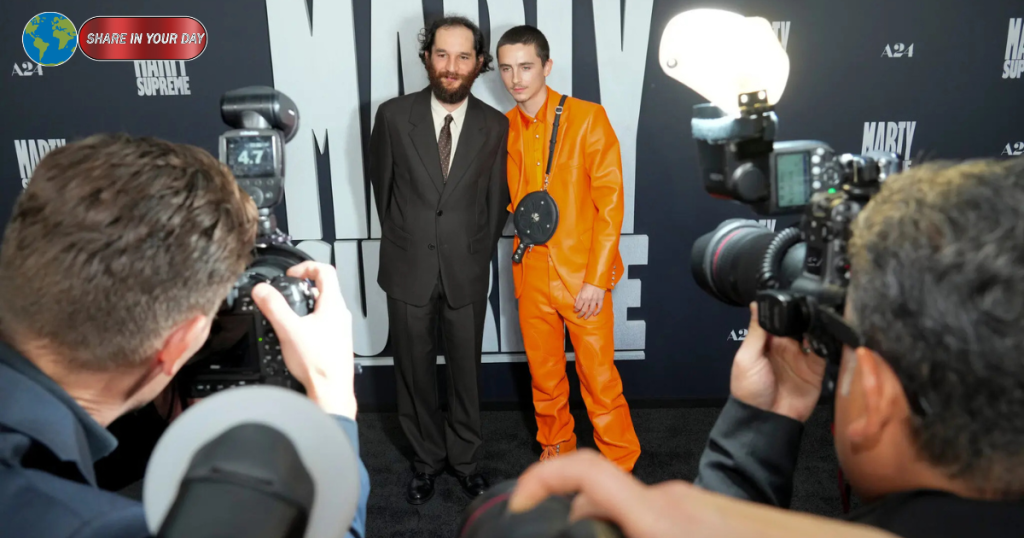
At the center of that bet is Marty Supreme, a high-energy, unconventional film led by Timothée Chalamet and directed by Josh Safdie—a project that has quickly become one of the most talked-about releases of the year.
More than just another awards contender, the film represents a turning point for both the studio and its collaborators, signaling a new era where indie cinema scales up without losing its edge.
A risky project with blockbuster ambition
For years, A24 has built its reputation on mid-budget films with strong artistic identity. But Marty Supreme marks a shift.
With a reported budget significantly higher than the studio’s typical productions, the film blends arthouse sensibilities with mainstream ambition. Set in the 1950s, it follows a brash, obsessive table tennis hustler chasing fame and validation in a chaotic postwar America.
The gamble appears to have paid off. The film has not only drawn critical attention but also delivered impressive box office results, becoming one of A24’s highest-grossing releases to date.
For a studio once considered niche, the success signals a growing ability to compete on a much larger stage.
Chalamet’s transformation into a flawed antihero
At the heart of the film is Chalamet’s performance—widely described as one of the most daring of his career.
He plays Marty Mauser, a deeply flawed yet magnetic character driven by ego, ambition, and an almost delusional belief in his own greatness. Critics have noted how the role strips away the actor’s usual charm, replacing it with something more abrasive and unpredictable.
The transformation is physical as well as emotional. Chalamet reportedly underwent extensive changes to embody the character, emphasizing the film’s commitment to realism and intensity.
The result is a performance that divides audiences but leaves a lasting impression—precisely the kind of risk that defines both the actor and the studio backing him.
Josh Safdie steps out on his own
For Safdie, Marty Supreme represents a personal milestone.
Best known for his collaborations with his brother Benny Safdie, the director steps into the spotlight solo here, bringing his signature high-stress, kinetic style to a broader canvas.
The film carries many of the hallmarks of his earlier work—fast pacing, morally ambiguous characters, and an almost suffocating sense of urgency—but with a more expansive narrative and visual scope.
It’s a transition that reflects both artistic growth and increased industry confidence in his vision.
A film that captures the spirit of modern ambition
Beyond its technical achievements, Marty Supreme resonates because of what it represents.
At its core, the film explores themes of ambition, self-invention, and the pursuit of success at any cost. Its protagonist embodies a kind of relentless drive that feels strikingly contemporary, even within its mid-century setting.
Some critics have argued that the character mirrors today’s culture of instant gratification and self-promotion—an interpretation that has fueled conversation around the film’s deeper meaning.
In that sense, Marty Supreme is not just a period piece. It’s a reflection of the present.
Awards buzz—and controversy
The film’s impact has extended well beyond theaters.
It entered awards season as a major contender, earning multiple nominations and positioning Chalamet as a frontrunner for Best Actor.
Yet the campaign has not been without turbulence.
From intense media scrutiny to broader industry debates, the film’s journey through awards season has underscored the complexities of modern Hollywood—where performance, publicity, and perception are increasingly intertwined.
Despite strong momentum, the film ultimately fell short of major wins, highlighting how unpredictable awards recognition can be even for widely praised projects.
Redefining what indie success looks like
Perhaps the most significant takeaway from Marty Supreme is what it signals for the future of independent film.
A24’s strategy—pairing bold creative risks with larger-scale production and star power—suggests a new model for success. One where originality is not sacrificed for commercial appeal, but amplified by it.
For audiences, that means more films that challenge expectations while still reaching wide audiences.
For the industry, it raises an important question: can independent studios reshape the mainstream?
A turning point for A24—and Hollywood
With Marty Supreme, A24 is no longer just the champion of indie cinema—it is becoming a serious force in the broader film landscape.
The collaboration between Chalamet and Safdie demonstrates how creative ambition and commercial viability can coexist, even in an industry often driven by formulas.
Whether this marks the beginning of a larger shift remains to be seen. But one thing is clear: Marty Supreme has already changed the conversation.