Ukraine Air Defence: 3 Urgent Allies’ Moves
Ukraine air defence has become an urgent priority as President Volodymyr Zelenskyy presses European allies for more interceptor missiles amid a renewed wave of Russian drone and missile attacks. On Monday, August 24, leaders and senior officials from Ukraine’s main European supporters gathered in Kyiv as the country marked its 35th Independence Day.
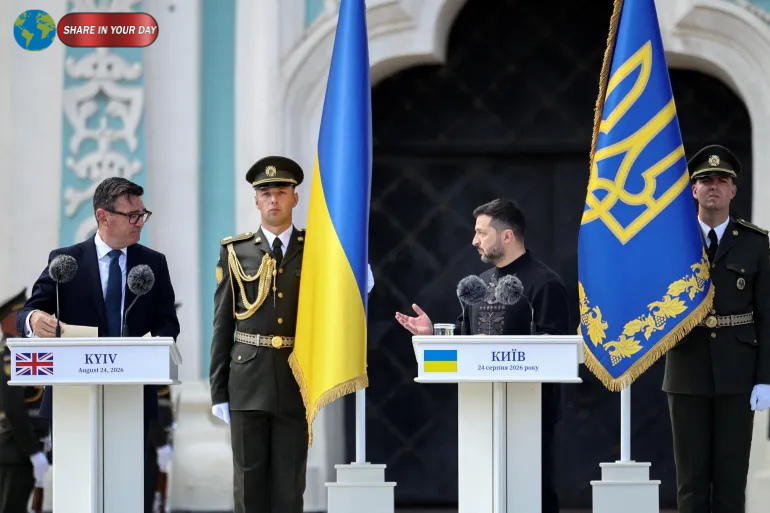
The meeting of the so-called “Coalition of the Willing” comes at a difficult moment for Kyiv. Russian attacks have intensified in recent weeks, while Ukraine says deliveries of crucial Patriot interceptors have fallen sharply even as the number of missile attacks has increased.
Zelenskyy said Ukraine received 675 Patriot missiles during 2023 and 364 during all of 2025. For 2026, the current projection is 264. Kyiv is therefore seeking a package of at least 300 interceptors for the coming winter.
The figures underline the central challenge facing Ukraine: protecting cities and critical infrastructure requires a steady supply of advanced air-defence ammunition, not simply the launchers themselves.
Ukraine Air Defence Becomes a Key Test for Europe
The Kyiv meeting is being held on Ukraine’s Independence Day, giving the gathering both a military and political significance.
UK Prime Minister Andy Burnham arrived in Kyiv for his first foreign visit since taking office. French President Emmanuel Macron and German Chancellor Friedrich Merz were expected to co-chair the Coalition of the Willing meeting remotely, while European Council President Antonio Costa attended in person.
The presence of senior European leaders sends a clear message of continued political support. However, Ukraine needs more than symbolic backing.
Its immediate concern is the availability of interceptors capable of stopping Russian ballistic missiles and other high-speed threats. The shortage has become more serious as Russia has expanded its aerial campaign beyond the battlefield.
Kyiv has repeatedly warned that Russian strikes are placing enormous pressure on its air-defence network. Residents of the capital have increasingly been forced to seek shelter in metro stations and basements during periods of heavy attacks.
For European governments, the problem is complicated by limited production capacity and competing demands for sophisticated missile systems.
That means the discussion in Kyiv is likely to focus not only on what allies can deliver immediately, but also on how Europe can increase production and sustain Ukraine’s defences through the winter.
1. Ukraine Seeks More Patriot Interceptors
The most immediate issue is the shortage of Patriot interceptors.
Patriot systems are among Ukraine’s most important tools for defending major cities and strategic infrastructure against ballistic missiles. Their effectiveness makes them highly valuable, but the missiles themselves are expensive and relatively difficult to replace quickly.
Zelenskyy’s figures show the scale of the problem. Ukraine says its Patriot missile deliveries dropped from 675 in 2023 to 364 in 2025. The projected figure for 2026 is lower still, at 264.
Kyiv is seeking at least 300 interceptors for the upcoming winter.
That request is significant because winter has repeatedly created additional security and humanitarian risks for Ukraine. Energy infrastructure remains particularly vulnerable to long-range attacks, while damage to electricity and heating systems can have serious consequences for civilians.
The request also illustrates an important distinction in modern air warfare. Having an air-defence launcher does not guarantee continuous protection. The system needs a sufficient stock of interceptors, trained crews, radar support and a reliable supply chain.
Therefore, a new European commitment will be judged not simply by its headline value but by how quickly equipment and missiles can reach Ukrainian forces.
2. European Leaders Face Growing Pressure
The second major development is the increasing responsibility being placed on European countries.
The United States has historically been a major source of advanced military assistance to Ukraine. However, European governments are now under growing pressure to fill gaps in areas where Kyiv urgently needs support.
The latest meeting demonstrates that Europe is attempting to coordinate its response rather than relying entirely on individual national decisions.
Norway, for example, announced that it would provide another 85 billion kroner, or about $9.1 billion, in support for Ukraine in 2027, matching the support it provided this year.
That commitment is important because Ukraine’s military needs are extending well beyond one type of weapon.
The country requires air-defence missiles, artillery ammunition, drones, long-range weapons, financial support and industrial cooperation. Maintaining those supplies over several years is increasingly becoming a test of Europe’s defence-industrial capacity.
Meanwhile, European governments must balance their support for Ukraine with their own national defence requirements.
The result is a difficult strategic calculation. Ukraine needs weapons now, while European manufacturers need time to expand production.
3. Britain Signals a Broader Military Partnership
The third development extends beyond Ukraine air defence.
During his Kyiv visit, Burnham said Britain would allow Ukraine access to classified technology needed to begin producing European SCALP long-range cruise missiles inside Ukraine. The move is intended to strengthen Ukraine’s ability to manufacture weapons domestically rather than relying exclusively on foreign deliveries.
The announcement represents a broader shift in the way some European governments approach military assistance.
Instead of simply sending finished weapons, allies are increasingly looking at ways to help Ukraine build its own defence industry.
That could eventually give Kyiv greater control over its ammunition and missile supplies. It could also reduce some of the pressure on foreign stockpiles.
However, domestic production cannot solve the immediate air-defence shortage.
Building missile-production capacity takes time. Ukraine still needs enough interceptors to protect its cities while factories, supply chains and industrial partnerships are being developed.
For that reason, the Kyiv discussions have two separate timelines.
The first is immediate: obtain enough air-defence missiles to survive the coming months.
The second is long-term: create a stronger European-Ukrainian defence-industrial base capable of sustaining the war effort.
Russia and Ukraine Intensify Long-Range Attacks
The air-defence debate is taking place against a broader escalation in long-range attacks.
Russia and Ukraine have both increased drone operations in recent weeks. Russian missiles and drones have struck targets in Ukraine far from the front line, while Ukrainian forces have expanded attacks against Russian logistics and industrial infrastructure.
In Russia, authorities reported casualties after drone debris struck areas in Krasnodar. Ukrainian officials, meanwhile, reported deaths and injuries from Russian attacks in the Kharkiv region.
The pattern highlights how the conflict is increasingly being fought across a large geographic area.
For Ukraine, this makes air defence essential not only around the front line but also around major population centres, energy facilities and transportation networks.
For Russia, Ukrainian long-range strikes create a similar challenge, particularly as Kyiv seeks to disrupt logistics and infrastructure supporting Moscow’s military campaign.
The exchange of attacks has therefore created a cycle in which both sides are investing heavily in drones, missiles and countermeasures.
Ukraine’s Winter Challenge
The coming winter is an important concern for Ukrainian officials.
Zelenskyy’s request for at least 300 Patriot interceptors reflects fears that Russia could maintain or increase its campaign against Ukrainian cities and infrastructure.
Winter also increases the consequences of successful attacks. Damage to electricity and heating systems can affect millions of civilians, particularly during periods of extreme cold.
That makes Ukraine air defence more than a battlefield issue.
It is also an issue of civilian protection, economic stability and national resilience.
The challenge for Kyiv is that Russia can potentially launch large numbers of relatively inexpensive drones alongside more sophisticated and costly missiles. Ukraine must decide how to allocate limited interceptor stocks against different threats.
That creates difficult choices for commanders.
Using an expensive interceptor against every incoming drone may not be sustainable. But allowing drones or missiles through can cause serious damage.
Consequently, Ukraine is seeking a layered air-defence network involving different systems and technologies.
A Wider European Security Question
The discussions in Kyiv also have implications beyond Ukraine.
European governments increasingly view the war as a test of their own defence capabilities. The conflict has demonstrated the importance of large ammunition stocks, air defence, drones, electronic warfare and industrial production.
Ukraine’s experience has also provided European militaries with lessons about modern warfare.
The need for large numbers of interceptors is particularly important. Advanced weapons can be extremely effective, but their value depends partly on whether enough ammunition can be produced and delivered.
This creates pressure for Europe to expand its defence industry.
For Ukraine, however, industrial reform is not an alternative to immediate assistance. Kyiv needs both.
European allies therefore face a dual challenge: help Ukraine withstand Russian attacks today while building the production capacity needed for a longer conflict or a future European security crisis.
What the Kyiv Meeting Could Mean
The Coalition of the Willing meeting is unlikely to resolve Ukraine’s air-defence shortage by itself.
Nevertheless, it could help determine the next phase of European support.
Three areas will be particularly important.
First, allies need to clarify how many additional interceptor missiles can be delivered and on what timetable.
Second, European governments need to determine how quickly production can be expanded.
Third, Ukraine needs continued support for domestic defence manufacturing, including missile and drone production.
The combination of immediate deliveries and long-term industrial cooperation could give Kyiv a stronger position heading into the winter.
The political message is equally important.
European leaders travelling to Kyiv on Ukraine’s Independence Day are demonstrating that support for Ukraine remains a major European security priority. Reuters reported that Burnham described Britain’s decision to make Kyiv his first foreign destination as evidence of the importance London places on Ukraine’s defence.
Peace Remains the Central Goal
Despite the military focus, Zelenskyy continued to emphasize that Ukraine wants peace.
In his Independence Day speech, he said Ukraine was not prepared to surrender while seeking an end to the war. He also called on allies to provide what Ukraine needs to stop the conflict.
That position reflects Kyiv’s argument that stronger military defences are necessary to improve its position in any future negotiations.
The war has now lasted more than four years since Russia launched its full-scale invasion in February 2022. Reuters reported that fighting continues along a front line stretching roughly 750 miles, or 1,200 kilometres.
Diplomatic efforts have struggled to produce a lasting settlement.
As a result, Ukraine is preparing for continued fighting while its allies seek ways to strengthen its ability to defend itself.
The Road Ahead for Ukraine Air Defence
Ukraine air defence is entering another critical phase.
The request for at least 300 Patriot interceptors shows that Kyiv is concerned about maintaining protection as Russian missile attacks continue. At the same time, European countries are being asked to provide more immediate assistance while expanding their own defence-production capabilities.
The stakes are high.
If Ukraine receives enough interceptors, it could improve its ability to protect major cities and infrastructure during another difficult winter. If supplies remain limited, Ukrainian commanders may face increasingly difficult decisions about which threats can be engaged and which must be accepted.
Meanwhile, Britain’s support for Ukrainian production of SCALP missiles suggests that European military assistance is evolving from emergency deliveries toward deeper industrial cooperation.
That shift could become one of the most consequential aspects of the war’s next stage.
For now, however, Kyiv’s message to its allies is straightforward: Ukraine needs more air defence, and it needs it before the winter attacks intensify.
The response from Europe will help determine how effectively Ukraine can protect its population, preserve critical infrastructure and maintain its military position in the months ahead.
External Sources:
- Al Jazeera — Ukraine’s allies convene in Kyiv
- Reuters — Ukraine wants peace but won’t give in, Zelenskiy says
Internal Link Suggestions:
- [Ukraine-Russia War Latest Updates]
- [World News and Geopolitics]
- [European Defence and Security]
- [Military Technology and Modern Warfare]
Featured Image: Zelenskyy with European allies during Ukraine’s 35th Independence Day events in Kyiv.