Novak Djokovic GOAT debate gets Roger Federer’s attention
The Novak Djokovic GOAT debate has received an intriguing response from one of the only players who can truly understand the scale of his achievements.
Roger Federer has revealed how he feels when tennis fans describe Djokovic as the greatest player of all time, and his response was notably positive. Rather than dismissing the claim or defending his own place in the debate, Federer appeared comfortable with the idea.
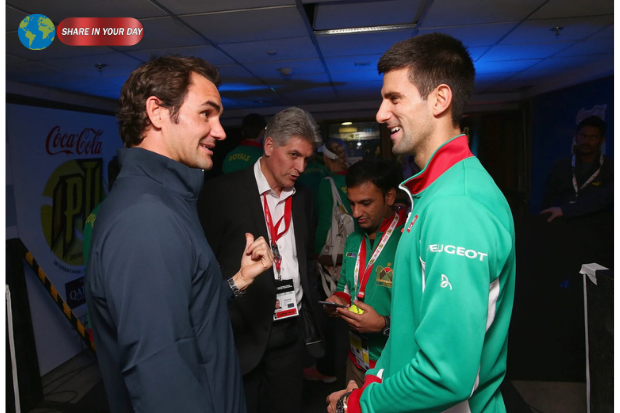
Asked about fans calling Djokovic the GOAT, Federer smiled and responded, “That’s good.” He then went further, praising Djokovic’s longevity, work ethic and continued ability to compete at the highest level despite being one of the oldest players in the modern game.
The comments carry particular weight because Federer and Djokovic spent more than a decade competing directly against one another.
Their rivalry was one of the defining chapters of the Big Three era, alongside Rafael Nadal. Djokovic eventually finished their head-to-head rivalry with a 27-23 advantage, while also surpassing Federer’s career records in several major statistical categories.
Now retired, Federer appears increasingly willing to appreciate what his former rival has accomplished.
Novak Djokovic GOAT argument becomes harder to ignore
The statistical case for Djokovic is already enormous.
He currently holds the men’s record with 24 Grand Slam singles titles, ahead of Rafael Nadal’s 22 and Federer’s 20. He also owns the record for weeks spent at world No. 1, with 428 weeks at the top of the ATP rankings.
Those numbers alone explain why the Novak Djokovic GOAT discussion has become so prominent.
However, the argument extends well beyond Grand Slam totals.
Djokovic has won a record 40 ATP Masters 1000 titles and seven ATP Finals championships. He also won Olympic singles gold at Paris 2024, completing the Career Golden Slam and adding another rare achievement to his résumé.
His record against his two greatest rivals also strengthens the case.
Djokovic leads Federer 27-23 and Nadal 31-29 in their career head-to-head records. Those victories are particularly significant because they came during an era when all three players were competing for the same biggest prizes.
For many observers, that combination of titles, longevity, consistency and direct rivalry success makes Djokovic the strongest statistical candidate for the GOAT label.
Federer praises Djokovic’s remarkable longevity
Federer’s latest comments were not simply about trophies.
The Swiss legend appeared particularly impressed by Djokovic’s ability to remain competitive deep into his career.
According to the latest report, Federer said he had once expected Djokovic to experience a more obvious decline. That decline, however, has not arrived in the way Federer anticipated.
Instead, Djokovic has continued reaching the latter stages of major tournaments.
In 2025, he reached the semifinals at all four Grand Slam tournaments. Although he did not reach a final that year, the consistency was remarkable for a player already well into his late 30s.
His 2026 season has followed a similar pattern.
Djokovic reached the Australian Open final and became the oldest man to reach that stage of the tournament. At Wimbledon, he also survived a five-hour, 15-minute quarterfinal against Felix Auger-Aliassime before losing to Jannik Sinner in the semifinals.
That level of durability is central to the modern Novak Djokovic GOAT argument.
Greatness is not simply about reaching the highest level once. It is about maintaining that level for an extraordinary period.
Djokovic continues to rewrite the record book
Djokovic’s statistical résumé has become almost difficult to summarize.
The ATP currently lists him first on several major career leaderboards.
He has 24 Grand Slam titles, 40 Masters 1000 crowns and 428 weeks at No. 1. He also has eight year-end No. 1 finishes, another record.
Federer, by comparison, finished his career with 20 Grand Slam titles, 28 Masters 1000 trophies and 310 weeks at No. 1.
Those numbers do not diminish Federer’s achievements.
Instead, they demonstrate just how extraordinary Djokovic’s career has become.
Federer himself remains one of the most successful players in tennis history. He won eight Wimbledon titles, five consecutive US Open championships and six ATP Finals titles.
His 20 Grand Slam victories were once the benchmark for men’s tennis.
Djokovic eventually moved past that mark.
The Federer-Djokovic rivalry changed tennis
The relationship between Federer and Djokovic cannot be separated from the GOAT discussion.
They met 50 times during their careers, making their rivalry one of the most significant in modern tennis. Djokovic eventually won 27 of those matches, compared with 23 for Federer.
Their matches also frequently came at the biggest tournaments.
They met in Grand Slam finals, semifinals and other high-pressure stages where the margins between victory and defeat were extremely small.
Djokovic’s ability to eventually establish a winning record against Federer is an important part of his legacy.
The same applies to Nadal.
Djokovic did not simply accumulate statistics while competing in a weak era. He had to overcome two players who are themselves widely regarded as all-time greats.
That makes his eventual statistical separation even more remarkable.
Why Federer’s response matters
Federer has no obligation to endorse Djokovic in the GOAT debate.
For years, the two were direct competitors.
Federer represented one style of tennis built around elegance, precision and attacking creativity. Djokovic developed a game based on extraordinary movement, flexibility, defensive resilience and mental strength.
Their careers overlapped during a period when every record was constantly being challenged.
Federer could therefore have responded defensively when asked about fans calling Djokovic the GOAT.
Instead, his reaction was essentially one of acceptance.
“That’s good,” Federer said, according to the report.
He then praised the effort behind Djokovic’s longevity and described his continued achievements as incredible.
That attitude reflects how the GOAT discussion has evolved.
Federer no longer has to compete with Djokovic.
He can now look at his former rival’s career from the perspective of someone who was there for much of it.
Djokovic has improved throughout his career
One of the most interesting parts of Federer’s comments was his recognition that Djokovic did not remain static.
Federer pointed to Djokovic’s ability to identify weaknesses and improve them over time.
That is a crucial part of Djokovic’s career.
When he first emerged as a major threat, Djokovic was already an exceptional athlete. But his game continued to evolve.
His return became one of the greatest weapons in men’s tennis.
His movement became a defining feature.
His ability to defend from seemingly impossible positions improved dramatically.
His serve also became more reliable, particularly after technical changes that allowed him to win more free points.
Perhaps most importantly, Djokovic became increasingly effective in pressure situations.
That evolution is one reason his career lasted so long.
The GOAT debate is about more than numbers
The Novak Djokovic GOAT argument is strongest when the numbers are considered alongside the context.
Grand Slam titles are important.
So are weeks at No. 1.
But other factors matter too.
Some fans value peak performance above longevity. Others place greater emphasis on style, cultural influence or emotional connection.
That is why Federer remains a popular GOAT choice despite Djokovic’s statistical advantage.
Federer’s style changed how many people viewed tennis.
His one-handed backhand, attacking forehand and effortless movement created an image of tennis that became almost synonymous with elegance.
Nadal, meanwhile, built one of the greatest sporting identities around his dominance on clay and his relentless competitiveness.
Djokovic’s legacy is different.
His career has been defined by resilience, adaptability and an almost relentless pursuit of records.
That difference makes the debate fascinating rather than straightforward.
Djokovic’s 25th Grand Slam remains the next target
The GOAT conversation is also taking place against the backdrop of Djokovic’s pursuit of another historic milestone.
He currently has 24 Grand Slam singles titles.
That puts him one away from becoming the first man to reach 25.
His last major title came at the 2023 US Open, where he won his fourth championship in New York.
The wait has continued through 2024, 2025 and the first three Grand Slam tournaments of 2026.
The 2026 US Open therefore presents another major opportunity.
The tournament begins with Djokovic still capable of making history, although younger stars such as Carlos Alcaraz and Jannik Sinner remain major obstacles.
Sinner has eliminated Djokovic from the latter stages of recent Grand Slam tournaments, while Alcaraz has also become one of the most significant players of the new generation.
Yet Federer believes Djokovic should never be counted out.
In a separate recent press conference, Federer said that whenever Djokovic enters a tournament or major, he has a chance to win it.
That is perhaps the most important endorsement of all.
Federer believes Djokovic still has a chance
Federer’s broader comments about Djokovic’s 25th major were equally revealing.
The Swiss said he has “very high regard” for Djokovic and emphasized that he has seen what his former rival can do at the highest level.
Federer also suggested that Djokovic’s continued participation is partly driven by his belief that he can still win.
That observation makes sense.
A player with Djokovic’s résumé does not need to continue simply to prove that he was great.
He already has the records.
If he continues competing, the motivation must come from something deeper.
The possibility of adding a 25th Grand Slam title is one obvious target.
So is the opportunity to prove that he can still defeat the younger generation.
Age has become another part of Djokovic’s legacy
Djokovic’s longevity may ultimately become one of the most impressive parts of his career.
The modern men’s tour has become increasingly physical.
Players hit harder. Matches demand enormous athletic effort. Recovery between tournaments is more important than ever.
Yet Djokovic has managed to remain competitive into his late 30s.
Federer himself said he is fascinated by how Djokovic continues to stay in contention.
The Serbian has also adjusted his schedule, choosing his tournaments more carefully as he has aged.
That approach allows him to focus his energy on the events that matter most.
It is a different strategy from the one many players use earlier in their careers.
Instead of attempting to play everything, Djokovic can prioritize Grand Slams and other major opportunities.
The results suggest the strategy has worked.
The Big Three left an extraordinary legacy
Any discussion of the Novak Djokovic GOAT debate must include Federer and Nadal.
Together, the three men dominated men’s tennis for roughly two decades.
From Wimbledon 2003 through the 2023 US Open, they combined for 66 of the 79 Grand Slam titles played during that period.
That level of dominance is almost impossible to reproduce.
Federer won 20.
Nadal won 22.
Djokovic won 24.
Their careers overlapped so extensively that each player’s legacy became connected to the others.
Federer pushed Nadal.
Nadal pushed Djokovic.
Djokovic pushed Federer.
Every generation of fans witnessed a different version of the debate.
At first, Federer appeared to be the obvious statistical leader.
Then Nadal challenged him.
Finally, Djokovic surpassed both.
Djokovic’s GOAT case is now historically strong
There may never be a universal answer to the GOAT question.
Tennis is too complex.
Different generations faced different conditions. Equipment changed. Training methods evolved. Tournament schedules changed.
Still, Djokovic’s statistical case is difficult to dismiss.
He has the most men’s Grand Slam titles.
He has spent the most weeks at No. 1.
He has the most Masters 1000 titles.
He has the most year-end No. 1 finishes.
He has a winning record against Federer and Nadal.
He has also won Olympic singles gold and completed the Career Golden Slam.
Those accomplishments explain why so many fans now call him the greatest ever.
And Federer’s willingness to accept that description is significant.
Federer’s reaction may say more than a GOAT declaration
Interestingly, Federer did not appear interested in turning the discussion into a personal ranking.
He did not need to say Djokovic was definitively the GOAT.
Instead, he acknowledged the fans’ view and praised the achievements that created it.
That may be a more meaningful response.
Federer understands what it takes to reach the top.
He knows how difficult it is to win a Grand Slam.
He knows how demanding it is to remain No. 1.
And he knows firsthand how difficult it is to compete against Djokovic.
So when Federer describes Djokovic’s longevity and continued excellence as incredible, the words carry unusual authority.
This is not simply another commentator praising a great player.
It is one all-time champion recognizing another.
What comes next for Novak Djokovic?
The immediate target is clear.
Djokovic wants Grand Slam No. 25.
The 2026 US Open offers him another opportunity to make history.
He enters New York without having won a major since 2023, but his recent performances show that he remains capable of reaching the latter stages.
The challenge is that the younger generation has become stronger.
Alcaraz and Sinner have already demonstrated that they can defeat Djokovic on the biggest stages.
That makes the next chapter particularly interesting.
If Djokovic wins another major, the Novak Djokovic GOAT argument will become even harder to challenge.
If he does not, his existing résumé will still stand as one of the greatest achievements in sports history.
A remarkable acknowledgment from a legendary rival
Roger Federer’s latest comments offer a fascinating perspective on the GOAT debate.
The Swiss icon was once Djokovic’s rival for the biggest titles in tennis.
Today, he can watch from outside the competitive arena and appreciate what his former opponent has accomplished.
His reaction when fans call Djokovic the GOAT was simple: he welcomed it.
He also praised Djokovic’s longevity, evolution and ability to remain competitive long after many players would have declined.
That may not be an official GOAT endorsement.
But it is certainly a powerful acknowledgment.
Djokovic already owns the numbers.
He has the records.
He has the Grand Slam titles.
He has the longevity.
And now one of his greatest rivals appears increasingly comfortable with fans placing him at the very top of tennis history.
The Novak Djokovic GOAT debate may never truly end.
But with Federer acknowledging the Serbian’s extraordinary achievements, one thing is becoming increasingly difficult to dispute: Djokovic has built one of the strongest claims the sport has ever seen.