Full Article
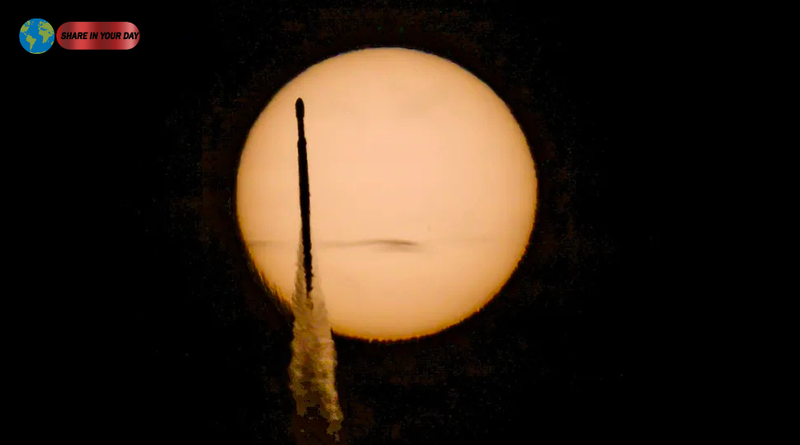
The Roman Space Telescope launch delivered far more than a successful ride into space. On Sunday, Aug. 30, NASA’s Nancy Grace Roman Space Telescope lifted off aboard a SpaceX Falcon Heavy and, for a brief instant, appeared to slice directly across the face of the Sun.
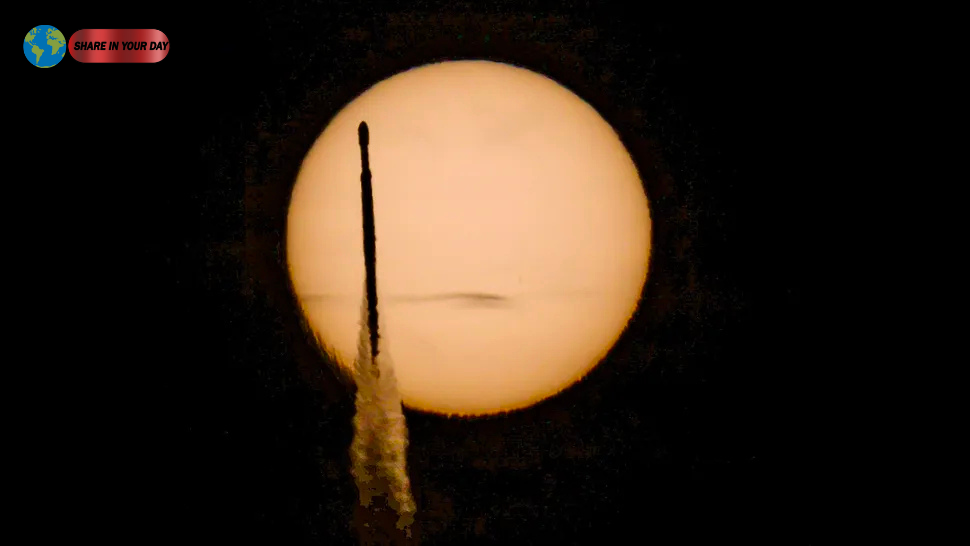
The extraordinary image was captured from Titusville, Florida, by Space.com spaceflight writer and photographer Josh Dinner. Instead of watching the launch from the Kennedy Space Center press site, Dinner made a last-minute decision to drive to a Hobby Lobby parking lot roughly 12 miles away.
That risky choice paid off.
The resulting photograph shows the Falcon Heavy climbing into the morning sky with the Sun directly behind it. The moment lasted only a fraction of a second, making the image one of the most striking photographs from the Roman Space Telescope launch.
NASA confirmed that the observatory lifted off at 7:26 a.m. EDT from Launch Complex 39A at Kennedy Space Center. The telescope is now beginning a roughly three-month journey toward its destination near the second Sun-Earth Lagrange point, about 1 million miles from Earth. NNASA Science+1
Roman Space Telescope Launch Creates a Rare Solar Moment
Rocket launches are difficult enough to photograph under normal circumstances. Capturing one crossing the Sun requires an extraordinary combination of trajectory, location, weather and timing.
The Sun has to be in precisely the right position. The rocket’s flight path must pass across it from the photographer’s location. Clouds must stay out of the way. And the launch itself has to occur almost exactly when predicted.
For the Roman Space Telescope launch, timing was especially important because the mission used an instantaneous launch window. A significant delay could have shifted the rocket away from the planned alignment with the Sun.
Dinner initially planned to cover the launch from the Kennedy Space Center press site. That location offered a much closer view of Falcon Heavy’s departure.
But photographers along Florida’s Space Coast began realizing that the rocket might cross the Sun from a particular viewing area in Titusville.
The opportunity came with a major trade-off.
Dinner would have to leave the press site and drive approximately 25 minutes to the Titusville area. He also faced uncertain weather, with clouds threatening to ruin the shot.
The decision ultimately came down to a simple philosophy: no risk, no extraordinary photograph.
Why the Photographer Left Kennedy Space Center
The Kennedy Space Center press site sits only a few miles from Launch Complex 39A. It is one of the most desirable places to watch a major NASA launch.
Leaving that location for a parking lot may sound strange.
However, the geometry of the photograph made the distant location much more valuable.
From Titusville, photographers had a potential line of sight that could place the Falcon Heavy directly in front of the rising Sun. That kind of alignment is rare even during frequent rocket launches.
It is even harder to achieve with Falcon Heavy.
Unlike SpaceX’s frequently flown Falcon 9, Falcon Heavy launches relatively infrequently. The heavy-lift rocket uses three Falcon-derived first-stage cores and 27 Merlin engines. NASA reported that the vehicle generated more than 5 million pounds of thrust during the Roman mission. NNASA Science
That combination made the opportunity particularly special.
Dinner also received assistance from fellow photographer David Diebold, who offered a solar filter for the camera. Other photographers in Titusville provided last-minute advice as the countdown approached.
The decision was made.
He drove to the Hobby Lobby parking lot.
The Weather Nearly Ruined the Shot
Even after reaching Titusville, there was no guarantee that the photograph would happen.
Clouds remained the biggest threat.
The morning forecast had suggested only a 50% chance of favorable conditions. As launch approached, however, the clouds began to break.
That timing proved critical.
The Falcon Heavy launched just over 20 minutes after sunrise. The Sun was still relatively low in the sky, creating the conditions needed for the solar-transit photograph.
NASA’s official launch image confirms the extraordinary result: the rocket appears silhouetted against the bright solar disk during ascent from Kennedy Space Center. NNASA
For photographers, the moment was measured in fractions of a second.
There was no opportunity for a second attempt.
The Camera Setup Behind the Photograph
Dinner used a Canon R5 Mark II paired with an RF100-400mm F5.6-8 lens.
The lens was extended to its full 400mm focal length to make the rocket appear large against the Sun. A solar filter was mounted to the front of the lens to protect the camera equipment and allow the Sun to be photographed safely.
The camera was set to an extremely fast shutter speed of 1/20,000 second, with the aperture at F16.
Those settings were designed to deal with the Sun’s intense brightness while freezing the rapidly moving rocket.
The photographer then had to wait.
When the countdown reached its final seconds, attention shifted completely to the cameras.
The Falcon Heavy lifted off.
Rather than spending valuable time searching for the rocket visually, Dinner kept his camera ready and waited for the predicted moment when the vehicle would cross the Sun.
Then it happened.
The rocket passed across the solar disk in an instant.
Dinner held down the shutter and hoped.
The result was the image photographers had been chasing.
Falcon Heavy Sends Roman Toward Deep Space
The spectacular photograph is only the visual highlight of a much bigger story.
The Roman Space Telescope launch marks the beginning of one of NASA’s most ambitious astrophysics missions.
After leaving Earth, Roman separated from the Falcon Heavy’s second stage at approximately 7:57 a.m. EDT. NASA then confirmed that the spacecraft was flying independently and beginning its journey toward the Sun-Earth L2 region. NNASA Science
The mission’s destination is approximately 1 million miles from Earth.
Roman will operate around the second Sun-Earth Lagrange point, commonly called L2. NASA’s James Webb Space Telescope also operates in this region, where gravitational dynamics allow spacecraft to maintain a relatively stable position while orbiting the Sun.
NASA expects Roman to spend about three months reaching and preparing for its final operating environment. NNASA Science+1
The observatory’s primary mission is expected to last five years, with a longer 10-year goal listed by NASA. NNASA Science
Roman Will Give Scientists a Wider View Than Hubble
One of Roman’s most important advantages is its enormous field of view.
NASA says Roman’s field of view will be at least 100 times larger than Hubble’s. Its 2.4-meter primary mirror is approximately the same diameter as Hubble’s, but Roman is designed to survey much larger portions of the sky. NNASA Science+1
That difference is crucial.
Hubble has transformed astronomy by producing extraordinarily detailed images of individual objects and relatively small areas of the sky. Roman is designed to complement that capability by surveying huge regions efficiently.
The telescope will operate primarily in infrared wavelengths and is expected to collect enormous amounts of astronomical data.
NASA says Roman could measure light from a billion galaxies over its mission lifetime. Its surveys will investigate everything from the large-scale structure of the universe to stars, galaxies, black holes and planets beyond our solar system. NNASA Science
The Roman Space Telescope Launch Begins a Search for Dark Energy
One of Roman’s biggest scientific goals is understanding dark energy.
Dark energy is the name scientists give to the unknown phenomenon associated with the accelerating expansion of the universe. NASA estimates that dark energy accounts for about 68% of the universe’s total contents, although its fundamental nature remains unknown. NNASA Science
Roman will study this mystery by examining how the universe has changed over cosmic time.
The observatory will map galaxies, study supernovae and use weak gravitational lensing to investigate how matter is distributed throughout the cosmos.
These observations could help scientists determine whether dark energy has remained constant or changed over the history of the universe.
That question has profound implications.
If dark energy behaves differently than expected, scientists may have to reconsider aspects of the standard model of cosmology. Roman will provide another powerful set of observations to test those ideas.
Roman Will Hunt Thousands of New Worlds
Dark energy is not Roman’s only target.
The telescope will also become a powerful tool for studying exoplanets, or planets outside our solar system.
NASA expects Roman’s microlensing survey to monitor roughly 100 million stars for hundreds of days. The mission could discover around 2,500 planets through this technique, including potentially rocky worlds. NNASA Science
Microlensing works because gravity bends light.
When a foreground star passes in front of a more distant star from Earth’s perspective, the foreground star can temporarily magnify the background star’s light. If the foreground star has a planet, that planet can produce a smaller additional signal.
The alignment is extremely precise and temporary.
Roman’s ability to monitor enormous numbers of stars makes it particularly well suited to finding these otherwise difficult-to-detect planets.
NASA has also said the mission could identify roughly 100,000 new exoplanets through its broader surveys and observations. NNASA Science
A New Era Begins After the Launch
The dramatic solar photograph captures only a tiny fraction of what happened on Aug. 30.
Behind the spectacular image was a carefully timed launch involving one of the world’s most powerful operational rockets and a sophisticated space observatory built to investigate some of astronomy’s biggest unanswered questions.
The Falcon Heavy’s two side boosters also returned toward Florida after separation. NASA reported that the boosters landed at Landing Zone 2 and Landing Zone 40. One booster completed its first flight, while the other completed its third after previously supporting other missions. NNASA Science
Meanwhile, Roman continued toward deep space.
The spacecraft’s journey will now transition from launch operations to commissioning. Engineers will deploy and test the observatory’s systems before scientific observations can begin.
For astronomers, the real payoff is still ahead.
Roman is expected to produce a vast public archive of observations that researchers around the world can use. NASA says its data will support investigations ranging from dark matter and dark energy to exoplanets, black holes, galaxies and the evolution of the universe. NNASA Science
The Photograph Is More Than a Beautiful Launch Image
The Roman Space Telescope launch produced an image that looks almost too perfect to be real.
A rocket rises from Florida.
The Sun hangs behind it.
For a fraction of a second, the two align.
But the photograph also illustrates something fundamental about space exploration: extraordinary results often depend on extraordinary precision.
The telescope’s launch had to occur within a narrow window. The rocket had to follow its planned trajectory. The photographer needed the correct location, equipment and camera settings. Finally, the clouds had to move away at exactly the right moment.
Miss any one of those elements and the image disappears.
Instead, the Falcon Heavy crossed the Sun almost like a silhouette drawn across the morning sky.
And while the photograph may become one of the defining images of this mission, the real story has only just begun.
Roman is now heading toward L2, where it will spend years examining the universe on an enormous scale.
Its cameras will not simply capture beautiful images.
They will gather evidence that could help answer some of the deepest questions in modern science: What is dark energy? How is dark matter distributed? How did the universe evolve? And how many planetary systems are hiding among the stars?
The answers will take years to emerge.
But on Aug. 30, 2026, NASA took the first major step toward finding them.
And for one remarkable fraction of a second, the Roman Space Telescope launch crossed the Sun.