Porsche Mission S Revealed as a New Mid-Engined Super Sports Car Vision
Porsche has unveiled the Mission S, a forward-looking vision model designed to preview the next evolution of the German automaker’s sports car identity. Presented in New York on October 15, 2026, the concept combines traditional Porsche styling, a driver-focused interior and a new mid-engined super sports car platform positioned above the iconic 911.
The Mission S represents a significant step in Porsche’s long-term strategy, known as “Sportwagenschmiede ’35.” Rather than introducing a one-off hypercar, the company is exploring a permanent addition to its sports car lineup that could accommodate different versions and configurations.
According to Porsche, the vision model demonstrates how the brand intends to preserve its recognizable design heritage while introducing new ideas for future performance cars.
Porsche Mission S Signals a New Direction for Future Sports Cars
The Mission S offers an early look at the design philosophy Porsche plans to apply to upcoming vehicles. The company describes its guiding principles as authentic, consistent and timeless, emphasizing the importance of maintaining a recognizable identity as automotive technology evolves.
Porsche CEO Michael Leiters said the Mission S provides a glimpse of the ideas and design features that will shape the brand in the coming years. He also highlighted its role in previewing a mid-engined super sports car platform positioned above the 911.
The distinction is important because Porsche is presenting the project as more than a styling exercise. The company envisions a lasting addition to its customer offering, with engineering flexibility and motorsport experience helping define its character.
The world premiere took place at a pier in Queens, New York, overlooking the Manhattan skyline. The location carries historical significance for Porsche because photographs of the mid-engined 550 Spyder taken at the same pier in 1953 helped introduce the car to a wider international audience.
By returning to that location, Porsche connected its historic sports car achievements with its vision for future performance vehicles.
Exterior Design Blends Porsche Heritage With Modern Engineering
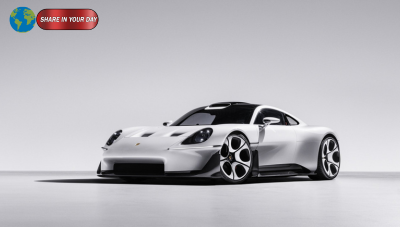
The Porsche Mission S combines familiar design cues with contemporary proportions and technical details. Its distinctive torpedo-shaped fenders, characteristic roofline and wide stance give the car an unmistakably athletic appearance.
A continuous main line connects the front and rear lighting signatures, creating a unified visual profile. Above this line, sculpted surfaces emphasize muscular proportions, while the lower sections highlight technical components and the vehicle’s lightweight design philosophy.
Several historic Porsche models influenced the exterior. The round headlights and pronounced fenders recall the 911, while the front-end design draws inspiration from the GT1. Details around the body panels reference the G-model generation, and the roofline leading toward the rear wing evokes the Porsche 959.
The rear incorporates a car-in-car design concept derived from the GT1, reinterpreted for a modern super sports car.
Porsche has also incorporated functional elements into the design. A fully integrated active rear wing contributes to the vehicle’s performance-oriented character, while a cooling solution inspired by the Porsche 917 demonstrates how motorsport heritage can influence modern engineering.
The wheels introduce another historical reference, drawing inspiration from the dial-style design associated with the Porsche 928. Their updated construction emphasizes lightweight engineering.
However, Porsche has not yet released complete technical specifications, including engine output, acceleration figures or maximum speed.
Driver-Focused Interior Reduces Dependence on Screens
Inside, the Mission S takes a deliberately restrained approach to digital technology. Instead of filling the dashboard with large displays, Porsche has emphasized physical controls, clear ergonomics and a direct connection between driver and vehicle.
The interior architecture draws inspiration from classic Porsche sports cars, including the 550 Spyder and 356. Two prominent lines extend across the dashboard and doors, creating a unified cabin design and reinforcing the sensation of sitting deep inside the car.
Traditional switches and buttons work alongside modern displays, offering a combination of familiar operation and contemporary functionality.
One of the most notable decisions is the absence of a permanently integrated central display and a fixed passenger display. Instead, Porsche has developed a retractable smartphone system compatible with MagSafe technology.
Drivers can use their personal smartphones for navigation and other information when needed. The My Porsche App also provides access to vehicle functions and allows users to select digitally rendered instrument designs inspired by the company’s history.
The redesigned Sport Chrono element combines an analogue-inspired appearance with digital precision. New push-pull controls provide direct access to selected comfort and driving functions.
Other details include a dedicated key holder positioned to the left of the steering wheel, following Porsche’s traditional layout, and revised seat adjustment controls. An integrated seatbelt buckle in the central seat panel further demonstrates the company’s effort to combine practicality with sporting character.
The interior color scheme uses white, grey and red tones, complemented by specially developed finishes including Firn White Metallic, Light Red Metallic and Black Chrome.
A Mid-Engined Platform Positioned Above the Porsche 911
The Mission S’s broader significance lies in the platform it previews. Porsche plans to develop a mid-engined super sports car offering that would sit above the 911 in its lineup.
The company says the project will draw on decades of motorsport experience, advanced engineering and technology associated with the Porsche brand.
Positioning the vehicle above the 911 suggests that Porsche wants to create a distinct category within its sports car range rather than simply introduce another variation of its established model.
The platform is also intended to support a versatile product offering. Porsche has described the Mission S as the foundation for a permanent addition to its portfolio, rather than a limited-production hypercar.
Nevertheless, the company has not confirmed production timing, pricing, powertrain specifications or final performance targets. The Mission S should therefore be understood as a vision model that previews future design and engineering direction, not a fully specified production vehicle.
What the Porsche Mission S Means for the Brand
The Mission S highlights Porsche’s attempt to balance heritage with future development. Its exterior references historic performance icons, while its interior emphasizes direct controls and a more selective use of digital displays.
More importantly, the concept points toward a potential expansion of Porsche’s super sports car lineup beyond the 911.
For enthusiasts, the combination of mid-engined architecture, motorsport-inspired details and a driver-focused cabin offers an intriguing preview of the company’s ambitions.
The next major question is how closely a future production model will follow the vision car and what technical specifications Porsche ultimately chooses.
For now, the Mission S establishes a clear direction: preserve the unmistakable Porsche identity while developing a new generation of high-performance sports cars for the years ahead.
Source: Porsche Newsroom, October 15, 2026.