aarger controllers can provide a better gaming experience, but they are not always practical to carry in a pocket or small bag. The Razer Prio attempts to solve that problem by combining a compact folding mechanism with console-style inputs.
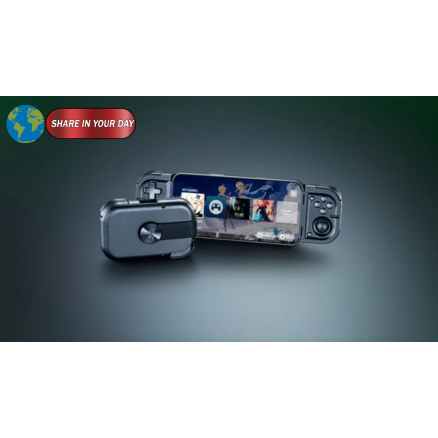
Here are seven important features that make the new Razer Prio one of the more interesting mobile gaming accessories to arrive this year.
1. Razer Prio Features a Unique Foldable Design
The biggest selling point of the Razer Prio is its unusual folding construction.
When not in use, the controller folds into a compact form designed to fit comfortably into a pocket. Razer describes the device as having a footprint similar to a credit card when folded, although it is naturally thicker than an actual card.
The controller uses a twist-to-unlock mechanism that allows it to expand into a full gaming layout when a player is ready to use it. This approach separates the Razer Prio from many traditional telescopic mobile controllers, which can still take up significant space even when detached from a phone.
Portability appears to be at the center of the product’s design philosophy.
Instead of requiring users to pack a dedicated gaming case or leave a controller in a backpack, the Razer Prio is designed to be carried throughout the day. That could make it particularly appealing to commuters, students and travelers who want access to physical gaming controls without adding much weight to their everyday belongings.
Razer has positioned the controller around the idea of turning short periods of downtime into gaming opportunities.
Whether someone is waiting for transportation, sitting in an airport or taking a break between activities, the device can be unfolded and connected to a smartphone when needed.
2. USB-C Connection Means No Extra Battery
Another major advantage of the Razer Prio is its direct USB-C connection.
The controller plugs directly into a compatible smartphone rather than relying on a separate wireless connection. According to Razer, this provides low-latency performance while also eliminating the need for users to pair the accessory before playing.
There is another practical benefit: no additional battery needs to be charged.
Many wireless gaming accessories require users to remember another charging cable or monitor battery levels. The Razer Prio avoids that extra maintenance by connecting directly through the phone.
The simplified setup could be especially useful for players who want to start gaming quickly.
Instead of opening a Bluetooth menu, waiting for a connection and checking the controller’s battery status, users can attach the device through USB-C and begin playing compatible games.
However, as with many USB-C accessories, players should still consider how the controller may affect the phone’s battery during longer gaming sessions.
3. Console-Style Controls in a Compact Package
The small size of the Razer Prio does not mean that Razer has abandoned traditional gaming controls.
The controller includes a tactile four-way D-pad, face buttons, bumpers and triggers. It also features analog thumbsticks designed to provide more precise control than a touchscreen interface.
Physical controls remain important for many types of games.
Action titles, racing games, shooters and platformers can all benefit from buttons and thumbsticks that provide consistent tactile feedback. Touchscreen controls can work well for casual games, but they may cover parts of the display and can make precise inputs more difficult.
Razer’s approach with the Prio appears to focus on bringing a more familiar console-style experience to smartphones while keeping the accessory small enough for everyday use.
The device also features silent tactile face buttons, according to the company’s announcement. That detail could be useful for players who want to game in public places without producing excessive clicking sounds.
4. Capacitive Thumbsticks Are Designed to Reduce Drift
One of the more technically interesting features of the Razer Prio is its capacitive analog thumbsticks.
Razer says the thumbsticks use contactless sensing technology designed to reduce the risk of drift. Stick drift has become a common concern among gamers because traditional analog mechanisms can gradually wear down and begin registering movement even when the player is not touching the control.
Contactless sensing reduces dependence on physical contact points that can wear over time.
For a compact controller intended for frequent travel and everyday use, durability could be an important factor. Gaming accessories carried in pockets and bags may face more physical movement than devices that remain at home.
Razer has also emphasized the accuracy of the thumbsticks during movement, including situations such as a bumpy commute.
That claim will ultimately depend on real-world performance, but the inclusion of capacitive sensing gives the Razer Prio a technical feature that goes beyond its folding design.
5. Razer Prio Supports iPhone and Android Devices
Broad compatibility is another key part of the Razer Prio’s appeal.
The controller supports compatible iPhones running iOS 18 and later, as well as Android devices running Android 14 or later, according to Razer. It can accommodate smartphones with displays up to approximately seven inches.
The controller is also designed to work with many slim-to-medium phone cases.
That may sound like a small feature, but it could make a meaningful difference in everyday use. Some mobile gaming controllers require users to remove their phone cases before attaching the accessory, creating an additional step before they can start playing.
By supporting many commonly used cases, the Razer Prio aims to make the transition from ordinary smartphone use to gaming more convenient.
The compatibility with larger smartphones also gives the controller a wider potential audience. Modern flagship phones have increasingly large displays, making support for bigger devices important for players who want a more immersive mobile gaming experience.
6. Cloud Gaming and Remote Play Expand Its Potential
The Razer Prio is not limited to native mobile games.
The controller also supports several major cloud gaming and remote-play services, including Xbox Cloud Gaming, Steam Link, PS Remote Play and Razer PC Remote Play.
That wider ecosystem is important because smartphones are increasingly being used as portable displays for games that originate on other platforms.
A player could potentially use a phone to stream a game from a console, connect to a PC remotely or access cloud-based gaming services. In those situations, physical controls can make the experience feel closer to using a traditional handheld or console controller.
The Prio also integrates with Razer Cortex Mobile, including a dedicated button intended to provide quick access to a user’s game library.
For gamers who already use multiple platforms, the ability to switch between native mobile games, cloud gaming and remote play could be one of the device’s strongest features.
Suggested internal link: Link the phrase “cloud gaming services” to a relevant article on your website about the future of cloud gaming or the best cloud gaming platforms.
7. The $100 Price Positions It as a Premium Portable Option
The Razer Prio is available for approximately $99.99 in the United States.
That price places the controller in the premium accessory category rather than the budget market.
For that amount, buyers are paying primarily for a combination of portability, physical controls and Razer’s compact folding design. The controller’s value will likely depend heavily on how much a player prioritizes convenience.
Someone who primarily games at home may prefer a larger and potentially more comfortable controller. However, for users who want an accessory that can fit into a pocket and be ready whenever they have a few minutes to play, the smaller design could justify the higher price.
The launch is also significant because Razer has described the Prio as the first product in a new family of ultra-portable mobile gaming controllers.
That means the device could represent the beginning of a broader strategy rather than a single experimental product.
Future accessories may build on the same concept of reducing the physical footprint of gaming hardware without removing important features.
Why the Razer Prio Could Matter for Mobile Gaming
The Razer Prio arrives at a time when smartphones are becoming increasingly capable gaming devices.
Modern phones have powerful processors, high-refresh-rate displays and improved network connectivity. Meanwhile, cloud gaming and remote-play services are making it possible to access games from consoles and PCs on a smartphone screen.
The remaining challenge is often the control system.
Touchscreen controls work well for certain games, but many traditional gaming experiences were originally designed around buttons, triggers and analog sticks. A compact physical controller can bridge the gap between the convenience of a smartphone and the familiarity of a console.
The Razer Prio attempts to make that bridge more practical for everyday life.
Its folding design means users do not necessarily have to decide in advance that they want to bring a controller with them. Instead, the device is designed to remain small enough to carry until an opportunity to play appears.
That concept could become increasingly important as gaming becomes more platform-independent.
A player may start a game on a console, continue it through remote play on a smartphone and later access another title through a cloud gaming service. Accessories such as the Razer Prio are designed to support that type of flexible gaming behavior.
Razer Prio: A Small Controller With a Big Idea
The Razer Prio is one of the more unusual mobile gaming controllers to appear in 2026 because its central innovation is not simply adding more buttons or increasing compatibility.
Instead, Razer is focusing on reducing the space required to carry a controller.
The foldable design, direct USB-C connection and lack of a separate battery are all intended to make the accessory easier to use on short notice. At the same time, the device retains many of the physical controls that players expect from a more traditional gaming setup.
Its $99.99 price means it may not appeal to every mobile gamer. Nevertheless, the combination of pocket-sized portability, capacitive thumbsticks and support for major gaming services makes the Razer Prio an interesting option for players who frequently game away from home.
The broader question is whether other companies will follow a similar path.
As smartphones continue to serve as portable gateways to console, PC and cloud gaming ecosystems, there may be growing demand for accessories that are both capable and easy to carry.
For now, Razer’s newest controller demonstrates that a mobile gaming accessory does not necessarily have to be large to provide a more traditional gaming experience.
The Razer Prio may be small, but its launch points toward a bigger idea: gaming hardware designed to disappear into everyday life until the moment a player is ready to use it.